
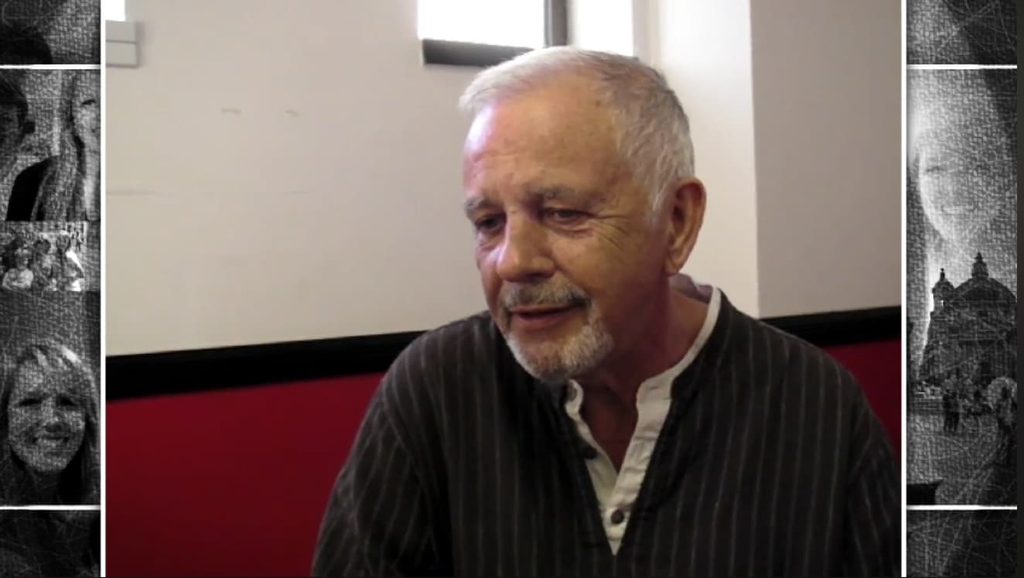
In 2010, David Essex looked back on a remarkable life in show business while standing at another turning point in his career
By 2010, David Essex was no longer the young man whose face had become one of the most recognizable images of British pop in the 1970s, yet there was still something unmistakably youthful about the way he approached his work. Nearly four decades after “Rock On” had taken him to No. 3 in Britain and made him a star almost overnight, David was still moving between music, theatre and television, still performing for audiences who had followed him since the beginning. An interview associated with Sophia Osmond around this period offers an interesting glimpse of that David Essex, the man behind the famous smile and the unmistakable eyes, at a time when nostalgia was beginning to surround his career while he himself was still looking forward. The timing was particularly significant because 2010 brought him together again with several of the artists who had shared the extraordinary pop landscape of his youth.
David’s career had never followed a single straight road. His breakthrough came in 1973, an extraordinary year in which “Rock On,” That’ll Be the Day and Godspell all helped establish him as a major new presence in British entertainment. The success was not limited to records. He became an actor, stage performer and film star, and the image that had initially made him a teenage idol gradually became only one part of a much larger career. By the time he reached his sixties, David had already experienced several completely different versions of fame. He had watched fashions change, watched audiences grow older, and watched some of the performers who had once shared the charts disappear from the spotlight. Yet he continued to work. That persistence is one of the most revealing things about David Essex. He never seemed particularly interested in becoming a museum piece from the 1970s.
That was especially clear in 2010, when he was part of Once in a Lifetime, a tour that brought together David, The Osmonds, Bay City Rollers and Leo Sayer. The lineup had an almost surreal quality because these were artists who had once represented different sides of the same teenage pop world. In the 1970s, their photographs filled magazines, their records competed for chart positions and their audiences could be fiercely devoted. Almost forty years later, they were sharing stages again, not as competitors but as survivors of the same remarkable musical era. Contemporary coverage described the tour as a return to the teenage dream of the 1970s, but there was something deeper in seeing these performers together. They were carrying decades of memories onto the same stage, and David’s presence fitted naturally into that story because his career had always extended beyond the records themselves.
What makes David particularly compelling in interviews from this period is the contrast between the public image and the man who emerged when he began talking about his life. The old photographs show the famous hair, the eyes, the smile and the unmistakable 1970s style. But David’s own memories often lead somewhere much more ordinary: east London, football, family, early rhythm and blues, small clubs and the determination to become a performer. He grew up in Plaistow and Canning Town and discovered music at a time when American rhythm and blues was opening a completely new world to young British musicians. Before the fame, before the screaming crowds and before the posters, there was simply a young man trying to find his way into music. That background helps explain why David’s later career never felt entirely comfortable inside the phrase “pop star.” There was always an actor, musician and storyteller underneath it.
And perhaps that is why seeing David Essex in 2010 feels different from watching him in 1973. The younger David possessed the extraordinary visual magnetism of someone who seemed destined for the spotlight. The older David carried something else: experience. He could return to “Rock On,” “Hold Me Close” and “Gonna Make You a Star” without needing to recreate the person who originally recorded them. The songs belonged to his history, but they did not define the limits of his life. By then, he had spent years learning that audiences do not only remember the music. They remember the face, the voice, the clothes, the television appearances, the theatre roles and the feeling of a particular moment in their own lives. David was now performing for people who had grown older alongside him.
There is something quietly moving about that stage of his career. In the 1970s, David Essex represented the excitement of something new. In 2010, he represented continuity without standing still. He could stand beside The Osmonds and other familiar names from that extraordinary decade, look back at the world that had made them famous, and then continue toward whatever came next. That is the quality that makes a conversation with David from this period worth remembering. Behind the celebrated face was a performer who had already lived several careers and still seemed curious about the next one. The young man who once wanted the stage had never really left it. He had simply grown into the life that came after the screaming crowds.