
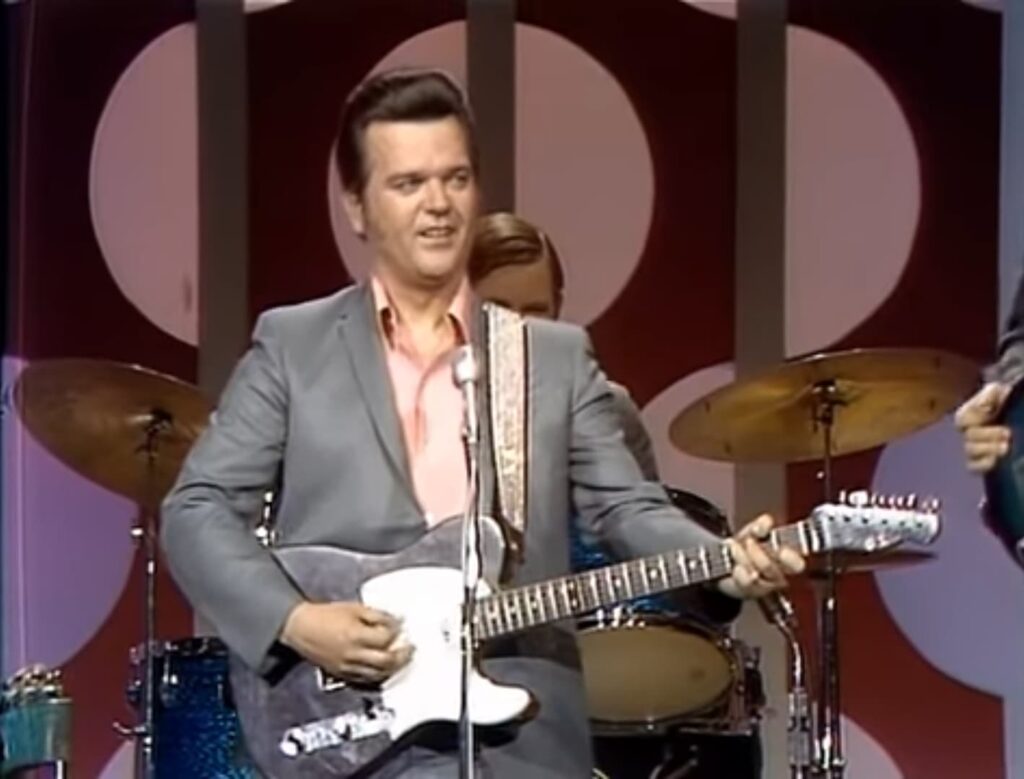
A Simple Greeting That Reopened a Lifetime of Regret
In 1971, Conway Twitty stepped onto the stage of The Johnny Cash TV Show and delivered a performance of “Hello Darlin’” that felt less like entertainment and more like a confession whispered into America’s living rooms. The song had already become a defining milestone in his career, reaching No. 1 on the Billboard Hot Country Singles chart in 1970 and appearing on the album Hello Darlin’. Yet on that evening, under the steady lights and in the dignified company of Johnny Cash, the song seemed to gather even greater emotional weight.
From the very first spoken words, “Hello darlin’, nice to see you,” the studio fell into a stillness rarely captured on television. There was no rush, no theatrical flourish. Twitty understood the power of restraint. His voice carried the ache of a man confronting the consequences of pride and lost love. It was country music in its purest form, rooted in everyday heartbreak and delivered with unvarnished sincerity.
By 1971, Twitty had already traveled an unusual musical road. Born Harold Lloyd Jenkins, he first found fame in rock and roll before reinventing himself as a country artist. That reinvention reached its emotional peak with “Hello Darlin’.” The song’s structure is deceptively simple: a chance meeting, a polite greeting, and beneath it all a tidal wave of regret. But Twitty’s phrasing transformed those ordinary words into something monumental. He lingered on syllables as if they carried the weight of years.
On The Johnny Cash TV Show, a program known for bridging generations and musical traditions, Twitty’s performance fit seamlessly. Cash, himself a master of understatement, often welcomed artists who could tell a story without spectacle. Twitty did exactly that. Standing almost motionless, he let the narrative unfold line by line. When he reached the chorus, there was no dramatic gesture, only the quiet realization that some apologies arrive too late.
What makes this televised rendition unforgettable is its intimacy. The camera drew close, capturing subtle shifts in expression. A slight tightening around the eyes. A breath held just a fraction longer before the final refrain. It felt as though the audience was witnessing not a performance but a private reckoning.
The early 1970s marked a golden era for country storytelling. Songs were not merely recorded; they were lived. “Hello Darlin’” became one of Twitty’s signature pieces, a staple of his concerts for decades. It resonated because it spoke to universal experience: the phone call never made, the letter never sent, the pride that kept two people apart. In that simple greeting lay an entire history.
Television in 1971 carried a different rhythm. Families gathered in the evening, the room dim except for the glow of the screen. When Twitty sang that night, he entered homes across America with a message that needed no explanation. His baritone moved gently, deliberately, as if mindful that every listener might have their own “darlin’” in memory.
Looking back now, the performance stands as a testament to the era’s craftsmanship. There were no elaborate stage effects, no distractions. Just a man, a microphone, and a song that refused to fade. Conway Twitty did not chase grandeur. He chose honesty. And in doing so, he ensured that “Hello Darlin’” would remain not just a hit record, but a moment suspended in time, forever echoing with the sound of love remembered and regret quietly endured.
 Music Legend
  Oldies Songs