
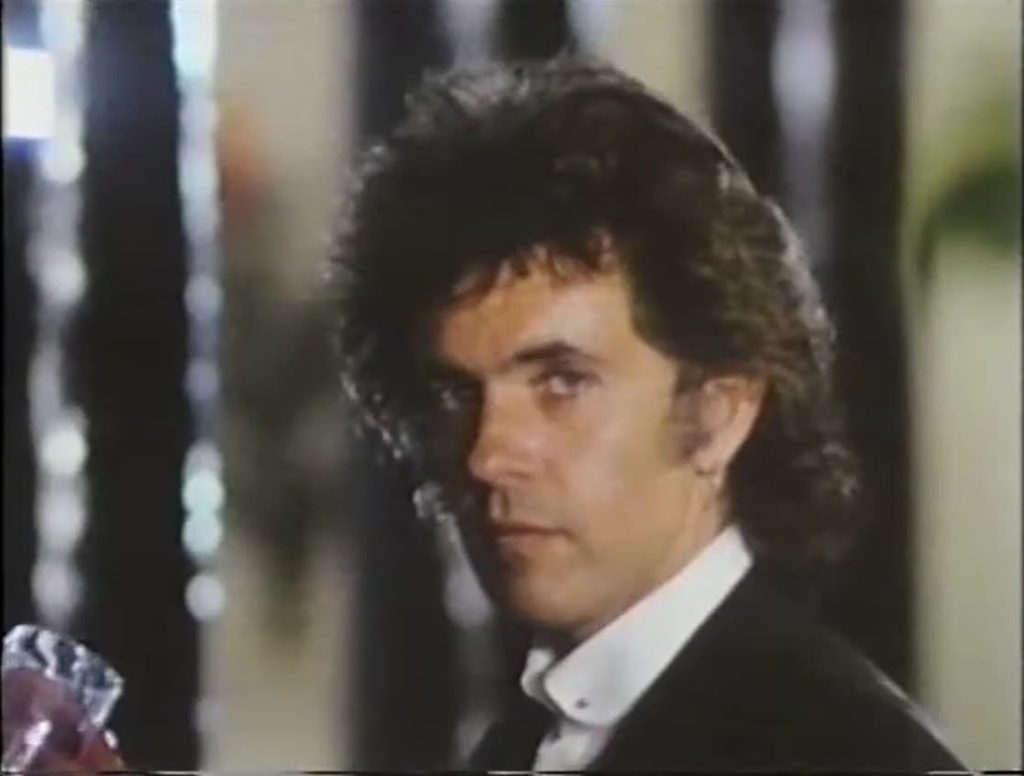
DAVID ESSEX – “THE SMILE”: A SECRET LANGUAGE BETWEEN TWO PEOPLE WHO ALREADY KNOW
In the spring of 1983, David Essex returned with a song that sounded lighter and more intimate than some of the dramatic records that had established him as one of Britain’s most recognizable stars. “The Smile”, written and produced by Mike Batt, was released by Mercury Records in May 1983, with “Slave” on the B side. It followed the extraordinary success of “A Winter’s Tale,” which had reached No. 2 on the UK Singles Chart only months earlier. “The Smile” did not approach that commercial height, peaking at No. 52 and spending six weeks on the British chart, but there is something particularly charming about the record precisely because it does not try to recreate the grandeur of his earlier hits.
The song is built around a wonderfully simple idea: sometimes two people do not need to say anything because they already understand each other. Across a crowded room, surrounded by strangers, the singer catches the eye of someone special and sends a private signal that only the two of them understand. That signal is the smile. The lyric repeatedly returns to the eyes, the look, the tiny expression that can reveal feelings that words might conceal. Mike Batt gives the song a romantic, almost cinematic quality, turning an ordinary moment between two people into something secret and slightly magical. Contemporary Record Mirror coverage confirmed Batt as the songwriter and noted that the record was being released as Essex’s new single in May 1983.
It was an interesting moment in David Essex’s career. The enormous wave of his 1970s success had already established songs such as “Rock On,” “Gonna Make You a Star,” “Hold Me Close,” and “Oh What a Circus” as part of British popular music. He had also continued moving between music, film and theatre, refusing to remain confined to one particular image. Then came “A Winter’s Tale” in late 1982, written by Mike Batt with lyrics by Tim Rice, which climbed to No. 2 in the UK. “The Smile” therefore arrived carrying the expectations created by a major hit, but its smaller scale was part of its character. Rather than presenting Essex as the restless young star of the early 1970s, it offered a more mature romantic mood.
There is also a fascinating connection between Essex and Mike Batt running through this period. Batt was responsible not only for “The Smile” but also for “A Winter’s Tale,” and later wrote “Fishing for the Moon” for Essex. The songs share a certain theatrical sensibility, with carefully constructed scenes and characters rather than simple declarations of love. Batt’s writing often feels as though a camera is moving through the room while the singer watches what is happening around him. In “The Smile,” that camera seems to settle on two people who have found each other among a crowd. Nothing spectacular has happened, yet everything suddenly feels different.
And David Essex was particularly suited to that kind of material. His appeal had never depended entirely on technical vocal display. There was something conversational and visual about the way he performed, an ability to make a song feel connected to a particular character or moment. Contemporary concert coverage from the late 1970s frequently commented on the reaction to his appearance and stage presence, showing just how strongly his image had become intertwined with the songs themselves. By the early 1980s, he had already lived through the strange transformation from young pop idol to established performer, and that experience gave a song like “The Smile” a different texture.
The record also arrived just before another interesting chapter. Later in 1983, Essex released “Tahiti,” taken from the musical Mutiny!, and that single climbed to No. 8 in Britain, demonstrating that his ability to find another major hit had certainly not disappeared. “The Smile,” by comparison, became a quieter entry in his catalogue, but it remains an appealing snapshot of the period.
What makes “The Smile” memorable now is the smallness of its central gesture. There is no grand declaration, no dramatic farewell, no promise that changes the world. There is simply a look across a crowded room, a smile returned, and the sudden certainty that someone else understands exactly what you mean. In the hands of David Essex, that tiny moment became a song. And perhaps that is why it still feels so intimate decades later. Before phones, messages and endless ways of announcing what we feel, there was the glance across the room, the smile that said everything, and the quiet knowledge that nobody else needed to know.