
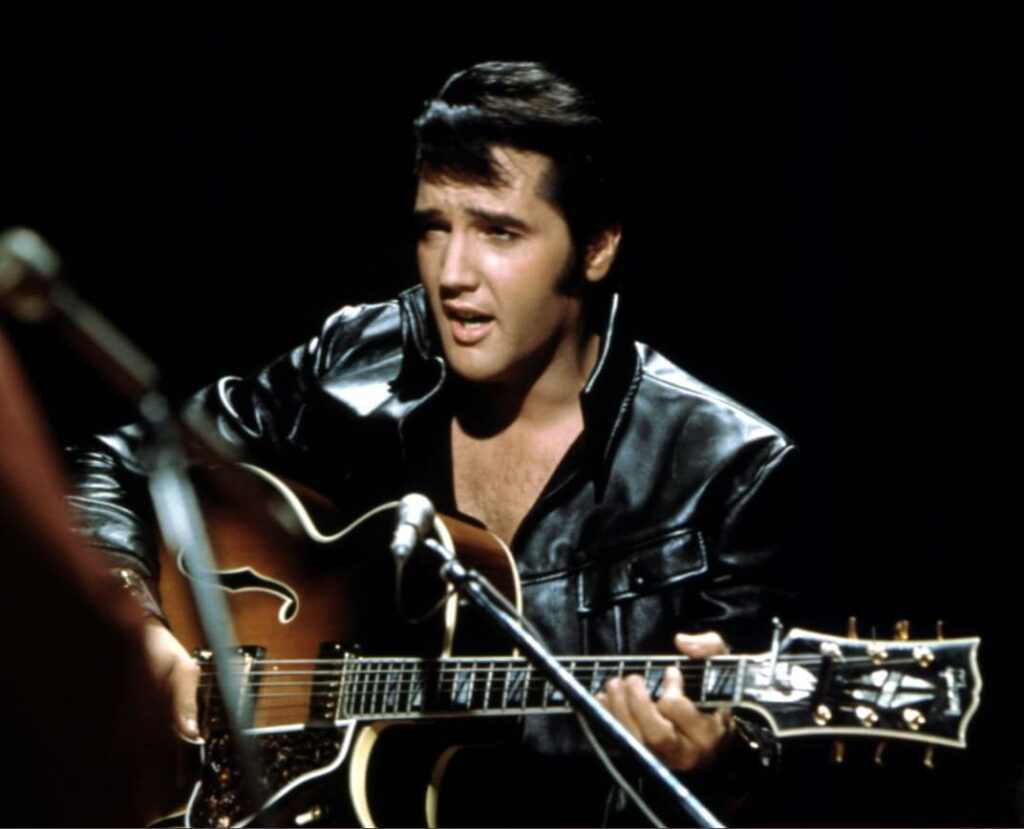
Elvis Presley – Can’t Help Falling In Love: An Eternal Hymn of Surrender to the Inevitable Power of the Heart
There are moments in musical history where a melody transcends the era of its birth and becomes a permanent part of the human experience. Elvis Presley’s “Can’t Help Falling In Love” is precisely that—a gentle, majestic sanctuary of a song that has provided the soundtrack to countless weddings, anniversaries, and quiet evenings of reflection for over six decades. For those of us who remember the velvet texture of the 1960s or the grand, emotional spectacles of the 1970s, this track isn’t just a ballad; it is a shared vessel for our most cherished memories of devotion.
Upon its release on October 1, 1961, as part of the soundtrack for the film Blue Hawaii, the song’s ascent was as inevitable as the love it describes. It reached Number 2 on the U.S. Billboard Hot 100 and held the Number 1 spot on the Adult Contemporary chart for six consecutive weeks. Across the Atlantic, it was an even greater phenomenon, reigning at Number 1 on the UK Singles Chart for four weeks in early 1962. While Elvis Presley was already a global icon of rock and roll, this recording signaled a sophisticated evolution, showcasing a maturity and a tender vulnerability that would define his legacy as a world-class crooner.
The pedigree of the song is as distinguished as its performer. The melody was adapted from “Plaisir d’amour,” a classical French love song composed in 1784 by Jean-Paul-Égide Martini. By bridging the gap between the 18th century and the mid-20th, songwriters Hugo Peretti, Luigi Creatore, and George David Weiss created a bridge between generations. When Elvis stepped into the recording studio, he took a melody that had survived the French Revolution and turned it into a modern prayer for the heart. It is a testament to the idea that while the world changes, the fundamental experience of falling in love remains ancient and untouched.
The lyrical brilliance of the song lies in its serene resignation. The opening lines—“Wise men say only fools rush in / But I can’t help falling in love with you”—set a scene of quiet defiance against logic. It acknowledges that love isn’t always a choice we make with our heads, but a tide that carries us away. The metaphor of the river flowing gently to the sea is perhaps one of the most evocative in popular music; it suggests that our lives have a natural, beautiful destination in the arms of another. For a mature listener, these words resonate with the wisdom of experience. We know that the “rushing in” of youth eventually matures into the “staying in” of a lifetime, and the song captures that transition with unparalleled grace.
For many of us, the most poignant association with this song comes from Elvis’s live performances throughout the 1970s. It famously served as the closing number for nearly all of his concerts, including the legendary “Aloha from Hawaii Via Satellite” in 1973. As the lights dimmed and the grand orchestration swelled, Elvis would drape his sequined cape over his shoulders, offering this song as a final, intimate blessing to his fans. In those moments, the song was no longer just about romantic love between two people; it became a communal expression of gratitude between an artist and his audience. Hearing it today, one cannot help but feel a powerful surge of nostalgia for a simpler time and for a performer who, despite his immense fame, could still make every listener feel like the only person in the room. It remains, quite simply, the gold standard of the romantic ballad.
 Music Legend