
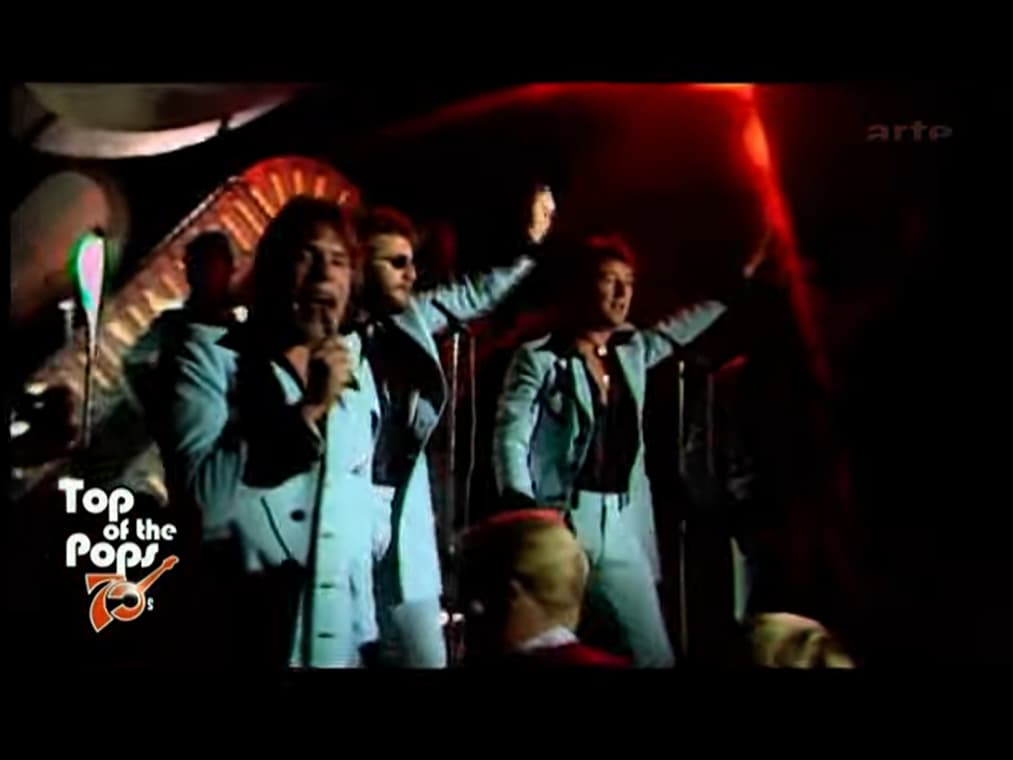
A burst of youthful rhythm captured on television, where nostalgia meets the unstoppable pulse of rock and roll
When Showaddywaddy stepped onto the stage of Top of the Pops in the 1970s to perform “Sweet Little Rock ’n’ Roller,” it was more than just another televised appearance—it was a moment that distilled the spirit of an era into a few fleeting minutes of sound and movement. Originally released in 1974 as part of their album Showaddywaddy, the track climbed to No. 7 on the UK Singles Chart, further cementing the group’s place in the revival of 1950s-inspired rock and roll that defined much of the British music scene at the time.
By the mid-1970s, Showaddywaddy had already become a familiar presence in British households. Their blend of retro style, tight harmonies, and energetic stagecraft offered something both comforting and invigorating—a bridge between past and present. Formed from the merging of several smaller bands in Leicester, they carried with them a shared affection for early rock and roll, drawing inspiration from artists like Buddy Holly and Eddie Cochran. Yet they were never simply imitators. They reshaped those influences into something distinctly their own, polished yet still rooted in the raw energy of the originals.
“Sweet Little Rock ’n’ Roller” itself has an interesting lineage. The song was originally recorded by Chuck Berry in 1958, a time when rock and roll was still finding its identity. Berry’s version carried the unmistakable swagger of early rhythm and blues, driven by sharp guitar lines and lyrical wit. When Showaddywaddy revisited the track nearly two decades later, they approached it not as a relic, but as a living piece of music—something that could still resonate if given new life.
Their performance on Top of the Pops captured this intention perfectly. Dressed in their signature drape jackets and vibrant stage attire, the band delivered the song with a sense of joy that felt almost defiant. It was as if they were reminding the audience that rock and roll, at its core, was never meant to age quietly. The dual lead vocalists, a hallmark of Showaddywaddy’s sound, created a layered dynamic that added both depth and immediacy to the performance.
What made this televised moment particularly memorable was not just the sound, but the atmosphere it created. In an era before digital saturation, appearances on Top of the Pops carried a certain weight. They were shared experiences, watched simultaneously across living rooms, where music became a collective memory rather than a solitary one. Seeing Showaddywaddy perform “Sweet Little Rock ’n’ Roller” in that setting gave the song a renewed sense of relevance, connecting generations through a familiar rhythm.
There is also something quietly reflective about revisiting this performance now. The song itself is exuberant, filled with movement and youthful energy, yet time has added another layer to it. What once felt immediate now carries a sense of distance, a reminder of how quickly moments pass and how enduring music can be in preserving them.
For Showaddywaddy, this period represented the height of their popularity, a time when their dedication to the roots of rock and roll found widespread appreciation. They would go on to achieve further chart success with songs like “Under the Moon of Love” (No. 1, UK, 1976), but “Sweet Little Rock ’n’ Roller” remains a defining example of their ability to reinterpret the past without losing its essence.
Listening again, or watching that performance unfold, one begins to understand that the appeal lies not just in nostalgia, but in authenticity. The band does not simply perform the song—they inhabit it, allowing its rhythm to carry them forward even as the years move on.
And perhaps that is the quiet truth behind it all: that music like this does not belong to a single moment. It lingers, it returns, and in doing so, it reminds us that somewhere within those familiar chords, the energy of another time continues to play on.