
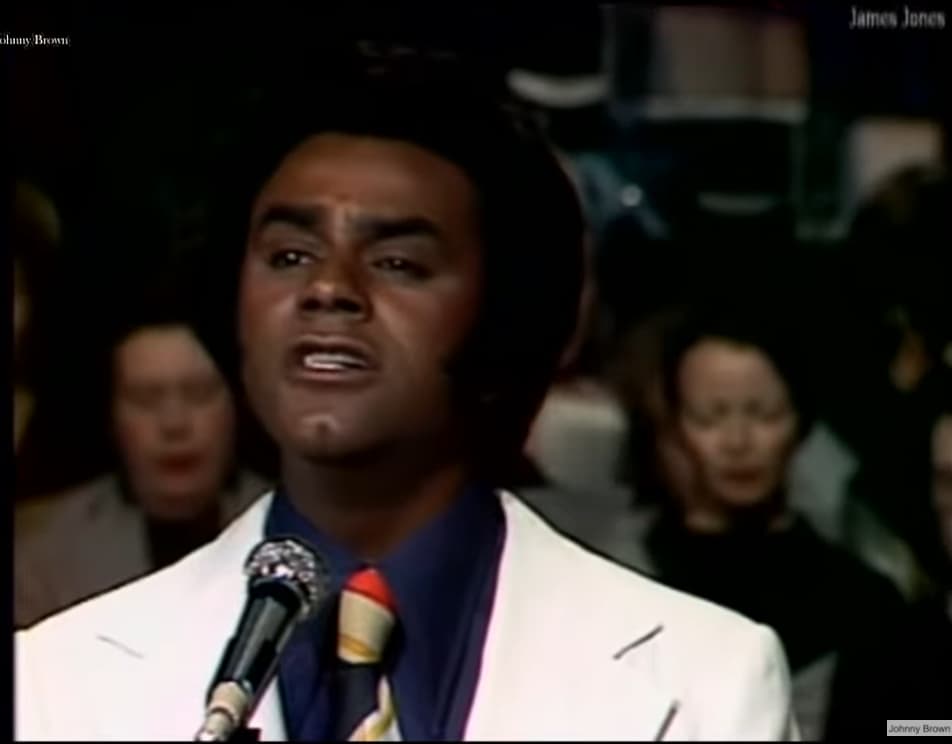
A sacred melody carried by a voice that never rushes time, only deepens it
When Johnny Mathis recorded “Ave Maria” in 1975, he was not stepping into unfamiliar territory, but rather returning to a spiritual and musical space that had long shaped his identity as an artist. Featured on the album Song of Joy (1975), his rendition of this timeless hymn did not compete on the pop charts in the conventional sense, yet its significance lies far beyond rankings. It belongs to a tradition of recordings that are measured not by commercial performance, but by their ability to endure quietly across decades, carried by memory and reverence rather than radio play.
By the mid-1970s, Johnny Mathis had already become one of the most recognizable voices in American music. His earlier successes—such as “Chances Are” (No. 1 Billboard Most Played by Jockeys, 1957) and “Misty” (Top 20 Billboard Hot 100, 1959)—had established him as a master of romantic balladry. But there was always another dimension to his artistry, one rooted in sacred music and traditional standards, where his voice could move beyond romance into something more reflective, more enduring.
“Ave Maria”, composed originally by Franz Schubert, has been interpreted by countless singers across generations. Yet Mathis approaches it with a distinct restraint, allowing the melody to unfold naturally, without embellishment or theatrical excess. His tenor, clear and steady, does not seek to dominate the piece. Instead, it becomes part of it, as though the voice itself is simply another instrument in service of something larger.
What sets this recording apart is its sense of stillness. At a time when popular music in 1975 was increasingly shaped by elaborate production and shifting trends, Johnny Mathis offered something that felt untouched by urgency. The orchestration is gentle, almost reverent, creating a space where each note has room to resonate. There is no attempt to modernize or reinterpret the hymn in a dramatic way. The power lies in its simplicity, in the decision to let the song remain what it has always been.
There is also a personal dimension to Mathis’s connection with sacred music. Raised in a household where faith and music were closely intertwined, he often spoke of how these songs were part of his earliest experiences as a singer. In that sense, “Ave Maria” is not just a performance, but a return—a moment where the distance between the artist and the song seems to disappear.
Listening to this recording now, one is struck not by its scale, but by its intimacy. The voice does not reach outward in search of attention. It turns inward, inviting reflection. And in doing so, it creates a kind of quiet continuity, linking past and present in a way that feels almost seamless.
Over time, Mathis continued to revisit this piece in live performances, even as he approached his later years. That enduring relationship speaks to something deeper than repertoire. It suggests a bond between artist and song that does not fade, but instead grows more meaningful with each passing year.
In the broader landscape of his career, “Ave Maria” may not stand among his most commercially celebrated recordings, but it holds a different kind of importance. It reveals the foundation beneath the success—the discipline, the restraint, and the understanding that sometimes the most powerful expression comes from knowing when not to do too much.
As the final notes linger, there is no sense of conclusion, only a quiet continuation. The melody does not end so much as it settles, leaving behind a space filled with memory, reflection, and a kind of calm that is increasingly rare.
And perhaps that is the lasting gift of Johnny Mathis in this recording. Not a moment designed to impress, but one that endures—softly, steadily—long after the music itself has faded.