
A night of chaos, glitter, and defiance—when noise became identity and the stage turned into a battleground
On September 20, 1973, Sweet brought “The Ballroom Blitz” to the national spotlight with a now-iconic performance on Top of the Pops. By that time, the single had already climbed to No. 2 on the UK Singles Chart, marking one of the band’s most explosive commercial successes. It would later reach No. 5 on the US Billboard Hot 100 in early 1975, confirming its international appeal. Yet charts alone never quite captured what this song represented. It was not merely a hit—it was an event, a moment when performance, attitude, and sound collided in a way that felt almost uncontrollable.
The origins of “The Ballroom Blitz” are rooted in a real incident that blurred the line between performance and confrontation. During a 1973 show at the Grand Hall in Kilmarnock, Scotland, the band faced a hostile audience that began throwing bottles at the stage. Instead of collapsing under the tension, the experience was transformed into something creative. Songwriters Nicky Chinn and Mike Chapman took that chaos and reshaped it into a narrative that would become one of glam rock’s defining anthems.
From its very first seconds, the song announces itself with urgency. The now-famous spoken introduction—“Are you ready, Steve?”—is not just a gimmick. It sets the tone for what follows: a controlled explosion disguised as a pop record. Each band member is introduced as if stepping into a ring, preparing for something unpredictable. When the music finally erupts, it does so with pounding drums, sharp guitar riffs, and a sense that everything could spiral at any moment.
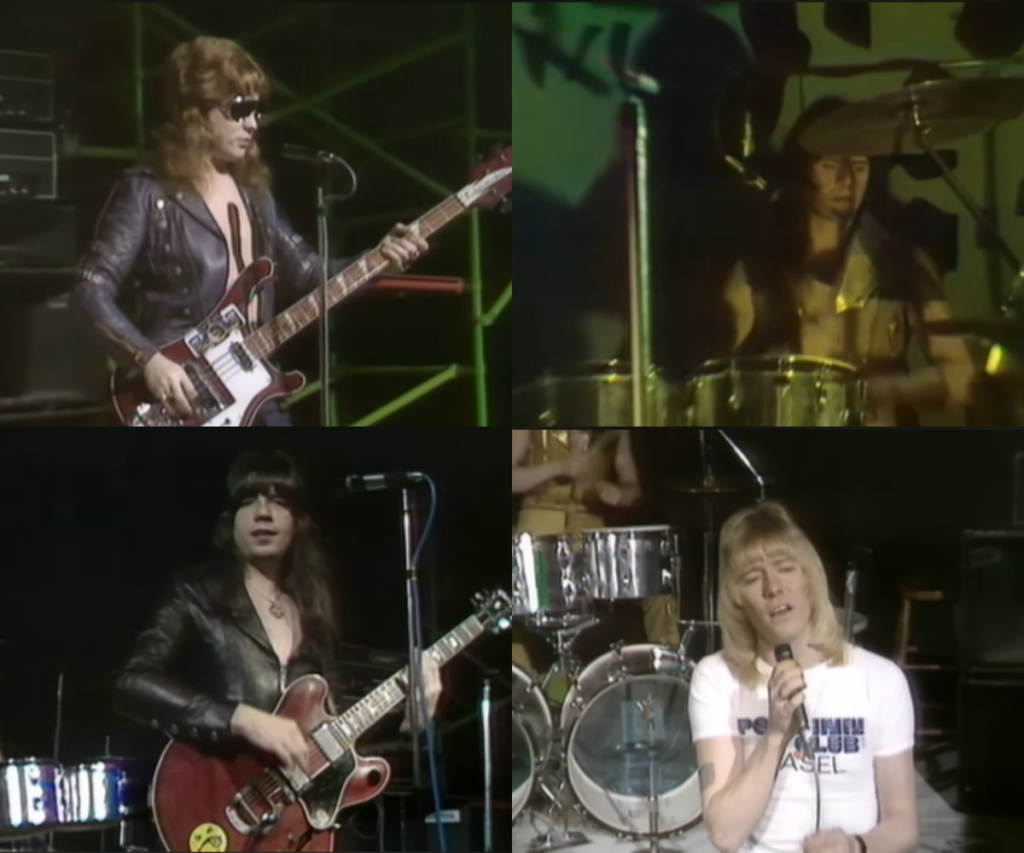
Watching Sweet perform this track on Top of the Pops in 1973 adds another layer to its meaning. Glam rock, at that point, was still pushing against the boundaries of what mainstream audiences were willing to accept. The band’s visual style—bold makeup, flamboyant clothing, exaggerated gestures—was as much a statement as the music itself. It challenged expectations, not with subtlety, but with deliberate excess. And yet, beneath that theatrical surface, there was precision. Every movement, every note, every glance was carefully placed, even if it appeared spontaneous.
Vocally, lead singer Brian Connolly delivers the song with a kind of theatrical aggression that never quite tips into chaos. There is control within the frenzy, a balance that keeps the song from collapsing under its own intensity. The backing vocals, almost chant-like, give the track a communal energy—as if the audience, whether willing or not, has been pulled into the performance.
In the broader context of 1973, “The Ballroom Blitz” stands as a reflection of a shifting musical landscape. Rock was becoming more visual, more performative, more aware of its own image. Bands were no longer just heard—they were seen, interpreted, even questioned. Sweet understood this instinctively. Their appearance on Top of the Pops was not just about promoting a single. It was about defining a moment.
Listening to the song now, decades later, it still carries that same restless energy. But time adds something else—a sense of distance, perhaps even clarity. What once felt like pure chaos now reveals its structure. What once seemed rebellious now feels almost inevitable, as though it had to happen exactly that way.
There is a certain irony in that transformation. A song born from disorder becomes, over time, a carefully preserved memory. A performance that once shocked becomes something to revisit, to study, to understand.
And somewhere within that shift lies the true legacy of “The Ballroom Blitz.” Not just as a hit record, but as a moment when music refused to stay within its boundaries. When noise became expression, and when a band, faced with hostility, chose not to retreat—but to turn it into something unforgettable.