
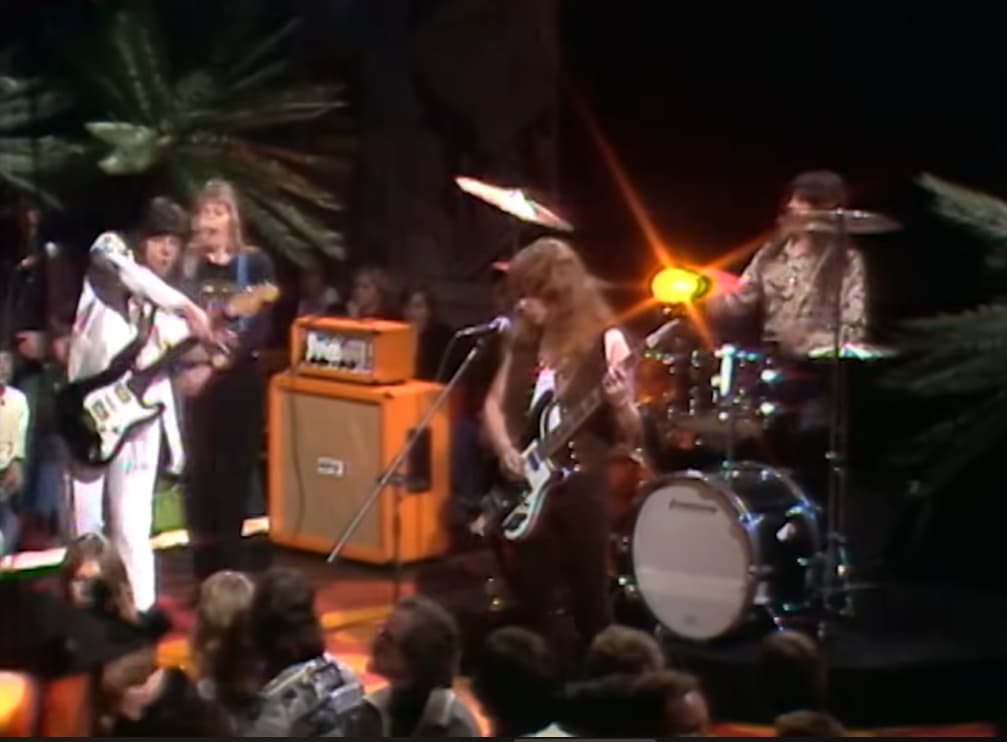
A fleeting moment between glitter and gravity—“Lost Angels” captures a band learning how to stand still after the noise fades
By December 11, 1976, when Sweet appeared on the German television program Musikladen, they were no longer simply the glitter-drenched hitmakers the world had come to recognize. Their performance of “Lost Angels”, a track from the album Off the Record (1977), revealed something quieter, more introspective—an evolution that had already begun to take shape behind the scenes. While the song itself was not released as a major charting single and therefore did not secure a prominent position on the UK Singles Chart or Billboard rankings, its significance lies elsewhere. It marked a moment of transition, a subtle but unmistakable shift in identity for a band often remembered only for its louder, more flamboyant successes.
In the early 1970s, Sweet had built their reputation on high-energy glam rock anthems—songs like “Ballroom Blitz” and “Fox on the Run” that thrived on immediacy, theatricality, and undeniable hooks. But by the mid-1970s, the group—particularly members like Brian Connolly, Andy Scott, Steve Priest, and Mick Tucker—had grown increasingly interested in reshaping their musical direction. They wanted more control, more authorship, and perhaps most importantly, more space to express something beyond the surface.
“Lost Angels” emerges from that desire. It is not a song designed to overwhelm. Instead, it unfolds gradually, almost cautiously, as if aware that it belongs to a different emotional register than what audiences might expect. The arrangement leans into softer textures—layered harmonies, restrained instrumentation, and a melodic line that doesn’t rush toward resolution. It lingers. It waits.
Watching that Musikladen performance, one notices the absence of spectacle. The glitter is still there, perhaps, but it no longer defines the moment. The band stands more grounded, more focused. There is a sense that they are listening to themselves as much as they are playing for the audience. And in that stillness, the song begins to reveal its deeper meaning.
Lyrically, “Lost Angels” speaks in images rather than declarations. It reflects on disillusionment, on the quiet realization that something once bright has dimmed—not dramatically, but inevitably. The “angels” of the title are not literal figures; they feel more like symbols of innocence, of earlier dreams that have slipped just out of reach. There is no bitterness in the delivery, only a kind of acceptance. The kind that comes not from giving up, but from understanding.
This was also a period of internal strain for Sweet. Tensions within the band were beginning to surface, and the pressures of constant touring and shifting musical expectations were taking their toll. In that context, “Lost Angels” can be heard as something almost reflective of the group itself—a recognition of what had been gained, but also what had quietly been lost along the way.
And yet, the song does not feel heavy. It carries a lightness that comes from honesty. It does not attempt to dramatize its message or elevate it into something larger than life. Instead, it remains grounded in its own simplicity, allowing listeners to find their own meaning within it.
Over time, performances like the one on Musikladen have come to represent a different side of Sweet—one that is often overlooked but no less essential. It is the side that chose reflection over repetition, subtlety over spectacle. And in “Lost Angels,” that choice is preserved in a form that still resonates, not because it demands attention, but because it quietly earns it.