
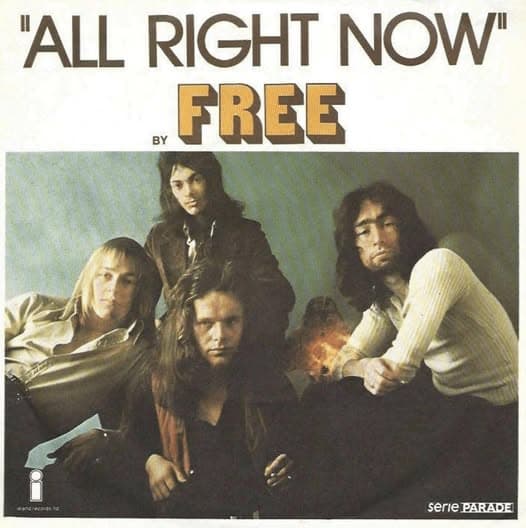
A sudden spark that refuses to fade—“All Right Now” captures the exact moment when freedom feels within reach and nothing else seems to matter
When Free released “All Right Now” in 1970, few could have predicted just how far that simple, swaggering riff would travel. The song quickly climbed to No. 2 on the UK Singles Chart and reached No. 4 on the Billboard Hot 100 in the United States, securing its place as one of the defining rock anthems of its era. It also topped charts in several European countries, becoming not just a hit, but a cultural marker of a particular kind of youthful confidence that felt both immediate and timeless. The track appeared on the album Fire and Water, a record that would ultimately become the band’s most successful release, elevating them from respected blues rock players into international prominence.
The story behind “All Right Now” is almost as enduring as the song itself. As it’s often recalled, bassist Andy Fraser and vocalist Paul Rodgers wrote the track in a burst of inspiration after a disappointing live show where the audience response had been lukewarm at best. There was a sense that something was missing—a connection, a spark. Backstage, Fraser reportedly began sketching out that now-iconic bass line, and within a remarkably short time, the song took shape. It wasn’t overthought or labored. It arrived quickly, almost instinctively, as if the band had finally tapped into something they had been circling all along.
What makes “All Right Now” endure is its balance between simplicity and presence. The structure is straightforward, the lyrics conversational, even casual. A chance meeting, a brief exchange, an invitation that may or may not lead anywhere—there is nothing overly poetic in the narrative. And yet, that very simplicity is what allows the song to feel so immediate. It doesn’t try to elevate the moment into something grand. It lets it remain what it is: fleeting, spontaneous, and real.
Musically, the track is built around one of the most recognizable guitar riffs in rock history, delivered with clarity and confidence by Paul Kossoff. His playing avoids excess, favoring space over speed, letting each note carry weight. There is a looseness in the performance, but never a lack of control. The rhythm section, anchored by Fraser’s bass and Simon Kirke, provides a steady foundation that allows the song to breathe. And above it all, Paul Rodgers’ voice moves with a kind of effortless authority—never strained, never forced, but always present.
There is also something quietly revealing about the song’s tone. While it is often remembered as an anthem of celebration, there is an undercurrent of transience beneath its surface. The encounter described in the lyrics is brief, almost incidental. There is no promise of permanence, no suggestion that the moment will last. And perhaps that is precisely why it resonates. It captures a feeling that doesn’t need to endure to matter.
In the years that followed, “All Right Now” would become a staple of classic rock radio, performed countless times across stages large and small. Yet it has never lost that sense of immediacy. It still sounds like something discovered rather than constructed—like a moment caught just as it happened, before it had time to become memory.
And that may be the song’s quiet achievement. It does not look back, nor does it attempt to predict what comes next. It exists entirely in the present tense, holding onto a single feeling with just enough clarity that, even decades later, it still feels close.