
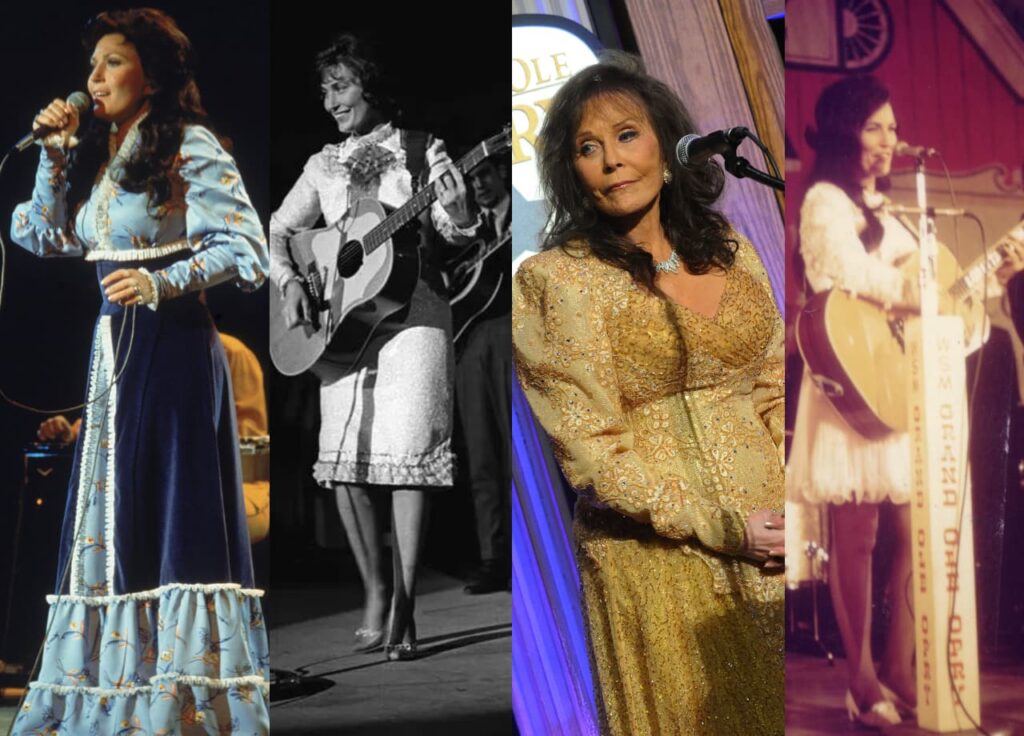
A Voice That Refused Silence — Loretta Lynn Turned Hard Truths into Songs the World Could No Longer Ignore
When Loretta Lynn passed away on October 4, 2022, at the age of 90, the response was not immediate spectacle — it was something quieter, deeper, almost instinctive. By the end of that very week, America had begun listening again, as if collectively realizing that a voice once taken for granted had been telling the truth all along. Her streaming numbers surged dramatically — a staggering 1,841% increase in a single day — and her signature song, “Coal Miner’s Daughter”, surpassed 1.3 million streams. These were not just statistics; they were echoes of recognition.
To understand why the loss of Loretta Lynn resonated so profoundly, one must return to where it all began. Born in Butcher Hollow, Kentucky, she grew up in poverty so stark it became the foundation of her most enduring work. Her breakthrough came with “Coal Miner’s Daughter”, released in 1970, which climbed to No. 1 on the Billboard Hot Country Singles chart. The song was more than a hit — it was a declaration. It told a story rarely heard on country radio at the time: not polished, not romanticized, but real. It spoke of hardship, family, and survival with a clarity that could not be ignored.
But Loretta Lynn did not stop at storytelling. She challenged. Songs like “The Pill” (1975), which controversially addressed birth control, were banned by many radio stations, yet still reached No. 5 on the country charts. Earlier hits like “Don’t Come Home A-Drinkin’ (With Lovin’ on Your Mind)” (1966) had already made her the first woman to win the CMA Award for Female Vocalist of the Year. Each song carried a piece of lived experience — marriage, betrayal, motherhood — and transformed it into something both personal and universal.
There is a certain courage in telling the truth when the world prefers silence. Loretta Lynn embodied that courage. She sang about subjects that were considered too raw, too uncomfortable, especially for women in country music at the time. And yet, those were precisely the songs that connected most deeply. They did not ask for approval; they demanded to be heard.
When she passed, the music industry did not respond with haste, but with reverence. Twenty-six days later, the Grand Ole Opry became the gathering place for remembrance. It was not just a tribute — it was a collective acknowledgment of a life that had shaped the very fabric of country music. Alan Jackson took the stage and performed a song written for his own mother, a gesture that felt deeply fitting. Because in many ways, Loretta Lynn had become a voice for countless untold stories.
She was honored by voices across generations — George Strait, Dolly Parton, Jack White, Taylor Swift — each representing a different era, yet all connected by the influence of one woman who had once been told to stay quiet.
The meaning behind “Coal Miner’s Daughter” and much of her catalog lies in its unwavering honesty. It is not simply about growing up poor or enduring hardship. It is about dignity — the kind that does not come from wealth or recognition, but from resilience. Her voice carried that dignity, steady and unpretentious, never asking for sympathy, only understanding.
There is something deeply moving about how her music found new life after her passing. It suggests that perhaps, in the rush of time, her contributions were not always fully appreciated. But in the stillness that followed her departure, people listened again — more carefully, more thoughtfully.
And what they heard was not just a singer, but a witness to a life lived without disguise.
In the end, Loretta Lynn did not simply leave country music behind. She left it changed. She left it more honest than she found it. And perhaps most importantly, she left it with a voice that will continue to speak, long after the silence that followed her passing has faded.
Because some truths, once sung, never disappear.