
A borrowed blues becomes a statement of identity, where repetition turns into conviction and the road itself begins to sound like home.
When Status Quo took on “Roadhouse Blues”, they were not simply covering a song—they were stepping into a lineage already defined by The Doors, who had first released it in 1970 on the album “Morrison Hotel.” That original version, driven by the unmistakable presence of Jim Morrison, had become one of the most enduring blues based rock tracks of its era, even though it was never issued as a major charting single. Its influence, however, was unmistakable—rooted in raw rhythm, repetition, and a sense of movement that felt less like performance and more like momentum.
By the time Status Quo began incorporating “Roadhouse Blues” into their live repertoire, they had already established their own identity through a series of successful releases. Songs like “Down Down”, which reached No. 1 on the UK Singles Chart in 1975, and “Whatever You Want”, peaking at No. 4 in 1979, had defined their place within British rock. Their albums, including “Hello!” (1973) and “On the Level” (1975), had also topped the UK Albums Chart, reinforcing their reputation as one of the most consistent and commercially reliable bands of their time. Yet chart success alone does not explain why “Roadhouse Blues” fits so naturally within their sound.
What makes their interpretation compelling is not reinvention, but alignment. Status Quo had always built their music around a steady, driving rhythm—often described as boogie rock—where the emphasis lies in repetition, in groove, in the physical sensation of the music as much as its structure. In this sense, “Roadhouse Blues” feels less like an addition to their catalog and more like an extension of it. The song’s foundation, already rooted in blues tradition, becomes tighter, more mechanical, almost hypnotic in their hands.
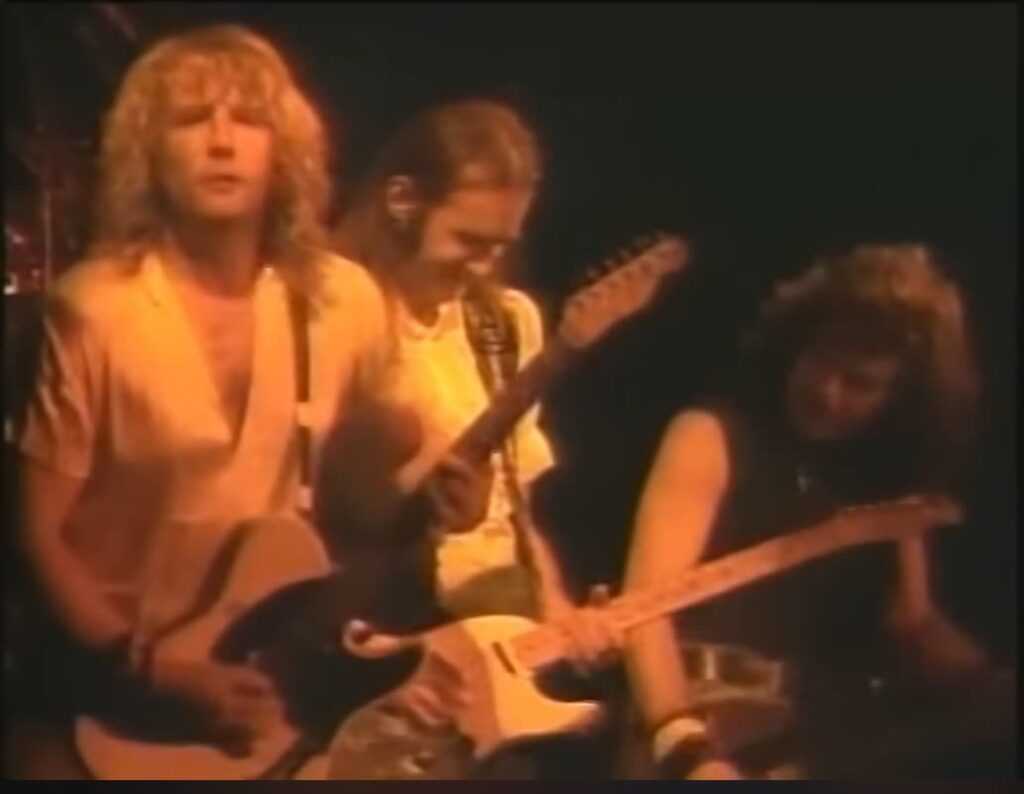
Unlike The Doors’ version, which carries a certain looseness and unpredictability, Status Quo approach the song with precision. The guitars of Francis Rossi and Rick Parfitt lock into a rhythm that rarely wavers. There is a discipline in their playing, a commitment to maintaining the pulse rather than expanding beyond it. This does not reduce the song’s energy. Instead, it concentrates it, turning it into something more controlled, more relentless.
Vocally, the shift is equally notable. Where Jim Morrison delivered the lyrics with a sense of improvisational swagger, almost as if the words were forming in real time, Status Quo present them with a more grounded approach. The focus is less on narrative and more on momentum. The song becomes less about the imagery of the road and more about the act of moving forward itself—steady, unbroken, without hesitation.
There is also something symbolic in their choice to perform this song. By the 1970s and into the early 1980s, Status Quo had become synonymous with touring. Their identity was tied not just to their recordings, but to the endless sequence of performances that defined their career. In that context, “Roadhouse Blues” takes on an additional meaning. It becomes a reflection of their own existence—a life spent on the road, measured not in destinations, but in the distance traveled.
Listening to their version now, one is struck by its consistency. It does not seek to surprise. It does not attempt to reinterpret the song in dramatic ways. Instead, it holds to a single idea and follows it through with unwavering commitment. And in doing so, it reveals something essential about Status Quo themselves. Their strength was never in constant change, but in persistence—in the ability to take a simple structure and sustain it with conviction.
In the end, “Roadhouse Blues” as performed by Status Quo becomes more than a cover. It becomes a statement of identity. A reminder that sometimes, the most enduring music is not the most complex or the most innovative, but the most certain—music that knows exactly what it is, and refuses to be anything else.