
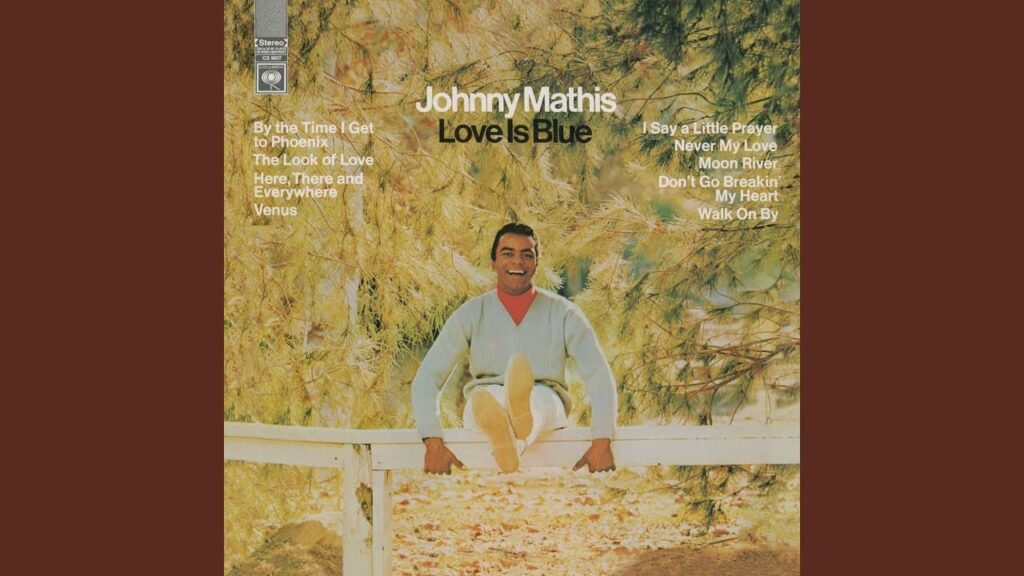
A timeless, wistful melody that whispers of moonlit rivers, dreams, and the longing in every human heart
Few songs carry as much quiet magic as “Moon River”, and when Johnny Mathis lends his voice to it, he offers a version that wraps the listener in warmth a gentle, reflective embrace. Though “Moon River” was not originally his song, Mathis’ own recording appears on his 1968 album Love Is Blue.
First conceived in 1961 by composer Henry Mancini and lyricist Johnny Mercer for the film Breakfast at Tiffany’s where it was sung by Audrey Hepburn “Moon River” quickly ascended to become a modern standard of longing and wistful elegance. The original soundtrack single (by Mancini & his Orchestra) reached No. 11 on the Billboard Hot 100 in December 1961 and became a No. 1 on American adult-contemporary charts, marking a milestone in pop-standard history.
By the time Johnny Mathis recorded his version for “Love Is Blue” in early 1968 exactly on February 3, 1968, according to the album liner notes the song was already beloved worldwide. His decision to include “Moon River” on the album reflects not only the song’s enduring resonance but also Mathis’s remarkable ability to bridge generations: to take a song born in a 1961 silver-screen romance and make it glow anew for late-60s listeners (and beyond).
Mathis’s rendition doesn’t come with headline-grabbing chart statistics like the original. Instead, its power lies in subtlety in the hushed tenderness of his vocal, in the orchestral arrangement that seems to part the mist of memory, and in the kind of emotional honesty that doesn’t clamor for attention but invites it quietly. Listeners familiar with his work often regard this version as among his finest interpretations of a standard: evocative, melancholic, yet suffused with hope.
The story behind the song itself is quietly rich. Mercer drew upon memories of his youth in Savannah, Georgia its slow rivers, the lazy summer days, the innocent dreams of wanderlust. Originally, a studio executive at Paramount had considered cutting the song from the film after a lukewarm preview. But Audrey Hepburn reportedly refused insisting the song stay. That insistence proved crucial: “Moon River” went on to win the 1962 Academy Award for Best Original Song and later, Grammy Awards for both Record of the Year and Song of the Year.
Because of its success, “Moon River” also revived Mercer’s career at a time when rock and roll threatened to overshadow the great song-book tradition. The result is a piece that feels both timeless and tender, a ballad for dreamers, for those who remember simpler times, for those who still believe in “some day.”
When Mathis steps to the microphone to sing its opening lines “Moon river, wider than a mile / I’m crossing you in style someday” there’s a hush, a moment of collective breath held. His voice doesn’t shout; it doesn’t need to. It simply carries the longing of every person who ever gazed out a window at a star hung low over water, wishing, hoping, remembering.
Over the decades, “Moon River” has been covered hundreds of times; versions range from orchestral to jazz to soulful reinterpretations. But Mathis’s treatment remains unique: he doesn’t attempt to outdo Broadway, film, or pop spectacle. Instead, he offers something gentler, more enduring a quiet reflection, a soft sigh, a river of moonlight stretching across memory.
For anyone who once swayed under a lamplit porch, who once felt nostalgia in the hush between dusk and night, or who once quietly wept over lost dreams Mathis’s “Moon River” becomes a companion, a soft echo of longing and hope. In the slow turn of vinyl, in the hush after the last note, the song doesn’t end. It lingers.