
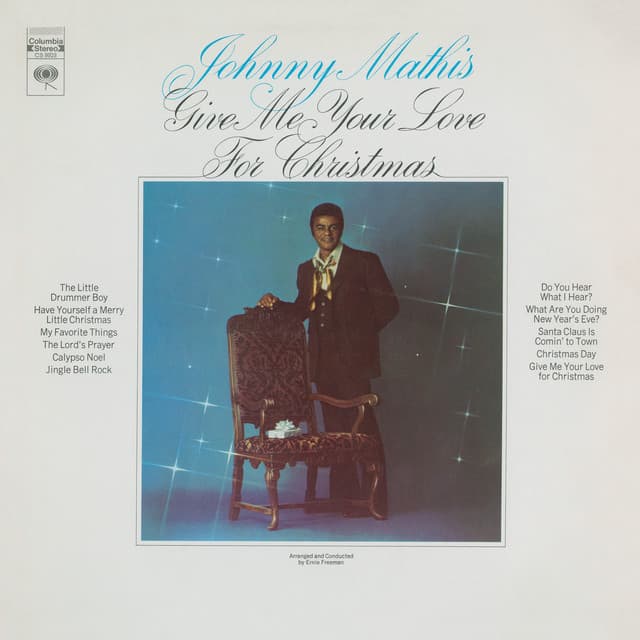
A tender musical inquiry into future togetherness and romantic promise, “What Are You Doing New Year’s Eve?” is both a question and a quiet wish wrapped in song.
“What Are You Doing New Year’s Eve?” is one of those rare songs that feels like a letter written with moonlight and anticipation — a melody that lingers in the heart long after the clock has chimed its final hour. Originally written in 1947 by legendary songwriter Frank Loesser, the song was not conceived strictly as a holiday tune but as a romantic proposal set against the turning of the year. Over the decades it has become a beloved classic, covered by countless artists — from Ella Fitzgerald to Nancy Wilson — each bringing their own emotional shade to its wistful lyrics. Among these interpretations is the elegant version by Johnny Mathis, included on his 1969 holiday album Give Me Your Love for Christmas, a record that became a cherished seasonal staple.
Released on October 13, 1969 under Columbia Records, Give Me Your Love for Christmas was Mathis’s third holiday-themed collection and featured a mix of timeless standards and contemporary favorites, all delivered in his signature smooth, expressive style. The album itself performed strongly on the Billboard Christmas Albums chart, reaching No. 1 in 1969, No. 3 in 1970 and No. 5 in 1971, and continuing to chart across subsequent holiday seasons — a testament to its enduring appeal.
Although “What Are You Doing New Year’s Eve?” was not released as a single in its own right by Mathis and therefore did not have a separate chart position, its place on Give Me Your Love for Christmas tied it to a seasonal tradition that millions have welcomed into their homes each winter for more than half a century. The album was produced by Jack Gold and arranged with the lush orchestral warmth that became Mathis’s hallmark — a blend of romance and subtle grandeur that perfectly suited both classic carols and songs of intimate yearning.
From the first notes of the Mathis performance, there’s a delicate tension in the air — a sense of quiet hope suspended between past and future. The lyrics themselves ask a simple yet profoundly vulnerable question: “Maybe it’s much too early in the game… but I thought I’d ask you just the same — what are you doing New Year’s Eve?” Originally penned from the perspective of someone madly in love and willing to take a risk with their heart, these lines carry even more weight when delivered in Mathis’s warm, trembling croon.
It’s that emotional honesty — the willingness to offer hope without presumption — that elevates the song beyond a mere holiday query. In Mathis’s voice, the question becomes a quiet confession, an unguarded moment shared with the listener as if leaning across a softly lit room. The arrangement supports this intimacy: gentle strings, understated horns, and a rhythm that feels like a slow walk under winter stars, echoing the pulse of time passing and the desire to fill it with someone dear.
In the broader context of Christmas recordings, “What Are You Doing New Year’s Eve?” stands apart because it speaks not of snow-covered scenes or festive gatherings, but of hope and future togetherness. It’s a song about the cusp of something new — a night that bridges what has been and what could be — and Mathis’s interpretation brings out every nuance of that emotional terrain. It’s the kind of performance that invites listeners to reflect on the year gone by, on love earned and given, and on the quiet moments when life’s true wishes are whispered rather than shouted.
Over time, this rendition has become part of the gentle soundtrack of year-end reflection, often played alongside other classics that signal warmth and nostalgia. While it may not have dominated the singles charts, its influence resides in the memories it evokes — of cozy evenings by the fire, of hands clasped under twinkling lights, and of hopeful hearts looking forward to the promise of tomorrow. Through Mathis’s rich and expressive phrasing, “What Are You Doing New Year’s Eve?” continues to resonate as a song that doesn’t just ask a question, but invites you to feel it, to live it, and to perhaps find joy in the answer.