
A love song reduced to its purest request, where longing speaks plainly and devotion finds its simplest form
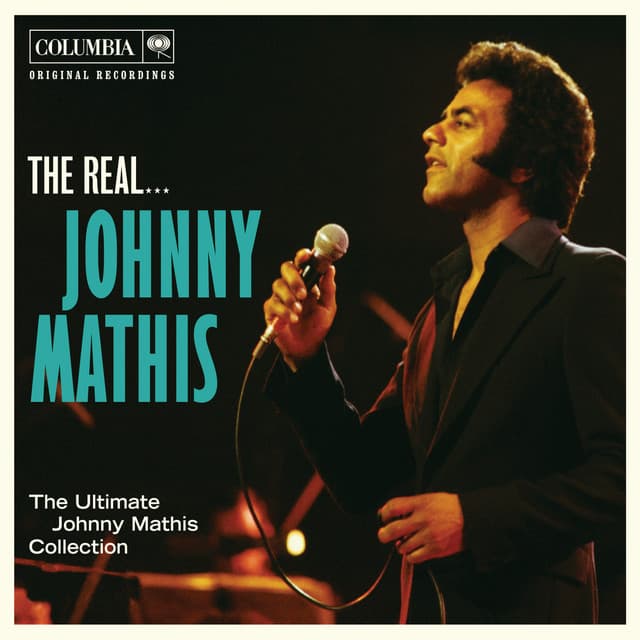
When Johnny Mathis recorded In Other Words (Fly Me to the Moon), he approached a song that was already quietly reshaping the language of modern romance. Written in 1954 by Bart Howard, the song was originally titled In Other Words, a name that reveals its true intention. This was never meant to be a song of spectacle. It was a conversation, an emotional shorthand, where extravagant imagery served only to clarify a very human desire: to love and be loved in return. Although the song would later achieve worldwide fame through other interpretations, Johnny Mathis’s early recording remains one of the most elegant and emotionally sincere versions ever committed to tape.
Mathis recorded In Other Words (Fly Me to the Moon) in 1959 for his album Open Fire, Two Guitars, an album that stood apart in his catalog for its stripped back instrumentation and intimate atmosphere. At a time when orchestral arrangements dominated popular ballads, this album featured only two guitars accompanying his voice. The result was startling in its simplicity. While Mathis’s version was not released as a major commercial single and did not enter the Billboard Hot 100 at the time, its artistic significance has only grown with the passing years. It represents one of the earliest and most refined interpretations of the song, predating its later association with the space age and big band swing.
The song’s journey to prominence is an important part of its story. After modest early success in cabaret and jazz circles, In Other Words gained broader attention when it was retitled Fly Me to the Moon in the early nineteen sixties. Its most famous chart success came later in 1964, when Frank Sinatra recorded it with Count Basie, leading to a Top 10 placement on the Billboard Hot 100 and cementing its place in popular culture. Yet Mathis’s earlier interpretation tells a very different story. Where later versions embraced confidence and outward motion, his recording turns inward, focusing on emotional closeness rather than ambition.
Lyrically, In Other Words (Fly Me to the Moon) uses celestial imagery not to impress, but to simplify. The moon, the stars, and the planets are metaphors for emotional surrender. In other words, as the lyric insists, what truly matters is love itself. This insistence on clarity is what gives the song its enduring strength. It strips romance down to its essentials, refusing grand declarations in favor of quiet truth.
Johnny Mathis understood this instinctively. His vocal delivery is soft, controlled, and unadorned. There is no sense of performance overtaking meaning. He sings as though he is speaking directly to one person, choosing intimacy over projection. The absence of heavy orchestration allows every nuance of his phrasing to be heard. Each line feels deliberate, as though the words are being discovered in the moment rather than rehearsed.
The guitar accompaniment on Open Fire, Two Guitars further reinforces this sense of closeness. The gentle interplay between the instruments creates space rather than filling it, allowing silence to become part of the emotional vocabulary. This approach transforms In Other Words (Fly Me to the Moon) into something closer to a whispered promise than a declaration. It invites listening rather than admiration.
Within Johnny Mathis’s broader career, this recording holds a special place. Known primarily for lush romantic ballads, Mathis revealed here a different strength: restraint. He demonstrated that his voice did not require orchestral grandeur to carry emotional weight. In fact, stripped of excess, his interpretive skill becomes even more apparent. This recording shows an artist confident enough to trust simplicity, to let the song speak without embellishment.
Listening to In Other Words (Fly Me to the Moon) as sung by Johnny Mathis today feels like stepping into a quiet room where nothing competes for attention. The song does not ask to be remembered as a cultural milestone. It asks to be felt. It reminds us that love does not always need poetry to be profound. Sometimes it needs only honesty, spoken gently, without urgency.
In the long life of this song, filled with celebrated versions and historic moments, Johnny Mathis’s interpretation remains a touchstone for emotional authenticity. It captures the heart of In Other Words exactly as Bart Howard intended, a simple message expressed without disguise. Long before the song became associated with grandeur and achievement, Mathis revealed its true center: a quiet confession, offered sincerely, and meant to last.