
A Quiet Campfire Song and a Rock ’n’ Roll Whisper: Two Voices of American Youth and Reflection
When Dean Martin and Ricky Nelson recorded “My Rifle, My Pony & Me” and “Cindy”, they were not merely cutting singles for the radio. They were capturing two different but deeply connected moods of late-1950s America: the reflective calm of adulthood looking back, and the restless tenderness of youth stepping forward. Both songs emerged at pivotal moments in popular music, when traditional pop, folk roots, and the rising tide of rock ’n’ roll quietly overlapped.
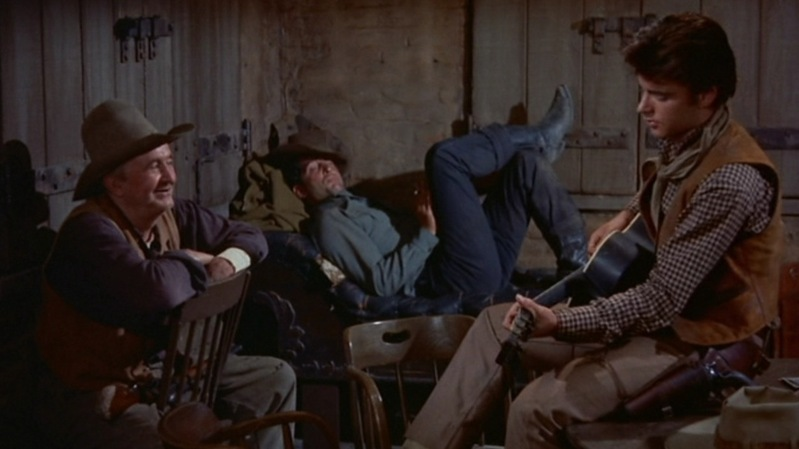
“My Rifle, My Pony & Me” was introduced to the public in 1959 as part of Howard Hawks’ classic Western film Rio Bravo. Performed on screen by Dean Martin alongside Ricky Nelson and Walter Brennan, the song became one of the film’s most memorable moments. Released as a single credited to Dean Martin, it reached the Billboard Hot 100, peaking in the lower Top 40 during the summer of 1959. While it was never designed as a chart-dominating hit, its presence on the national charts reflected how deeply it resonated with audiences.
The song’s power lies in its restraint. Written by Dimitri Tiomkin and Paul Francis Webster, it avoids grand Western heroics. Instead, it offers a hushed meditation on companionship, trust, and the longing for home. A rifle, a pony, and a trusted friend become symbols of survival and loyalty rather than violence or conquest. In the context of Rio Bravo, the song appears at night, by a campfire, when action pauses and characters reveal their inner lives. For older listeners, this moment often feels familiar: a pause in life when noise fades and memory takes over.
Dean Martin’s performance is key to the song’s enduring appeal. Known for his easygoing charm and lounge sophistication, Martin sings with unusual softness here. His voice sounds unguarded, almost intimate, suggesting a man who has seen enough of the world to value quiet moments over triumph. For many listeners who lived through the postwar years, “My Rifle, My Pony & Me” echoes a time when simplicity felt earned rather than naive.
On the other side of this musical pairing stands “Cindy”, recorded by Ricky Nelson in 1958, a year before Rio Bravo. Released as a single and included on his album Ricky Nelson, the song was a major success, climbing to No. 4 on the Billboard Hot 100. Unlike the Western ballad, “Cindy” is rooted in American folk tradition, adapted into a gentle rock ’n’ roll framework that made it accessible to a new generation.
At the time, Ricky Nelson was transitioning from television star on The Adventures of Ozzie and Harriet to a legitimate recording artist. “Cindy” played a crucial role in that transformation. His clean, sincere vocal delivery bridged generations, allowing parents to hear echoes of familiar folk melodies while teenagers recognized the emotional directness of contemporary pop. The song tells a simple story of affection and longing, but beneath that simplicity is a quiet assertion of independence. Nelson was no longer just a son on a sitcom; he was a young man finding his own voice.
The pairing of Dean Martin and Ricky Nelson through these songs is particularly meaningful. In Rio Bravo, they appear together not as rivals, but as reflections of different stages of life. Martin embodies experience, patience, and reflection. Nelson represents youth, vulnerability, and hope. For listeners who have grown older alongside this music, revisiting “My Rifle, My Pony & Me” and “Cindy” can feel like looking at old photographs from different chapters of the same life.
Today, these recordings endure not because of technical innovation or lyrical complexity, but because of emotional truth. They remind us of evenings when songs were allowed to breathe, when silence mattered as much as sound. For those who remember hearing these voices when they were new, or discovering them later through memory and film, they remain gentle companions. Not loud, not insistent, but quietly present, like a familiar tune carried on the wind from a distant campfire.
 Music Legend