
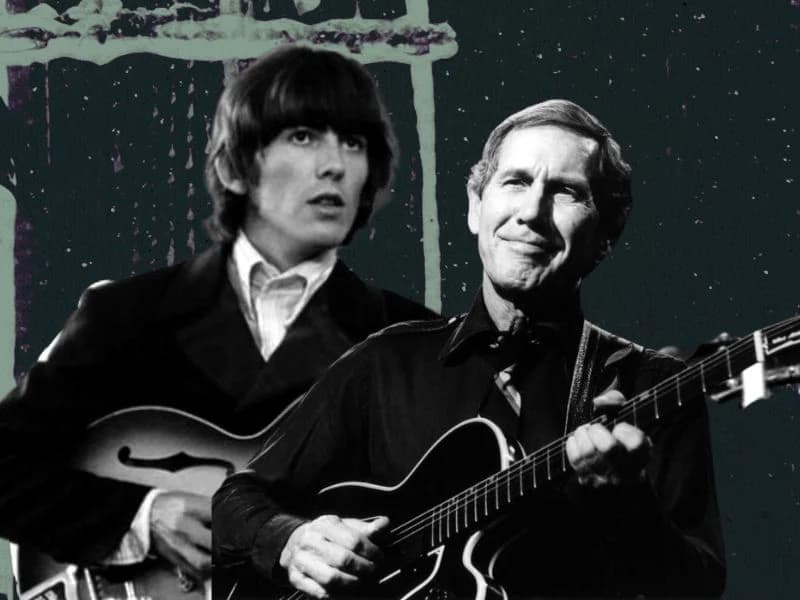
When George Harrison Admitted Awe Before Perfection — The Quiet Power of Chet Atkins
“Chet, you scare me!”
That was what George Harrison once said to Chet Atkins — half in jest, half in reverence. It was not the fear of stage fright or rivalry. It was something far more intimate: the tremor a musician feels when standing in the presence of flawless command. And coming from a member of The Beatles, at the very height of their global ascendancy, those words carried extraordinary weight.
By the early 1960s, Beatlemania was in full roar. The Beatles were rewriting the rules of popular music, topping charts across continents. Yet even as they dominated the airwaves, they remained students of craft. Harrison, the band’s lead guitarist, looked beyond the frenzy of fame toward the quiet giants of musicianship. Among them stood Chet Atkins, already a revered figure in American country and instrumental guitar.
By the time the British Invasion began, Atkins had long established himself not merely as a performer, but as a defining architect of the so-called “Nashville Sound.” His instrumental recordings such as “Mr. Sandman” (1954) and “Yakety Axe” (1965) had demonstrated a style that was elegant, clean, and astonishingly controlled. Though his singles rarely stormed the pop charts in the manner of rock acts, his influence ran deep. His albums consistently performed well on the Billboard Country charts throughout the late 1950s and 1960s, and his reputation among musicians bordered on mythic. He would go on to win 14 Grammy Awards and earn the title “Certified Guitar Player” — a distinction he personally bestowed only on a select few.
What made Atkins intimidating was not volume or spectacle. It was clarity. His fingerstyle technique — alternating bass lines played with the thumb while melody and harmony danced above on the fingers — created the illusion of two guitarists performing at once. The sound was polished but never sterile, intricate but never cluttered. Each note landed precisely where it belonged, like a watchmaker setting gears into motion.
Harrison absorbed this language with almost academic devotion. One can hear echoes of Atkins’ influence in “Cry for a Shadow” (1961), the early Beatles instrumental recorded in Hamburg and credited to Harrison and John Lennon. The track’s clean articulation, its deliberate melodic phrasing, and its understated twang bear the subtle fingerprints of the American master. While it was also a playful nod to The Shadows and Hank Marvin, the disciplined picking technique owes much to Atkins’ example.
Imagine the scene: a young British guitarist, barely in his twenties, navigating unprecedented fame — yet still sitting quietly with records, slowing them down, studying how Atkins’ thumb never faltered, how the melody floated without strain. That kind of mastery does not shout. It whispers. And sometimes a whisper is far more unsettling than a scream.
Atkins did not chase the hysteria that followed bands like The Beatles. He did not need stadium lights or television spectacles. His authority came from restraint. In a decade increasingly defined by amplification and experimentation, he proved that technical excellence and tonal purity could command equal respect. Producers sought his ear. Musicians sought his approval. And younger guitarists — Harrison among them — measured themselves against his standard.
There is something deeply moving about that admission: “Chet, you scare me.” It reveals the humility behind artistry. Even those who changed the course of music felt small in the presence of someone who had mastered his instrument so completely.
Today, when we listen to a Chet Atkins recording, the effect remains disarming. The notes fall like polished glass beads, each one reflecting discipline, patience, and years of refinement. And in those moments, one understands exactly what Harrison meant. True mastery is not loud. It does not demand attention. It simply exists — calm, assured, untouchable.
And for any musician who has ever tried to make six strings sing with such effortless grace, that calm perfection can indeed be a little frightening.