
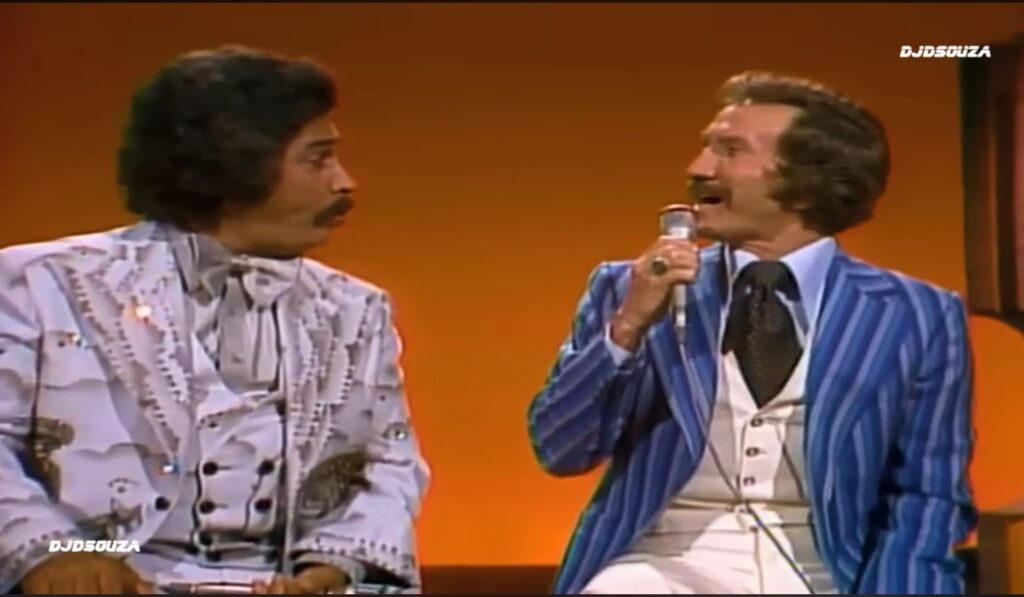
A meeting of two sincere voices where country music became conversation, memory, and shared respect rather than performance
The appearance of Freddy Fender alongside Marty Robbins on The Marty Robbins Show represents one of those quiet but deeply meaningful moments in classic country history, where music was less about chart positions and more about connection, lineage, and mutual understanding. Though not tied to a single song release or a chart debut, this collaboration carries its own kind of historical weight. It captured two artists from different backgrounds and career arcs meeting on equal ground, united by storytelling, humility, and an unspoken respect for the traditions that shaped them.
The Marty Robbins Show, which aired briefly in 1966, was an extension of Robbins’ artistic personality. It was not designed as spectacle. Instead, it functioned as a welcoming space where songs were allowed to breathe and performers were invited to be themselves. When Freddy Fender appeared on the program, the moment felt less like a guest spot and more like an introduction to a voice that carried lived experience in every note.
At that time, Marty Robbins was already a towering figure in country music. With multiple No. 1 hits to his name, including classics like “El Paso” and “Big Iron”, Robbins had established himself as a master storyteller whose songs blurred the line between folk narrative and emotional confession. His show reflected those same values. He favored sincerity over polish, and emotional truth over commercial urgency.
Freddy Fender, still in the early stages of his national recognition, brought something entirely different yet completely compatible. His voice carried the weight of struggle, cultural hybridity, and survival. Rooted in country, Tex Mex, and traditional pop, Fender sang with an aching gentleness that felt earned rather than performed. On The Marty Robbins Show, that quality became unmistakable.
The significance of this appearance lies not in any particular chart statistic but in the way the two artists mirrored each other. Robbins, known for his smooth phrasing and narrative clarity, approached songs with calm authority. Fender, by contrast, sang as if each lyric were a personal reckoning. Together, they demonstrated the breadth of country music’s emotional language. One voice offered reassurance. The other offered vulnerability. Neither overshadowed the other.
In performances from the show, the atmosphere is strikingly intimate. There is no rush, no need to impress. The arrangements are simple, allowing melody and lyric to remain at the center. Marty Robbins often stepped back, giving Fender space to inhabit the song fully. That gesture alone speaks volumes. It reflects Robbins’ understanding that country music thrives when artists listen as much as they sing.
The meaning behind this shared moment extends beyond television. It symbolizes a passing of quiet encouragement. Robbins, representing the established tradition, acknowledged Fender as a voice worth hearing. Fender, in turn, met that respect with humility and emotional honesty. There is no sense of hierarchy, only shared ground.
For Freddy Fender, appearances like this foreshadowed what would come later in the decade. His breakthrough hits, including “Before the Next Teardrop Falls”, would reach No. 1 on both the Country and Pop charts in 1975, but the emotional core of his artistry was already present here. On The Marty Robbins Show, viewers could see the foundation being laid: a singer who trusted simplicity and truth.
For Marty Robbins, the show reaffirmed his role not just as a star, but as a steward of the genre. He understood that country music survives through generosity. By sharing his platform, he ensured that new voices could be heard without dilution or compromise.
Watching Freddy Fender and Marty Robbins together today feels like stepping into a room where time slows down. There is a sense of patience, of listening, of songs being treated as something fragile and valuable. It reminds us that country music, at its best, is not about dominance or novelty. It is about recognition.
This moment on The Marty Robbins Show endures because it captured country music in its most honest form. Two voices, shaped by different lives, meeting in a shared emotional language. No spectacle. No pretense. Just songs, sung with care, and understood without explanation.