
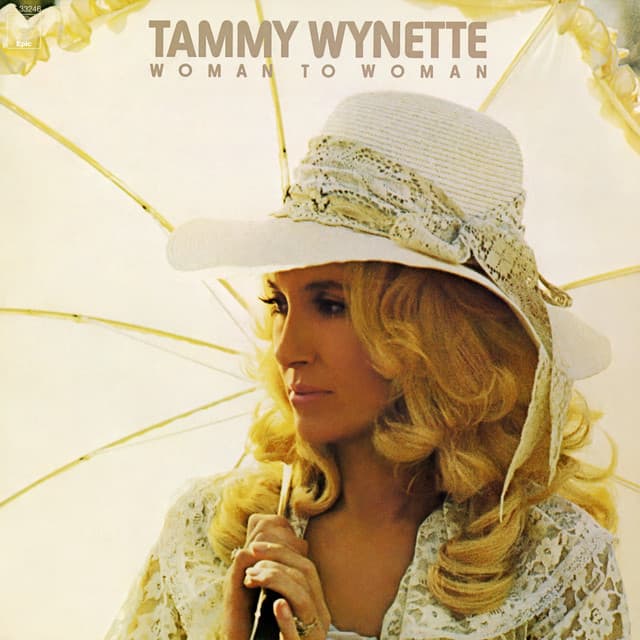
A quiet conversation between two hearts, where dignity and empathy speak louder than anger or blame
Released in 1977, “Woman to Woman” stands as one of the most emotionally measured and quietly powerful recordings in Tammy Wynette’s catalog. Issued as the title track from her album Woman to Woman, the song climbed to No. 3 on the Billboard Hot Country Singles chart, reaffirming Wynette’s unique ability to translate deeply personal situations into universally understood emotional truths. By the time it reached the charts, her voice had already become synonymous with country music honesty, yet this song revealed a new kind of strength, one rooted not in endurance alone but in empathy.
By the late nineteen seventies, Tammy Wynette was no longer merely the voice of traditional country devotion. She was an artist shaped by lived experience, public scrutiny, and private reckoning. “Woman to Woman” arrived after a period of emotional turbulence in her personal life, including her widely discussed marriage and separation from George Jones. While the song is not autobiographical in a literal sense, its emotional perspective feels informed by a woman who understood both love and its unraveling with painful clarity.
Musically, “Woman to Woman” is restrained and deliberate. The arrangement favors subtle piano lines, soft strings, and a steady rhythm that never intrudes on the story being told. There is no dramatic crescendo. Instead, the song unfolds like a calm conversation held late in the evening, where raised voices would only obscure the truth. This quietness allows every word to carry weight.
Lyrically, the song takes an unusual and deeply humane approach. Rather than confronting a romantic rival with bitterness, the narrator addresses her directly, not as an enemy but as another woman caught in the same emotional storm. The song acknowledges pain without assigning cruelty. It recognizes that love, when it falters, often leaves more than one heart bruised. This perspective was rare in popular music at the time and remains striking even now.
Tammy Wynette’s vocal delivery is central to the song’s enduring impact. Her voice carries weariness, compassion, and dignity in equal measure. She does not plead, accuse, or dramatize. She simply speaks. The phrasing is careful, almost conversational, as if each line has been weighed before being spoken. That restraint transforms the song from a tale of heartbreak into a meditation on understanding.
The album Woman to Woman marked an important chapter in Wynette’s career. It reflected a shift toward more mature emotional narratives, moving beyond the singular devotion that had defined earlier hits like “Stand by Your Man.” In “Woman to Woman,” loyalty is not blind. It is thoughtful. It acknowledges complexity, regret, and shared vulnerability.
At the time of its release, the song resonated strongly with listeners who recognized themselves in its quiet wisdom. Its chart success was not driven by novelty but by recognition. People heard their own unspoken thoughts reflected back to them, framed with grace rather than judgment. That connection is why the song has endured long after its initial chart run.
The deeper meaning of “Woman to Woman” lies in its refusal to simplify emotional conflict. It suggests that strength can be gentle, that honesty does not require cruelty, and that empathy does not negate self respect. In a genre often associated with dramatic declarations, Wynette chose reflection instead.
Listening to “Woman to Woman” today feels like revisiting a letter written with care, one that understands that life rarely offers clear villains or perfect victims. The song accepts that love can be sincere even when it fails, and that dignity is preserved not by winning but by understanding.
Within Tammy Wynette’s legacy, “Woman to Woman” remains a quiet landmark. It captures a moment when country music allowed itself to speak softly, trusting that truth does not need volume. It is a song that lingers not because it demands attention, but because it offers wisdom, gently and without condition.