
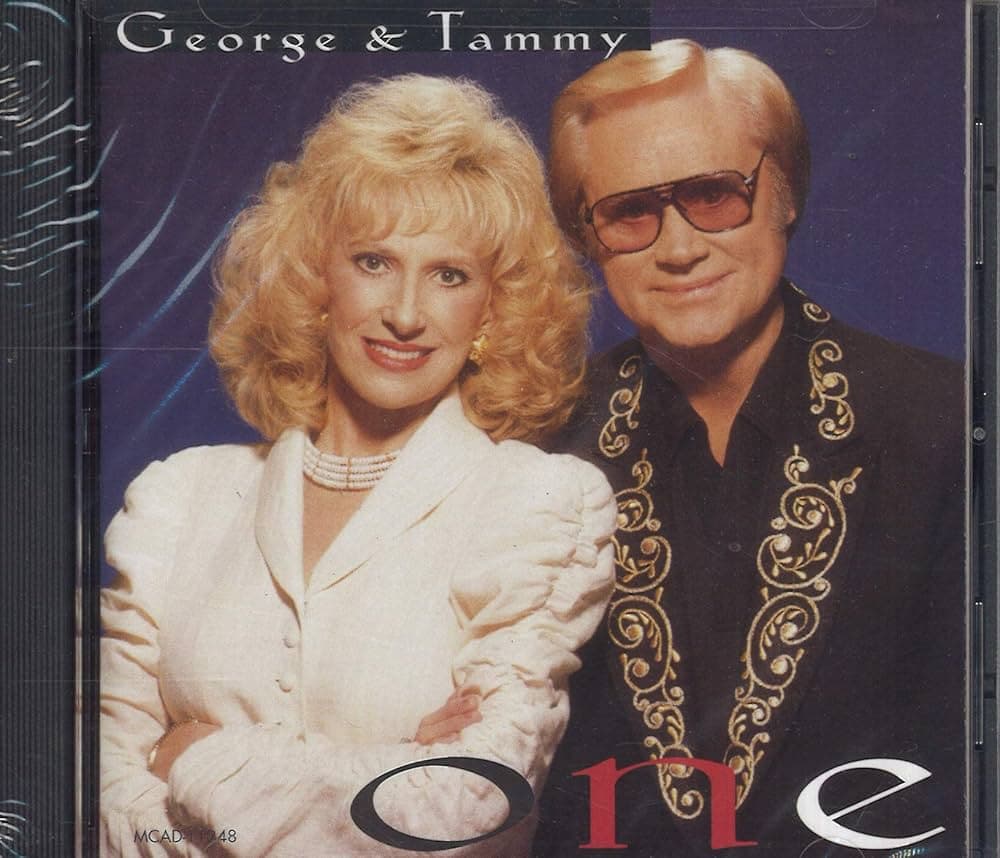
A tender promise of unity that quietly reveals how fragile togetherness can be
Released in 1976, “One” by George Jones & Tammy Wynette occupies a singular place in country music history, not only for its chart success but for the emotional contradiction at its core. The song reached No. 1 on the Billboard Hot Country Singles chart, becoming one of the most memorable duets ever recorded by the genre’s most famous couple. It appeared on their joint album Golden Ring, an album that, with remarkable irony, chronicled devotion, unity, and shared destiny at a moment when their real life marriage was nearing its end.
From the very first lines, “One” presents itself as a vow. The lyrics speak of two lives merging, of separate paths choosing a shared direction, of love defined not by passion alone but by commitment. Yet beneath that surface lies a quiet tension. When sung by George Jones & Tammy Wynette, the words carry weight beyond the page. Their voices do not simply perform the song. They inhabit it, bringing with them years of love, struggle, reconciliation, and public heartbreak.
Musically, “One” is built on simplicity. The arrangement is restrained, allowing the harmonies to remain front and center. There are no grand instrumental flourishes, no distractions from the emotional exchange unfolding between the two voices. The melody moves gently, almost cautiously, as if aware that it is stepping into sacred emotional territory. This spareness gives the song its power. It feels intimate, personal, and unguarded.
The story behind “One” is inseparable from the history of George Jones & Tammy Wynette themselves. By 1976, their relationship had already become part of country music folklore. Their marriage, marked by profound love and equally profound turmoil, played out under constant public attention. Songs like “Golden Ring”, “Near You”, and “We’re Gonna Hold On” blurred the line between performance and confession. “One” stands among these recordings as perhaps the most quietly heartbreaking, precisely because of its hopeful message.
Lyrically, the song speaks of unity as an ideal, not a certainty. It frames love as a choice made daily, an agreement renewed through patience and understanding. When Tammy Wynette sings, there is warmth and resolve in her voice, a steady belief in the promise being described. When George Jones responds, his tone carries vulnerability and longing, as though aware of how easily such promises can slip away. Together, their voices intertwine, sometimes seamlessly, sometimes with subtle friction that makes the performance feel painfully real.
The album Golden Ring became one of their most successful collaborative projects, and “One” played a significant role in that success. Its ascent to the top of the charts was driven not by novelty but by recognition. Listeners heard something authentic in the way the song unfolded. It did not sound like a polished fantasy. It sounded like two people reaching for something meaningful, even as it trembled in their hands.
What gives “One” its lasting resonance is the way it reflects the complexity of human connection. The song does not deny hardship. Instead, it frames unity as something precious because it is difficult. Love, in this telling, is not effortless harmony. It is the decision to stand together, knowing how easily separation can occur.
In retrospect, “One” feels almost prophetic. Soon after its release, George Jones & Tammy Wynette would divorce, making the song’s message all the more poignant. Yet this knowledge does not diminish the recording. It deepens it. The song becomes a document of hope, captured at a moment when hope still felt possible.
Today, “One” endures as more than a chart topping duet. It remains a meditation on togetherness, sung by two voices who understood both its beauty and its cost. In the quiet space between their harmonies, the song continues to ask a timeless question about love, commitment, and the fragile miracle of becoming one.