
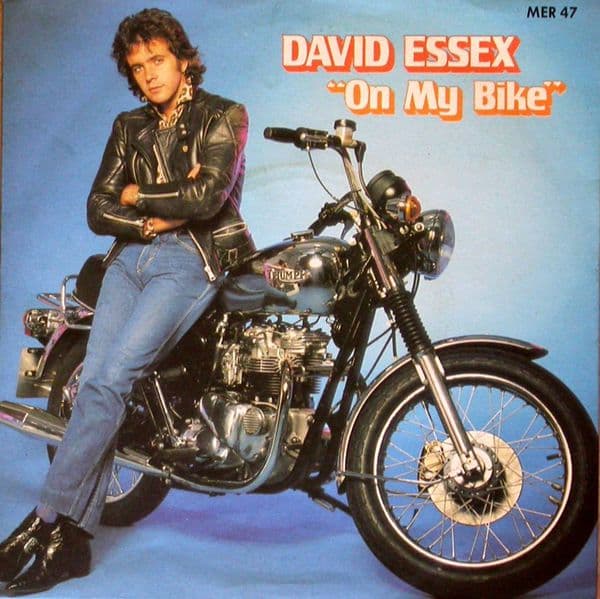
A portrait of youthful escape where motion becomes memory and freedom rides on two thin wheels
On My Bike by David Essex arrived as a defining statement of youthful restlessness and romantic independence, released in 1975 at the height of his popularity. The single reached an impressive No. 2 on the UK Singles Chart, becoming one of the most recognizable songs of his career and a lasting emblem of British pop storytelling in the mid nineteen seventies. At a time when pop music often leaned toward grand emotion or theatrical excess, David Essex chose something quieter, more personal, and deeply reflective, a song that found its power not in volume but in movement.
By the mid seventies, David Essex had already established himself as a singular voice in British music, balancing pop success with a thoughtful narrative instinct. Following earlier hits like Rock On and Gonna Make You a Star, he was increasingly interested in songs that felt lived in rather than performed. On My Bike captured this shift perfectly. It was not attached to a major studio album at the time of its release, instead standing alone as a single, which only reinforced its feeling of independence. Later, it would appear on compilations such as The Best of David Essex, where its significance became even clearer in retrospect.
The song itself is built around a deceptively simple idea. A young narrator riding his bicycle through familiar streets, leaving behind the noise of expectation and responsibility. Yet beneath that simplicity lies a deeper emotional truth. On My Bike is not really about transportation. It is about escape without rebellion, about solitude without loneliness. The bicycle becomes a symbol of self reliance, a way to move forward without asking permission, powered only by one’s own effort.
Musically, the arrangement is gentle and unforced. Acoustic guitar lines roll steadily like turning wheels, while subtle orchestration adds warmth rather than drama. David Essex’s vocal delivery is intimate, almost conversational, as if he is sharing a private memory rather than addressing an audience. There is a reflective calm in his voice, a sense that the song is being recalled rather than lived in real time. This distance gives the song its emotional weight. It feels like a moment remembered years later, still vivid, still meaningful.
The success of On My Bike on the UK charts spoke to its broad resonance. It connected not through spectacle, but through recognition. Many listeners understood the feeling immediately. The desire to keep moving, to find clarity in motion, to let the road absorb unspoken thoughts. Unlike many pop hits of the era, the song did not hinge on romance or heartbreak. Instead, it explored a quieter form of longing, the wish to belong only to oneself for a while.
There is also a subtle melancholy woven through the song. Not sadness, but awareness. The awareness that such moments of freedom are fleeting, that youth passes even as it feels endless. David Essex never states this outright, yet it lingers between the lines. The ride is joyful, but it is also temporary. That understanding gives On My Bike its enduring emotional pull.
In the broader context of his career, the song represents David Essex at his most sincere. It bridges the gap between pop stardom and personal reflection, showing an artist comfortable enough to slow down and observe his own life. While other songs brought him chart dominance, On My Bike brought something quieter and perhaps more lasting. A sense of shared memory.
Today, the song remains a touchstone not because of nostalgia alone, but because its meaning still holds. The need to step away, to find peace in simple motion, to let the world fade into the background for a few moments. On My Bike reminds us that sometimes the most profound journeys are short, familiar, and powered only by the will to keep moving forward.
In the legacy of David Essex, this song endures as a gentle anthem of independence, a reminder that freedom does not always roar. Sometimes it hums softly, keeping pace with the rhythm of turning wheels and quiet thought.