
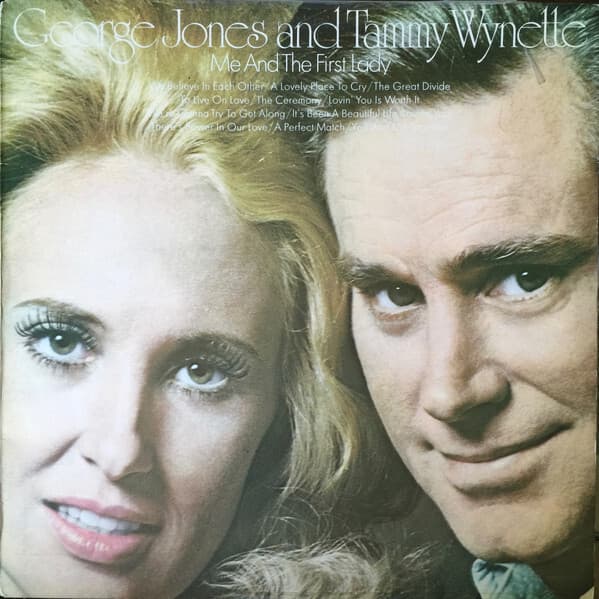
A quiet vow between two wounded hearts where love is chosen despite the cost and the scars it leaves behind
Lovin’ You Is Worth It stands as one of the most revealing and emotionally honest duets ever recorded by George Jones and Tammy Wynette, released in 1972 during a period when their personal lives and musical partnership were inseparably intertwined. Issued as a single from the album George & Tammy & Tina, the song rose to No. 2 on the Billboard Hot Country Singles chart, confirming that even when their story was marked by turbulence, their shared voice still spoke directly to the heart of country music.
By the early nineteen seventies, George Jones and Tammy Wynette were no longer simply celebrated collaborators. They were a symbol. Their marriage, their conflicts, their reconciliations, and their separations had become part of the public consciousness, and every duet they released carried an unspoken weight of lived experience. Lovin’ You Is Worth It arrived not as a dramatic confrontation, but as a weary confession. It did not promise perfection. It did not pretend that love was easy. Instead, it asked a harder question. After all the damage, all the disappointment, is love still worth choosing.
The song was written by Don Chapel, Tammy Wynette’s then husband, and this detail alone adds an undeniable layer of tension and intimacy. The lyrics speak of a relationship battered by misunderstanding and emotional exhaustion, yet held together by a belief that something valuable still remains. When George Jones sings his lines, there is a fragility in his voice, a sense of a man who knows his faults and does not attempt to excuse them. Tammy Wynette, in response, sounds resolute but tired, a woman who has endured disappointment yet refuses to abandon hope entirely. Their voices do not blend smoothly in the traditional sense. They lean into each other cautiously, as if each phrase must be earned.
Musically, Lovin’ You Is Worth It is restrained and deliberate. The arrangement is classic country, built around gentle acoustic guitar, steady rhythm, and understated steel guitar that sighs rather than cries. Nothing distracts from the conversation at the center of the song. The production allows space for silence, for breath, for hesitation. These pauses matter. They suggest things left unsaid, memories too heavy to articulate.
What makes this song endure is its refusal to romanticize suffering. Love here is not portrayed as redemptive magic. It is portrayed as labor. Something chosen daily, sometimes reluctantly, sometimes painfully. The title itself feels like a conclusion reached after long debate. Not a declaration of passion, but a decision. That honesty resonated deeply when the song first appeared on the charts, and it continues to resonate because it reflects a truth many recognize but few songs articulate so plainly.
Within the broader arc of George Jones and Tammy Wynette’s collaborations, Lovin’ You Is Worth It occupies a unique place. Earlier duets often carried playful banter or dramatic contrast. This song, by contrast, sounds like the aftermath. It belongs to the quiet hours after arguments have ended, when pride has faded and only sincerity remains. It is less about winning and more about staying.
The album George & Tammy & Tina further emphasized this mature tone, presenting a couple no longer pretending to be unbreakable. While their marriage would eventually dissolve, the music they created together during this period captured something rare. A willingness to let vulnerability be heard. In that sense, Lovin’ You Is Worth It feels almost documentary. It does not invite the listener into a fantasy, but into a moment of reckoning.
Decades later, the song remains one of the most emotionally grounded recordings in classic country music. It speaks to the cost of connection, to the endurance required to love deeply, and to the quiet courage it takes to admit that love can hurt and still matter. In the legacy of George Jones and Tammy Wynette, this duet stands not as a triumphant anthem, but as something more lasting. A truthful record of two voices acknowledging that even when love is difficult, its value is measured not by ease, but by the willingness to stay.