
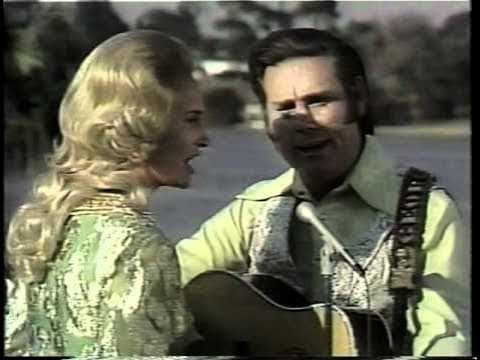
A fragile promise spoken in low voices, where love survives not by certainty but by effort
We’re Gonna Try to Get Along by George Jones and Tammy Wynette captures a moment in country music when honesty mattered more than polish and emotion outweighed perfection. Released in 1969, the song reached No. 11 on the Billboard Hot Country Singles chart, a modest chart position that belies its lasting emotional weight. While it never climbed to the very top, it became one of the most revealing duets in the long and complicated musical partnership between two voices who understood heartbreak not as an idea, but as lived experience.
Recorded during the early years of their marriage, We’re Gonna Try to Get Along feels less like a performance and more like a confession set to melody. Written by Glenn Sutton, a songwriter renowned for his ability to articulate emotional tension with restraint, the song avoids grand declarations. Instead, it focuses on something quieter and far more difficult: the decision to stay. The word “try” in the title is everything. It suggests uncertainty, effort, and vulnerability. There is no promise of victory here, only the resolve to keep going.
At the time of its release, George Jones was already widely regarded as one of the most expressive singers in country music, a vocalist whose phrasing could make even the simplest line feel deeply personal. Tammy Wynette, still early in her ascent, brought a clarity and emotional directness that balanced Jones’s rawness. When their voices meet in this song, there is no dominance. They share the space equally, as if neither can carry the burden alone.
The song arrived during a fertile period for country duets, yet it stood apart. Many male female collaborations of the era leaned toward playful banter or dramatic confrontation. We’re Gonna Try to Get Along chooses neither. It occupies the uneasy middle ground where love is no longer effortless but not yet lost. The lyric acknowledges misunderstandings, unspoken resentment, and emotional fatigue, yet it refuses to surrender. That tension gives the song its quiet power.
Musically, the arrangement is understated, allowing the emotional exchange to remain front and center. Gentle instrumentation supports the voices without ornamentation. There is space between the notes, room for the listener to breathe with the singers. This restraint mirrors the song’s message. Nothing is rushed. Nothing is forced. Even hope is expressed carefully.
Although the single peaked at No. 11, its cultural significance has grown over time, especially when viewed in the context of George Jones and Tammy Wynette’s later work. In hindsight, the song feels prophetic. It foreshadows both the triumphs and the struggles that would define their partnership, including later chart topping duets such as Golden Ring and We’re Gonna Hold On. But unlike those later successes, this song exists before the narrative was fully written, when belief still required effort.
The meaning of We’re Gonna Try to Get Along lies in its emotional realism. It does not romanticize conflict, nor does it promise resolution. Instead, it affirms that love can exist alongside doubt, that commitment sometimes means choosing patience over certainty. The singers do not convince each other. They reassure themselves.
For George Jones, the song highlights his ability to convey vulnerability without sentimentality. His voice carries hesitation and hope in equal measure. Tammy Wynette answers with steadiness rather than optimism, offering partnership instead of reassurance. Together, they sound like two people standing at the same crossroads, aware of the distance already traveled and uncertain of what lies ahead.
Decades later, We’re Gonna Try to Get Along remains quietly affecting. It endures because it tells a truth rarely spoken plainly: that love is not always about winning or losing, but about choosing to remain present when leaving would be easier. In the history of classic country music, few songs capture that moment with such grace and honesty.