
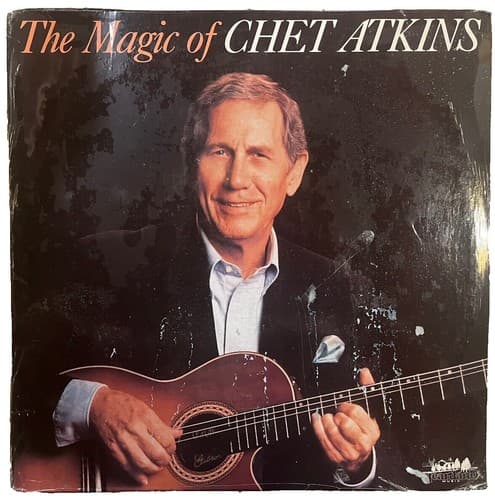
A graceful meeting of jazz elegance and country refinement, where guitar strings whisper the language of memory and quiet sophistication.
When Chet Atkins recorded “The Jitterbug Waltz” for his 1970 album Pickin’ My Way, he was not merely revisiting a jazz standard—he was gently reshaping it through the lens of a lifetime devoted to tone, taste, and touch. The album reached No. 36 on the Billboard Top Country Albums chart in 1970, a respectable position for a largely instrumental record during a time when vocal-driven country hits dominated the airwaves. While “The Jitterbug Waltz” itself was not released as a charting single, its presence on the album stood as a subtle but powerful statement: that true musicianship transcends genre labels.
Originally composed in 1942 by Fats Waller, “The Jitterbug Waltz” was groundbreaking in its own right—a rare jazz piece written in 3/4 time, blending swing sensibilities with the lilting grace of a waltz. Waller’s version carried the buoyancy of Harlem stride piano, playful yet harmonically sophisticated. By the time Chet Atkins approached it nearly three decades later, the piece had already traveled through various interpretations. Yet in his hands, it found an entirely different voice—more restrained, more contemplative, and deeply personal.
The late 1960s and early 1970s were transitional years for Atkins. Having shaped the Nashville Sound as a producer at RCA, guiding artists like Elvis Presley and Jim Reeves toward crossover success, he was increasingly turning inward as a recording artist. Pickin’ My Way feels like a deliberate step away from commercial expectations. It is an album built on nuance rather than novelty. And within that quiet framework, “The Jitterbug Waltz” becomes a moment of understated brilliance.
Atkins’ interpretation does not attempt to replicate the stride exuberance of Waller’s piano. Instead, he translates the harmonic richness onto nylon and steel strings with remarkable clarity. His famous fingerstyle technique—alternating bass lines played by the thumb while fingers articulate melody and inner harmonies—creates the illusion of two or three musicians conversing at once. There is no flash for its own sake. Every phrase feels measured, considered, almost reverent.
What makes this rendition so affecting is its emotional shading. The waltz rhythm sways gently, but there is a reflective undertone beneath the surface charm. Atkins seems less interested in the “jitterbug” exuberance implied by the title and more drawn to the piece’s melodic architecture. The melody unfolds like a recollection—familiar, slightly wistful, tinged with a sense of time passing.
One must remember that by 1970, popular music had grown louder, more electric, more confrontational. Psychedelic rock and arena anthems were redefining mainstream taste. Against that backdrop, Chet Atkins offered something profoundly different: intimacy. Listening to his version of “The Jitterbug Waltz” feels almost like stepping into a quiet room away from the noise of the world. The notes breathe. Silences matter.
There is also something symbolic in Atkins choosing this particular composition. Fats Waller represented a golden era of American popular music—an age of craftsmanship, melody, and sophisticated harmony. By interpreting Waller, Atkins was, in a sense, paying homage to an earlier generation of masters. It was a bridge between traditions: African American jazz innovation meeting Southern country refinement, united by mutual respect for songcraft.
Critics at the time often praised Atkins for his technical precision, but technique alone does not explain the enduring appeal of performances like this. What lingers is the warmth. The tone of his guitar—clear yet rounded—carries a human quality that resists aging. Decades later, it still feels immediate.
In the end, “The Jitterbug Waltz” as rendered by Chet Atkins is not about virtuosity, though there is plenty of it. It is about continuity. About honoring the past while speaking in one’s own voice. It reminds us that great melodies survive because they invite reinterpretation, and that true artistry lies not in overpowering a song, but in listening to what it already contains.
As the final notes fade, one senses not a performance concluded, but a conversation gently paused—ready to be resumed whenever the needle returns to the groove.