
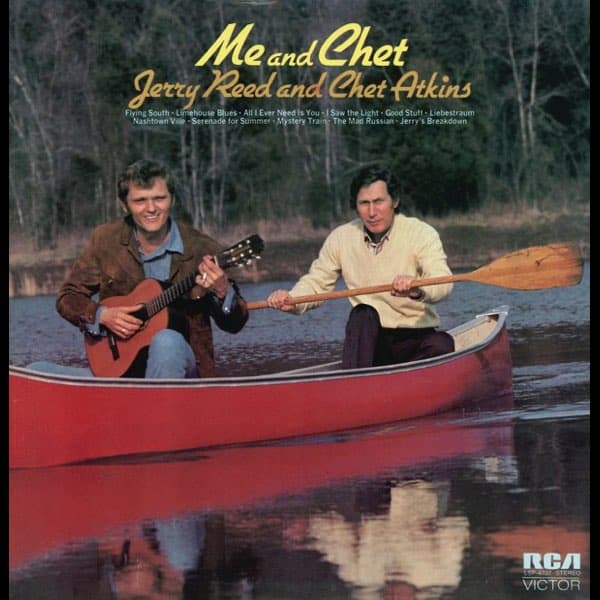
A warm, unhurried reflection on gratitude and craftsmanship, where every note feels like a lifetime distilled into melody.
When Chet Atkins released “Good Stuff” in 1988 as the title track of his album Chet Atkins, C.G.P. – Good Stuff, he was not chasing charts or trends. He was reaffirming a philosophy. The album climbed to No. 17 on the Billboard Top Country Albums chart—an impressive showing for an instrumental guitar record at a time when country music was leaning heavily toward vocal-driven commercial hits. More significantly, the album earned Chet Atkins the 1989 Grammy Award for Best Country Instrumental Performance, a testament not only to the title track but to the enduring respect he commanded within the industry.
By the late 1980s, Atkins had already spent decades shaping the very sound of Nashville. As a producer, executive, and guitarist, he had defined the “Nashville Sound” in the late 1950s and 1960s, smoothing the raw edges of country music into something that could sit comfortably on mainstream radio. Yet with “Good Stuff,” he returned to something more intimate—less concerned with commercial polish and more focused on musical conversation, tone, and the quiet confidence of mastery.
The title itself is deceptively simple. “Good stuff” can mean the essentials in life—the moments, the friendships, the craft honed over years. In the hands of Chet Atkins, it becomes almost philosophical. The track unfolds with his signature fingerstyle technique, that seamless blend of bassline, melody, and gentle harmonic shading all played simultaneously. There is no rush in the phrasing. Each note seems chosen with care, allowed to bloom and then gently fade, as if he were savoring the sound.
Behind the recording lies an artist comfortable in his own legacy. By this point, Atkins had earned the honorary designation “C.G.P.” (Certified Guitar Player), a playful yet telling acknowledgment of his stature among fellow musicians. He bestowed that title sparingly on others, but it was first and foremost a quiet badge of honor he carried himself. On Good Stuff, the tone is relaxed, almost conversational. One senses a musician who no longer needs to prove anything—only to express.
What makes “Good Stuff” resonate so deeply is its restraint. In an era increasingly driven by production gloss and digital precision, Atkins leaned into warmth. The guitar sounds organic, almost tactile. You can imagine the wood of the instrument resonating against his chest, the subtle shift of fingers along the fretboard. There is a humanity in the slight variations of tempo, the gentle sway that refuses to be mechanized. It feels lived-in.
Emotionally, the piece carries a reflective quality. It does not soar dramatically nor plunge into melancholy. Instead, it rests in a space of gratitude. The melody suggests contentment—not complacency, but the kind of peace that comes after decades of striving. It is the sound of someone looking back not with regret, but with appreciation for the journey.
Critically, Chet Atkins, C.G.P. – Good Stuff was seen as a reaffirmation of Atkins’ artistry at a time when newer guitar heroes were capturing headlines. Yet none could quite replicate his balance of technique and taste. Many could play faster; few could say more with less. That was always his gift. And on “Good Stuff,” he demonstrates that virtuosity is not about velocity—it is about voice.
Listening now, decades later, the track feels like an old friend dropping by for a quiet evening. There is no spectacle, no grand statement—just melody, harmony, and a sense of ease earned through experience. In a world that often confuses noise with substance, Chet Atkins offered something different: a reminder that the “good stuff” in music, as in life, is rarely loud. It is steady. It is sincere. And it lingers long after the final note fades.