
A Tender Confession of Regret and Responsibility in the Quiet After Love Fades
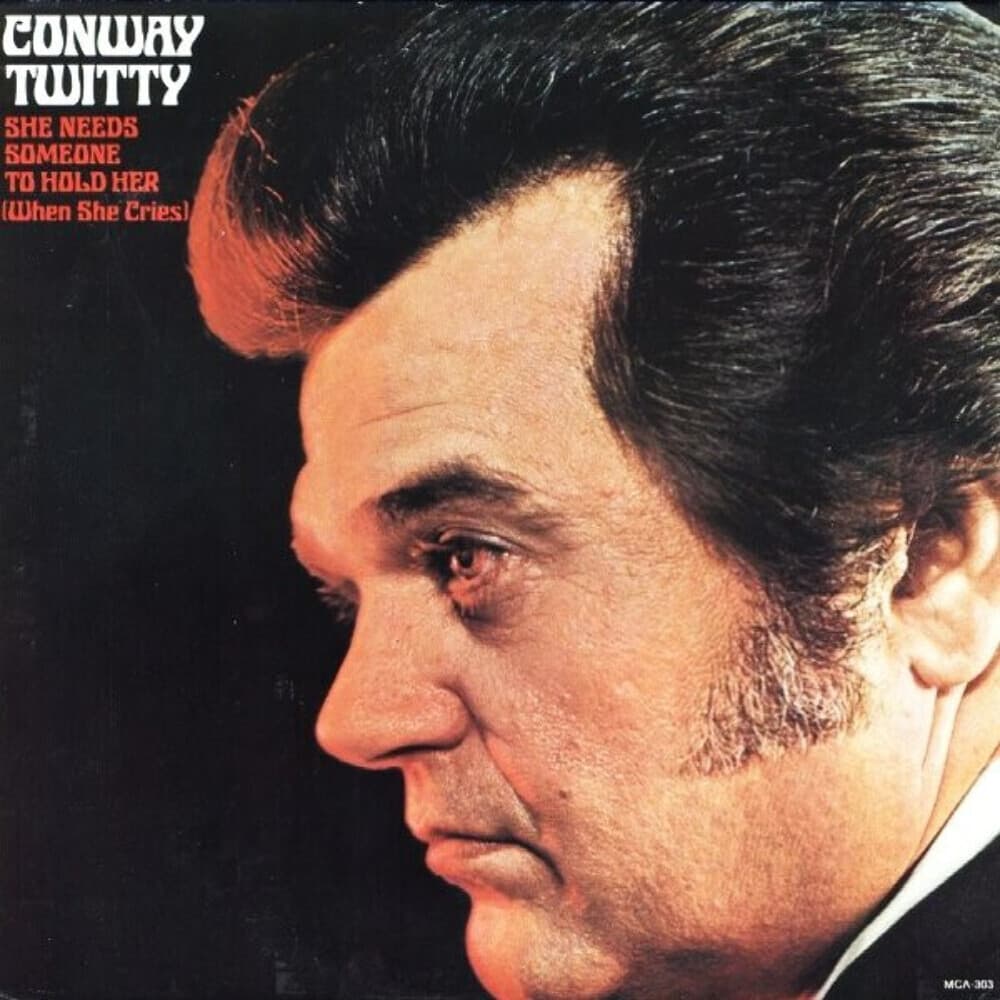
When “She Needs Someone to Hold Her (When She Cries)” was released in 1971, it became yet another defining moment in the remarkable career of Conway Twitty, one of country music’s most enduring voices of heartbreak and devotion. The song climbed to No. 1 on the Billboard Hot Country Singles chart in early 1971, further solidifying Twitty’s dominance during a period when his baritone seemed to echo from every jukebox across America. Included on the album How Much More Can She Stand, the single reaffirmed his extraordinary connection with listeners who found in his voice a mirror for their own private sorrows.
By the early 1970s, Conway Twitty had already completed one of the most fascinating transformations in popular music. Once a rock and roll artist known for “It’s Only Make Believe,” he had seamlessly reinvented himself as a country storyteller of rare emotional precision. But reinvention alone does not guarantee longevity. What secured his place was sincerity — and “She Needs Someone to Hold Her (When She Cries)” stands as a masterclass in restrained vulnerability.
The song itself is deceptively simple. Written by Conway Twitty and Carmol Taylor, it unfolds as a confession — not of anger, not of betrayal, but of regret. The narrator recognizes that the woman he loves is suffering because of his own emotional absence. There is no melodrama, no soaring orchestral climax. Instead, there is the steady ache of realization. Twitty does not raise his voice; he lowers it, allowing space between phrases as if each word must travel through memory before reaching the present moment.
That quiet space is where the song truly lives.
“She Needs Someone to Hold Her” speaks to a universal truth: love can wither not through grand betrayals, but through neglect — through silence, through pride, through the small distances that accumulate unnoticed. In this way, the song feels less like a performance and more like a late-night admission spoken across a kitchen table long after the argument has ended. Twitty’s phrasing carries a maturity that refuses self-pity. He does not plead for forgiveness; he simply acknowledges the cost of emotional distance.
Musically, the arrangement is classic early-1970s Nashville — gentle steel guitar weeping softly behind a measured rhythm section, subtle background harmonies cushioning Twitty’s lead. The production never overwhelms the lyric. Instead, it frames it, much like a photograph carefully placed in a worn album. There is warmth in the recording, a warmth that feels analog, unpolished, human.
It is worth remembering that in 1971, country music was navigating change. The polished “Countrypolitan” sound was dominant, yet artists like Twitty managed to balance refinement with authenticity. “She Needs Someone to Hold Her” does precisely that. It is polished, yes — but never artificial. The emotion feels lived-in.
For many, the song evokes images of long drives beneath open skies, of radios glowing softly in dim rooms, of moments when pride finally gives way to understanding. Twitty had a rare gift: he sang about responsibility in love, not merely desire. That distinction matters. In an era often defined by bravado, he offered reflection.
Over the decades, countless country ballads have explored heartbreak. Yet few carry the same quiet dignity as this recording. It does not dramatize suffering; it humanizes it. And perhaps that is why it resonated so strongly upon release, rising to the top of the charts and embedding itself into the emotional memory of its time.
Listening now, more than half a century later, one can still feel the stillness between the lines. Conway Twitty does not simply sing about holding someone when she cries — he reminds us that love requires presence, tenderness, and humility. The song lingers not because it shouts, but because it understands.
In the end, “She Needs Someone to Hold Her (When She Cries)” stands as a testament to Twitty’s enduring artistry: a gentle, honest portrait of love’s fragile responsibility, delivered by a voice that knew exactly how to carry regret without losing grace.
 Oldies Songs