
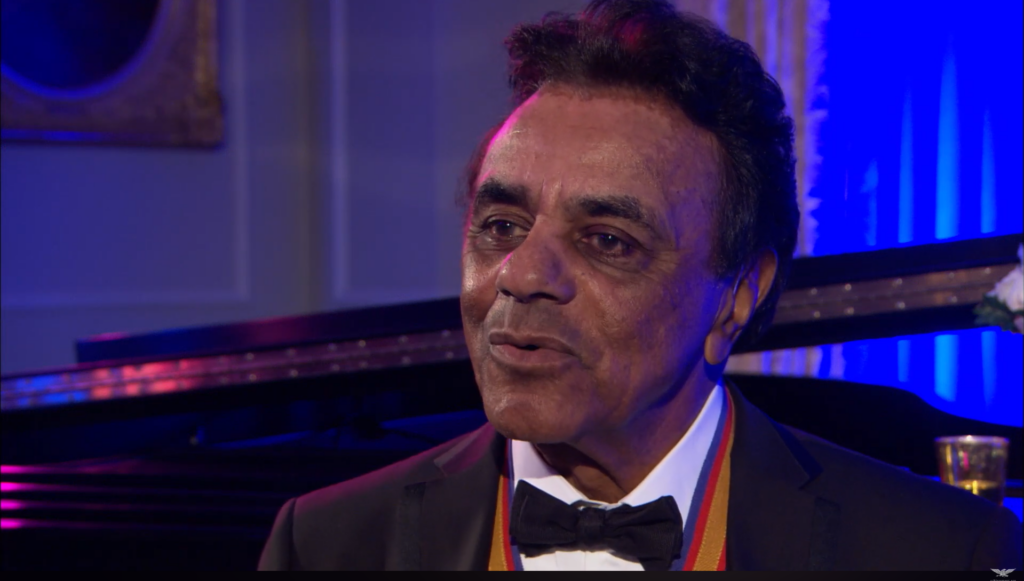
A Voice That Time Could Not Tarnish — Grace, Longevity, and the Art of Romance
When Johnny Mathis sat down for his Academy Class of 2011 Full Interview, it was not merely another retrospective conversation—it was the living testimony of one of the most enduring voices in American popular music. By 2011, Mathis had already spent more than five decades in the spotlight, his career beginning in the mid-1950s and flourishing through eras that saw rock ’n’ roll, soul, disco, and digital pop rise and fall. Yet through it all, his velvet tenor remained unmistakable—refined, romantic, and remarkably intact.
To understand the significance of that 2011 interview, one must revisit the astonishing commercial achievements that defined Mathis’s early years. His breakthrough came with “Chances Are” (1957), which climbed to No. 1 on the Billboard Most Played by Jockeys chart and No. 2 on the Billboard Top 100. That same year, “It’s Not for Me to Say” reached No. 5 on the Billboard Top 100. But perhaps his most extraordinary chart accomplishment was the album Johnny’s Greatest Hits (1958), which spent an unprecedented 490 consecutive weeks—nearly ten years—on the Billboard album chart. It was a record that stood as a benchmark of consistency and devotion from listeners, long before the age of streaming metrics and viral fame.
During the Academy Class of 2011 Full Interview, Mathis reflected not with bombast but with humility. There was no sense of self-mythologizing. Instead, he spoke about discipline, about his early training as a high jumper in San Francisco, and how that athletic rigor informed his vocal control. He often credited his father for nurturing his musical gifts, insisting on classical lessons that would later give his phrasing its signature polish. Listening to him recount those early days felt like opening a carefully preserved scrapbook—each page revealing quiet determination rather than overnight stardom.
What has always distinguished Johnny Mathis is not simply vocal purity, but emotional intelligence. Songs like “Misty” (which reached No. 12 on the Billboard Hot 100 in 1959) and “Wonderful! Wonderful!” (No. 14 in 1957) were not delivered with theatrical excess. Instead, they unfolded with restraint, allowing melody and sentiment to breathe. In the interview, Mathis discussed his reverence for the Great American Songbook, for composers such as Gershwin and Kern. He approached each lyric as literature, each melody as architecture. That respect is audible in every sustained note.
By 2011, the music industry had transformed beyond recognition from the one that welcomed him in 1956. Yet Mathis remained active, touring consistently and recording new material. Few artists from the pre-Beatles era maintained such continuity. In fact, his holiday albums—especially Merry Christmas (1958)—continued to re-enter seasonal charts decades after their release, a testament to how deeply his interpretations became woven into cultural memory.
The emotional core of the 2011 conversation was not nostalgia for fame, but gratitude for longevity. Mathis spoke about audiences who had grown alongside his music, about performing songs that had accompanied engagements, weddings, reconciliations. There was an unspoken understanding that certain voices become markers of time itself. When he described stepping onto a stage and sensing immediate warmth from the crowd, it felt less like celebrity adoration and more like reunion.
There is something profoundly reassuring about artists who endure not by reinvention alone, but by steadfast authenticity. In an age when trends can feel fleeting, Johnny Mathis represents continuity. His interview in 2011 was not a curtain call—it was a reaffirmation of purpose. The same clarity that carried “Chances Are” to the top of the charts in 1957 still resonated more than half a century later.
Watching that full interview today, one is struck by the elegance of his demeanor. No bitterness. No grand proclamations. Only a quiet pride in craftsmanship and a deep affection for the songs that shaped his life. And perhaps that is the true legacy revealed in that Academy conversation: not merely chart positions or gold records, but the enduring power of a voice that chose tenderness over trend, melody over noise, and sincerity over spectacle.
In the end, the charts tell part of the story. The rest lives in memory—in the way a single sustained note from Johnny Mathis can still hush a room, even decades after it first floated across the airwaves.