
A Gentle Meditation on Comfort and Quiet Strength in Times of Trouble
When “Why Worry” was first introduced to the world in 1982 on Love Over Gold by Dire Straits, it was never meant to be a chart-storming single. The album itself reached No. 1 on the UK Albums Chart and No. 19 on the US Billboard 200, but “Why Worry” was not released as a major commercial single. Instead, it settled into something far more enduring: a whispered reassurance, a late-night companion, a hymn for weary hearts. Written by Mark Knopfler, the song stood apart even within an album already marked by its expansive arrangements and brooding introspection.
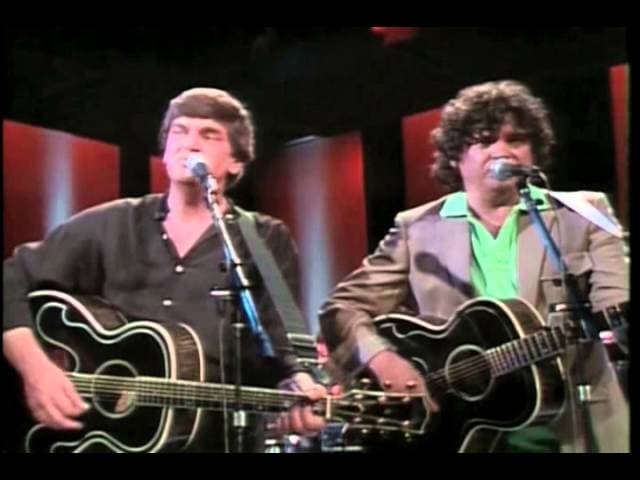
Years later, when Chet Atkins, Mark Knopfler, and The Everly Brothers came together in performance to revisit “Why Worry,” the song took on an added layer of grace and generational resonance. By then, it was no longer simply a Dire Straits composition; it had become a meeting place for masters—artists whose careers had shaped the soundscape of the 1950s, ’60s, and ’70s. In their hands, the song felt less like a pop ballad and more like a fireside conversation between old friends who had seen the world change more than once.
The origins of “Why Worry” reveal much about Knopfler’s songwriting temperament. Unlike the driving pulse of “Money for Nothing” or the cinematic sprawl of “Telegraph Road,” this piece was hushed, almost fragile. Built around a gentle fingerpicked guitar pattern, it drew heavily on country and folk influences—territory that Chet Atkins had long since mastered. Atkins, known as “Mr. Guitar,” was instrumental in shaping the Nashville Sound, smoothing country music into something that could cross over to mainstream audiences. His touch on the strings was always economical, never wasteful. When he interpreted “Why Worry,” one could hear how naturally the melody fit his style. It was as though the song had been waiting for him.
And then there were The Everly Brothers, whose harmonies defined an era. Long before stadium rock and digital production, Don and Phil Everly had demonstrated how two voices intertwined could express longing, regret, and devotion with disarming simplicity. On “Why Worry,” their vocal sensibility—whether directly present in performance or spiritually echoed in arrangement—seemed to underline the song’s central promise: that love, steadfast and patient, can be a shelter against life’s inevitable storms.
Lyrically, “Why Worry” is almost deceptively simple. “Baby, I see this world has made you sad…” With that opening line, Knopfler establishes a mood of intimate empathy. The song does not deny hardship; it acknowledges it plainly. Yet it refuses to be defeated by it. The refrain—“Why worry? There should be laughter after pain”—carries a quiet authority. It is not naïve optimism. It is the voice of someone who has endured enough to understand that sorrow passes, that healing often arrives in small, unannounced ways.
In the broader arc of popular music history, “Why Worry” stands as an example of how restraint can be more powerful than spectacle. At a time when the early 1980s were increasingly defined by synthesizers and bombast, this song leaned into space and silence. That choice was brave. It asked listeners to slow down, to reflect. And when artists like Chet Atkins and Mark Knopfler shared the stage with legends such as The Everly Brothers, the performance became more than nostalgia—it became continuity. A reminder that musical traditions do not disappear; they evolve, carried forward by those who understand their roots.
There is something profoundly moving about seeing musicians of such stature gather around a song built on reassurance. It feels like an unspoken acknowledgment that behind every glittering career lies vulnerability. “Why Worry” does not demand attention. It does not roar. Instead, it sits beside you quietly, offering a steady hand.
Over the decades, many songs have climbed higher on the charts, sold more copies, or generated louder applause. Yet few have aged with the same quiet dignity. In revisiting “Why Worry,” these artists were not chasing past glory. They were honoring a truth that transcends trends: that music, at its most sincere, is an act of comfort.
And perhaps that is why the song endures. Because long after the lights fade and the amplifiers cool, what remains is that gentle promise—whispered through six strings and close harmonies—that no darkness is permanent, and that love, in its simplest form, is reason enough not to worry.