
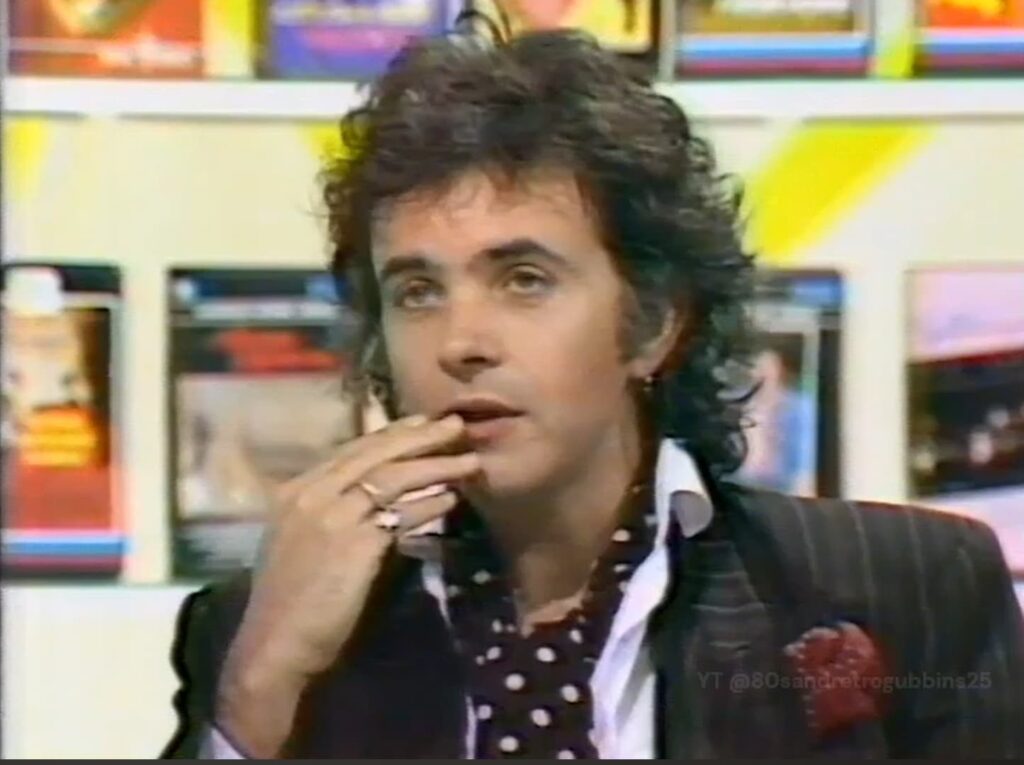
A Voice Between Glamour and Reflection: David Essex Looks Back in The Video Age (ITV, 22/12/1982)
On 22 December 1982, British television audiences tuning into ITV were given something more valuable than a seasonal special or another glittering performance. They were offered a conversation — thoughtful, unguarded, and quietly revealing — with one of Britain’s most distinctive pop figures: David Essex. The program, titled The Video Age, was not a chart event and did not carry a ranking position like his hit singles once did. Yet in its own way, it marked a different kind of milestone: a reflective pause in the career of a man who had once dominated the UK singles chart and teenage bedrooms alike.
By the time of this interview, David Essex was nearly a decade removed from the seismic success of “Rock On”, the haunting 1973 single that reached No. 3 on the UK Singles Chart and climbed to No. 5 on the US Billboard Hot 100 in 1974. That sparse, echo-drenched track — driven by rhythm rather than melody — had redefined his image from pop idol to serious recording artist. It was followed by the irresistible “Gonna Make You a Star,” which soared to No. 1 in the UK in late 1974, confirming that his appeal was not a passing infatuation but a genuine cultural moment.
But by 1982, the musical landscape had shifted. MTV had launched in the United States the previous year. The visual component of pop music was no longer optional — it was central. Artists were navigating what many saw as a new frontier, where charisma had to translate not just on vinyl or radio waves, but through the camera lens. That was precisely the tension explored in The Video Age. The interview was less about promoting a single and more about examining the changing identity of the pop performer.
Essex had always been something of a paradox. He emerged in the early 1970s amid the glam rock explosion, sharing an era with names like David Bowie and Marc Bolan, yet his persona was less theatrical, more grounded in earnest romanticism. His role in the stage production of Godspell in 1971 had already signaled a performer comfortable with both narrative and music. Unlike many teen idols of the era, he wrote much of his own material, lending his hits a personal stamp that resonated beyond surface glamour.
In the ITV interview, what struck viewers most was not nostalgia, but clarity. Essex spoke candidly about fame — about how sudden adoration could both elevate and isolate. He reflected on the machinery behind pop success, acknowledging that timing, image, and media exposure could amplify a song just as much as its melody. Yet there was no bitterness in his tone. Instead, there was a seasoned understanding — the kind that only distance can provide.
The program also served as a meditation on the meaning of longevity in popular music. Essex’s career had already spanned acting, stage performance, and recording, and he had navigated the fickle tides of public taste. His later hit “A Winter’s Tale” in 1982 — released just months before the interview — reached No. 2 on the UK Singles Chart, proving that he could still command the charts nearly a decade after his breakthrough. The song’s sweeping orchestration and nostalgic lyricism felt almost prophetic in the context of the interview: a reminder that reflection itself can be powerful.
There is something quietly moving about watching an artist at mid-career speak not with bravado, but with measured introspection. In an age increasingly obsessed with immediacy and spectacle, Essex’s calm demeanor stood in contrast to the frenetic energy of early-80s pop culture. He did not resist the “video age,” but neither did he surrender to it. He seemed to understand that the core of music — the story, the emotion, the human voice — must endure beyond formats and fashions.
Looking back, that December 1982 broadcast feels less like a promotional appearance and more like a time capsule. It captured a transitional moment — not only for David Essex, but for popular music itself. The era of vinyl dominance was giving way to a visual revolution, yet the heart of the singer-songwriter tradition remained intact in voices like his.
For those who remember the thrill of hearing “Rock On” crackle through a transistor radio, or the warmth of “A Winter’s Tale” drifting across winter evenings, this interview offered reassurance. It reminded us that behind every hit record is a thinking, feeling individual — someone navigating the same passage of time as the rest of us.
And perhaps that is the enduring meaning of The Video Age interview. Not merely a discussion about music videos, but a quiet affirmation that artistry, when rooted in sincerity, survives every technological shift.