
A Tender Confession of Choice and Consequence in the Golden Age of Teen Pop
When “It’s Up to You” was released in 1977, it arrived at the very height of Shaun Cassidy’s meteoric rise—an era when his name alone could ignite radio playlists and send vinyl sales soaring. The single climbed to No. 25 on the Billboard Hot 100 in early 1978, a respectable showing in a fiercely competitive pop landscape. It followed the extraordinary success of “Da Doo Ron Ron” (US No. 1, 1977) and “That’s Rock ’n’ Roll” (US No. 3, 1977), both from his self-titled debut album, Shaun Cassidy, which itself reached No. 3 on the Billboard 200 and was certified multi-platinum. While “It’s Up to You” did not scale those same dizzying chart heights, it revealed something more nuanced: a maturing voice beginning to navigate the fragile territory between youthful infatuation and emotional responsibility.
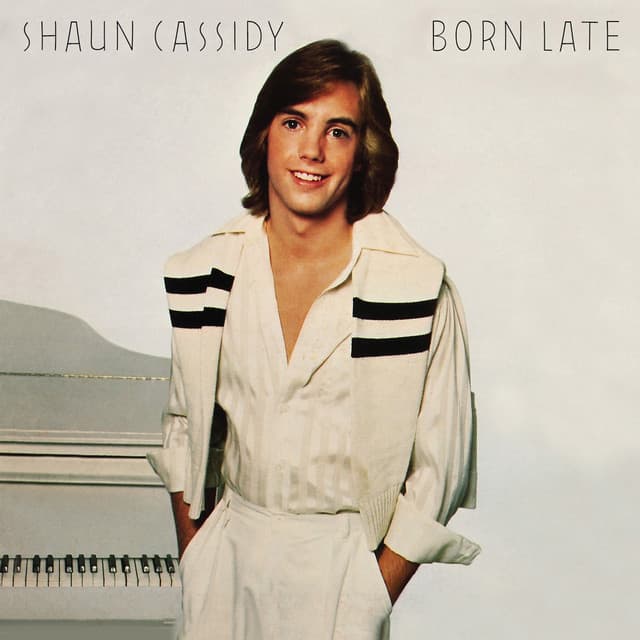
By the late 1970s, Shaun Cassidy had become one of the defining teen idols of the decade. With his tousled blond hair and effortless charm, he was often compared to earlier pop heartthrobs, yet his success was rooted in a lineage deeply musical. As the son of Tony Award-winning actor Jack Cassidy and Academy Award-winning actress Shirley Jones, and the half-brother of David Cassidy of The Partridge Family fame, Shaun was born into performance. But lineage alone does not create resonance. What distinguished him was his instinct for melody and his ability to convey vulnerability within the tight structure of radio-friendly pop.
“It’s Up to You” is built on that vulnerability. Unlike the exuberant, almost celebratory energy of “Da Doo Ron Ron,” this track carries a reflective undercurrent. The lyrics revolve around romantic uncertainty—the delicate moment when one person places the decision for love squarely in another’s hands. There is no bravado here. No grand promises. Instead, there is a quiet admission: the future of the relationship depends on mutual choice. That sentiment, deceptively simple, speaks to a universal human crossroads.
Musically, the song embodies the polished craftsmanship of late-1970s pop production. Produced by Michael Lloyd—who was instrumental in shaping Cassidy’s early sound—the arrangement blends crisp percussion, buoyant guitar lines, and layered harmonies that soften the edges of adolescent longing. Lloyd understood how to frame Cassidy’s youthful tenor without overwhelming it. The instrumentation supports rather than competes, allowing the emotional center of the song to remain intact.
It is worth remembering that 1977 was a year of shifting musical tides. Disco was ascending rapidly, punk was challenging establishment norms, and arena rock was expanding in scale and ambition. Within that vibrant, sometimes chaotic environment, Shaun Cassidy occupied a specific cultural space: melodic pop rooted in the traditions of 1960s rock ’n’ roll but updated for contemporary tastes. His choice to record covers like “Da Doo Ron Ron” showed reverence for earlier eras, while songs like “It’s Up to You” hinted at a desire to step beyond revivalism and into personal storytelling.
The deeper meaning of “It’s Up to You” lies not only in its lyrics but in its timing within Cassidy’s career. At a moment when adoration could easily inflate ego, the song expresses humility. It acknowledges that love cannot be commanded—it must be chosen freely. That message carries a quiet dignity. In retrospect, it feels almost prophetic, considering how swiftly teen idol fame can crest and recede. Cassidy himself would later pivot toward songwriting and theatrical work, stepping away from the narrow confines of pop stardom to pursue creative control.
Listening now, decades removed from its original chart run, one hears more than a late-1970s single. One hears a snapshot of a particular cultural innocence—a time when a three-minute pop song could still capture the flutter of uncertainty with sincerity. The production may reflect its era, but the emotional truth remains untouched by time.
There is something profoundly moving about revisiting “It’s Up to You.” It reminds us that beneath the posters, the screaming crowds, and the Billboard rankings, there was a young artist grappling with the same questions that echo through every generation: Who chooses whom? What happens when we leave our hearts in someone else’s hands? And how do we grow when the answer is uncertain?
In that gentle admission—“it’s up to you”—lies both vulnerability and strength. And perhaps that is why the song endures quietly in memory, long after the charts have turned their pages.