
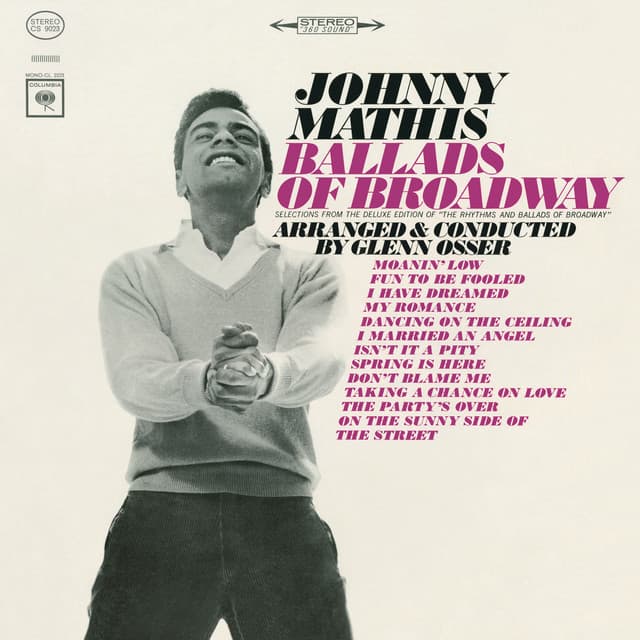
A Lighthearted Dream of Love — “I Married an Angel” Shows the Elegant Charm and Playful Romance of Johnny Mathis
Among the many songs that showcase the gentle sophistication of Johnny Mathis, the delightful standard “I Married an Angel” holds a special place. The song carries the graceful charm of classic American songwriting while allowing Mathis’s unmistakably warm voice to glide through a melody that feels both playful and deeply romantic. Though it may not be one of his most famous chart hits, “I Married an Angel” beautifully reflects the timeless musical style that made Mathis one of the most beloved interpreters of romantic songs in the twentieth century.
The song itself has an interesting history that reaches back long before Johnny Mathis recorded it. “I Married an Angel” was originally written in 1938 by the legendary songwriting team Lorenz Hart and Richard Rodgers for the Broadway musical I Married an Angel. The show premiered that same year, offering audiences a whimsical romantic story built around the imaginative idea of a man who falls in love with a celestial being. As with many songs created by Rodgers and Hart, the composition blended clever lyric writing with a graceful melody that could move easily between theatrical performance and popular recording.
By the time Johnny Mathis brought his voice to “I Married an Angel,” the song had already become part of the rich tradition of American popular standards. Mathis had spent much of his career exploring exactly this kind of material—songs that required not only vocal skill but also emotional sensitivity and interpretive finesse.
At this stage of his career, Johnny Mathis was already one of the most successful vocalists in popular music history. His breakthrough recording “Chances Are” had reached No. 1 on the Billboard Most Played by Jockeys chart in 1957 and No. 2 on the Billboard Top 100, launching him into international stardom. Soon after, his unforgettable interpretation of “Misty” became another signature performance, peaking at No. 12 on the Billboard Hot 100 in 1959 and earning a permanent place among the great vocal recordings of the era.
Those successes helped establish Mathis as a master of romantic ballads, a reputation he maintained through decades of recordings with Columbia Records, one of the longest artist-label partnerships in the history of popular music. Throughout the 1960s and 1970s, he continued to release albums that regularly appeared on the Billboard 200 and Adult Contemporary charts, proving that his style remained deeply appreciated even as musical trends evolved.
When Johnny Mathis sings “I Married an Angel,” the song takes on a slightly different atmosphere from its theatrical origins. In the Broadway production, the lyric carried a playful narrative tone, reflecting the whimsical storyline of the musical. Mathis, however, transforms the piece into something more intimate. His interpretation softens the theatrical edges and highlights the romantic imagery at the heart of the lyric.
The idea of marrying an angel, of course, is not meant to be taken literally. It functions as a poetic expression of devotion—the feeling that someone is so kind, so radiant, that they seem almost otherworldly. In the tradition of classic American songwriting, such imagery allowed lyricists to describe love in imaginative ways that felt both charming and emotionally sincere.
Musically, the arrangement surrounding Mathis’s recording emphasizes elegance and warmth. Gentle orchestral strings provide a soft cushion beneath the melody, while the rhythm moves with relaxed grace. This style of orchestral pop became closely associated with Johnny Mathis, particularly in the many albums he recorded during the golden era of vocal standards.
What makes his interpretation so memorable is the ease with which he navigates the melody. Mathis never appears to strain for emotional effect. Instead, he allows the beauty of the song itself to shine through subtle phrasing and smooth vocal tone.
Listening to “I Married an Angel” today feels like stepping into a quieter musical world—one where romance was expressed with wit, elegance, and a touch of playful imagination. The song carries a sense of timeless optimism, suggesting that love, when genuine, can feel almost miraculous.
As the final notes fade, the listener is left with the gentle impression that perhaps the lyric is not so exaggerated after all. After all, anyone who has truly fallen in love has likely experienced that same feeling—that for a moment, the ordinary world seemed touched by something heavenly.
And through the graceful voice of Johnny Mathis, that feeling continues to echo softly across the decades.