
A Quiet Ballad Beneath the Glam, Where Love Glows Softly Beyond the Noise of Stardom
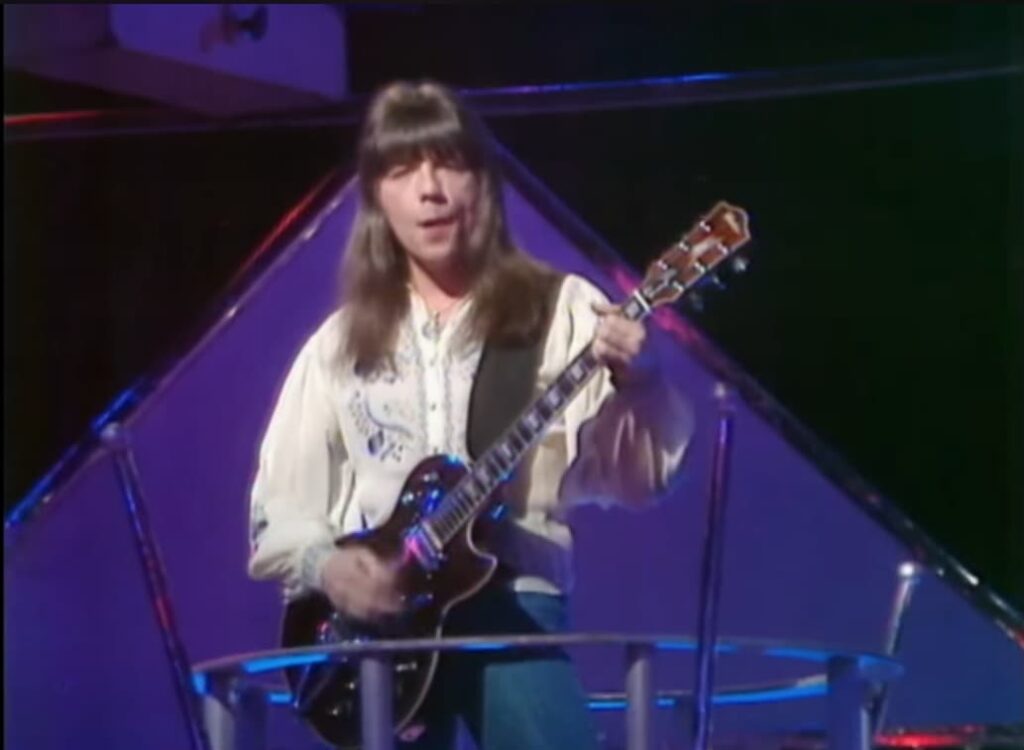
On December 13, 1975, during an appearance on the iconic British television program Supersonic, Sweet, led in this moment by guitarist Andy Scott, offered something unexpected to their audience—“Lady Starlight”, a song that stood in stark contrast to the glittering, high-energy image that had defined much of their success. Known for chart-dominating hits like “Ballroom Blitz” (No. 5 UK, No. 5 US) and “Fox on the Run” (No. 2 UK, No. 5 US), Sweet had built a reputation on bold, electrified glam rock. But “Lady Starlight”, originally released on the 1974 album “Desolation Boulevard”, revealed a different dimension—one that felt quieter, more introspective, and deeply human.
Unlike their major singles, “Lady Starlight” was not released as a standalone chart hit, and therefore did not achieve a specific ranking on the UK Singles Chart or the Billboard Hot 100. Yet its presence within “Desolation Boulevard”, an album that reached No. 2 in the UK Albums Chart, ensured that the song found its place among listeners who were willing to look beyond the band’s more explosive sound. It became, over time, one of those understated pieces that linger—not because of commercial success, but because of emotional resonance.
Written by Andy Scott, the song carries a sense of personal reflection that feels almost at odds with the flamboyant world of glam rock. Where Sweet’s more famous tracks thrive on rhythm, spectacle, and immediacy, “Lady Starlight” unfolds slowly, almost hesitantly, as though aware that its strength lies in restraint. The arrangement is delicate—soft guitar lines, minimal orchestration, and a vocal delivery that avoids excess in favor of sincerity.
The performance on Supersonic in December 1975 adds another layer of meaning. Television appearances during that era often demanded energy and visual impact, yet here was Andy Scott presenting a song that seemed to turn inward rather than outward. There is something quietly striking about that choice. It suggests a desire to show not just the public image of Sweet, but the emotional depth that existed beneath it.
At its core, “Lady Starlight” is a song about admiration—about seeing someone not just as they appear, but as they are. The title itself carries a certain poetic ambiguity. “Starlight” suggests distance, something beautiful yet far away, while “lady” brings it back to something intimate, personal, and real. The song moves gently between these two ideas, as though trying to reconcile the difference between idealization and genuine connection.
Listening closely, one can sense that this is not a love song in the conventional sense. It does not declare or demand. Instead, it observes. It reflects. There is a quiet acceptance within its lines, an understanding that not all feelings need resolution to be meaningful. In this way, the song feels less like a moment of passion and more like a moment of recognition—an awareness of something beautiful that may not fully belong to the singer, yet still leaves a lasting impression.
What makes “Lady Starlight” particularly enduring is its contrast within Sweet’s catalog. In a body of work often associated with glam rock’s theatricality, this song stands apart as something more grounded. It reminds us that even within the brightest, most amplified moments of an artist’s career, there are quieter truths waiting to be expressed.
Over time, performances like the one on Supersonic have taken on a kind of reflective quality. Watching it now, there is a sense of looking back not just at a band, but at an era—a time when music could shift so effortlessly between spectacle and subtlety. The audience, perhaps expecting another burst of glam energy, was instead given something more enduring: a moment of stillness.
In the end, “Lady Starlight” is not defined by chart success or widespread recognition. Its significance lies in its ability to reveal a different side of Sweet, and of Andy Scott as a songwriter. It shows that beneath the surface of fame and performance, there exists a quieter space where music becomes less about impressing and more about expressing.
And in that space, the song continues to glow—softly, steadily, like starlight that does not fade, but simply waits to be noticed.