
A song about love that lifts you up, then quietly takes the air away—“Love Is Like Oxygen” reveals how something essential can also become overwhelming
By March 1978, Sweet had already lived through the brightest rise of glam rock and begun navigating the quieter, more uncertain phase that followed. It was during this period that they released “Love Is Like Oxygen,” a single that would become one of their most enduring and musically ambitious works. Unlike the explosive immediacy of their earlier hits, this song carried a different weight—more reflective, more expansive, and in many ways, more revealing.
Commercially, the song marked a significant success. “Love Is Like Oxygen” reached No. 8 on the UK Singles Chart and climbed to No. 4 on the Billboard Hot 100 in the United States, making it one of Sweet’s biggest international hits. It also performed strongly across Europe, confirming that even as musical trends shifted, the band still possessed a remarkable ability to connect with a wide audience.
What made this track stand apart was not just its chart performance, but its structure. Written by Andy Scott and Trevor Griffin, the song departed from the concise, high-energy format that had defined much of Sweet’s earlier work. Instead, it unfolded in layers—beginning with a soft, almost hypnotic introduction before expanding into something more complex, incorporating progressive elements that were unusual for a band so closely associated with glam rock.
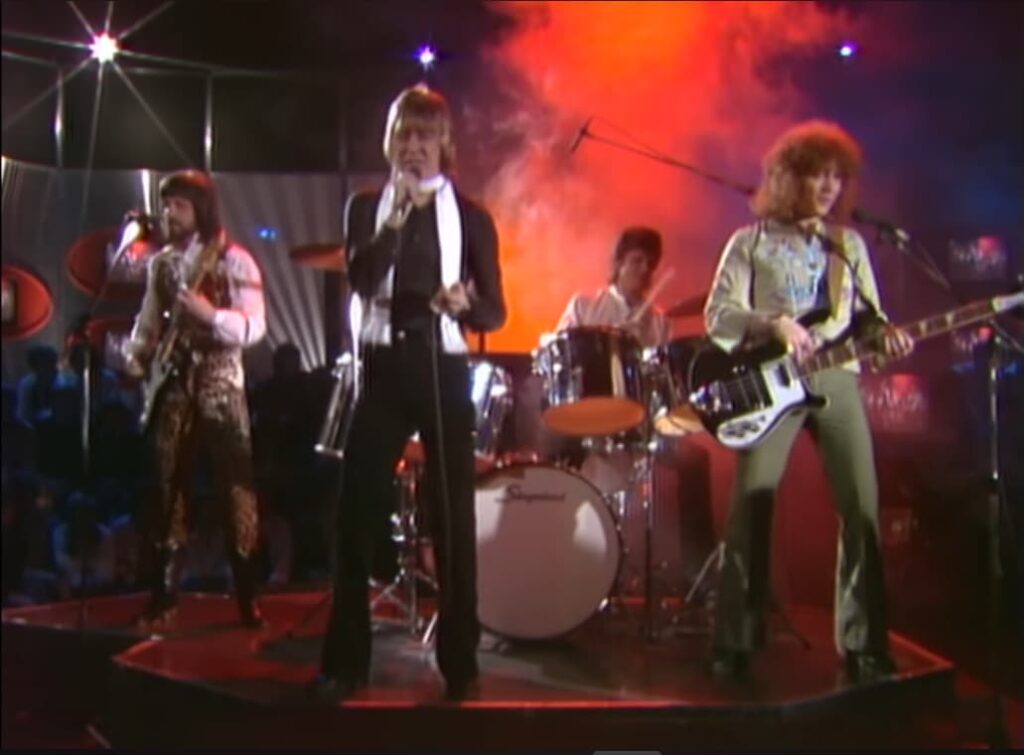
The performance of “Love Is Like Oxygen” on Disco on March 20, 1978, captures this transition with striking clarity. On that stage, there is a noticeable shift in presence. The flamboyance that once defined the band is still there, but it feels tempered, more controlled. The focus is no longer on spectacle alone—it has moved toward the music itself, toward the texture and depth of the sound.
At the center of it all is the voice, carrying a lyric that seems simple at first glance, yet unfolds into something far more nuanced. The line “love is like oxygen, you get too much, you get too high, not enough and you’re gonna die” does not rely on elaborate imagery. Its power lies in its directness. It speaks of balance, of the delicate space between need and excess—a theme that resonates beyond the song itself.
There is a quiet honesty in that message. Love, often idealized and celebrated, is presented here with a sense of caution. It is not diminished, but it is understood as something that must be held carefully. Too much, and it overwhelms. Too little, and something essential is lost.
This perspective reflects, perhaps unintentionally, the state of the band at that time. By 1978, internal tensions and personal struggles had begun to reshape Sweet. The earlier unity that fueled their rise was no longer as certain. And yet, rather than retreating, they produced a song that acknowledged complexity rather than avoiding it.
Musically, Andy Scott’s guitar work plays a central role in shaping this atmosphere. His approach is measured, allowing space for the song to breathe while guiding its progression with subtle precision. There is no need for excess—each note feels intentional, contributing to a larger structure that unfolds gradually rather than all at once.
The arrangement itself mirrors the song’s theme. It builds, expands, then settles, never remaining in one place for too long. There is movement, but it is controlled, almost reflective. It invites the listener not just to hear the music, but to consider it—to sit within it for a moment.
Looking back, “Love Is Like Oxygen” stands as more than just a late-career hit. It represents a point of transition, where a band known for immediacy chose instead to explore depth. It is a reminder that even within the framework of popular music, there is room for introspection—for songs that do not simply entertain, but quietly examine the nature of the emotions they describe.
And perhaps that is why the song continues to endure. Not because it is louder or more dramatic than what came before, but because it is more honest. It does not promise simplicity. It acknowledges complexity, and in doing so, it captures something that remains true long after the final note fades.
In the end, Sweet did not abandon their identity—they allowed it to evolve. And in “Love Is Like Oxygen,” that evolution can be heard clearly: a moment where sound, meaning, and experience come together in a way that feels both immediate and lasting.