
A Rolling Instrumental Journey Where Every Note Carries the Motion of Time Itself
When Chet Atkins performed “Wheels” live in 1973, he was not merely revisiting a familiar instrumental—he was breathing new life into a composition that had already traveled a long and winding road through American music. Originally written by Norman Petty and first popularized in 1960 by The String-A-Longs, “Wheels” had reached No. 3 on the Billboard Hot 100, its bright, gliding melody capturing a sense of motion that felt almost cinematic. Yet in the hands of Chet Atkins, more than a decade later, the song became something quieter, more reflective—a journey not forward, but inward.
By 1973, Atkins was no longer simply a guitarist admired for his technical brilliance; he had become a living institution. A key architect of the Nashville Sound, a producer, and a mentor, he carried with him the weight of experience that inevitably reshaped everything he touched. His live rendition of “Wheels” did not aim to recreate the youthful sparkle of the original hit. Instead, it slowed the road just enough for the listener to notice the scenery—the subtle shifts in tone, the gentle bends of each note, the way silence itself became part of the music.
What made that performance so compelling was its sense of ease. Chet Atkins never chased the melody; he allowed it to come to him. His signature fingerstyle technique—thumb steady on the bass, fingers weaving the melody above—created the illusion of two guitars speaking at once. It was a conversation, not a display. And within that conversation, “Wheels” revealed a deeper character, one that had perhaps always been there but rarely given space to emerge.
There is a quiet story behind Atkins’ connection to pieces like this. He had always been drawn to melodies that could stand on their own, without the need for words. In “Wheels,” he found a tune that suggested movement, but also memory—the feeling of traveling a road you have known for years, where every turn carries both familiarity and a hint of something lost. In a live setting, especially during the early 1970s when musical trends were shifting rapidly, Atkins’ choice to perform such an instrumental felt almost like a gentle act of preservation.
Unlike chart-driven singles of the era, Atkins’ live performances were not measured by their positions on the Billboard rankings. Yet his recordings and albums consistently found their place within the Billboard Country Albums chart, and more importantly, within the quiet corners of listeners’ lives. “Wheels” in 1973 was not about competing with contemporary hits—it was about reminding audiences of the enduring beauty of melody, of craftsmanship, of restraint.
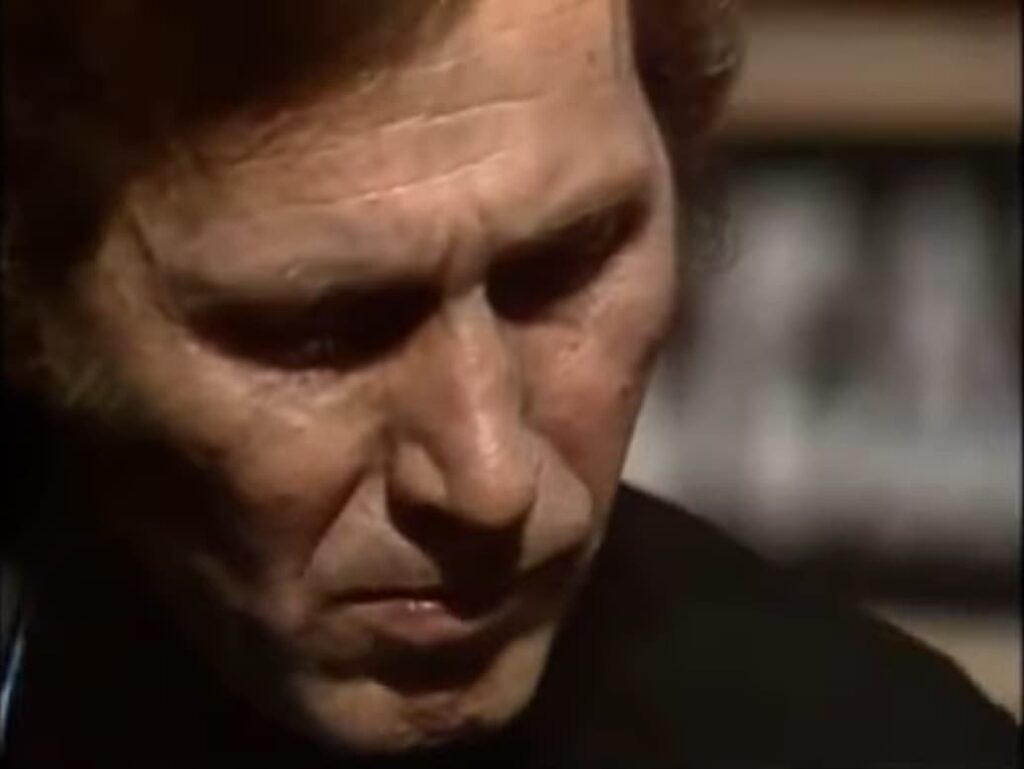
Watching him perform, one could sense that the passage of time had not diminished his artistry, but refined it. There was no urgency in his playing, no need to prove anything. Each phrase felt deliberate, as though he were choosing not just the notes, but the memories they carried. The bright, almost carefree tone of the original 1960 recording became something warmer, more grounded—less about the thrill of the open road, and more about the quiet satisfaction of having traveled it.
And perhaps that is what gives Chet Atkins’ 1973 performance of “Wheels” its lasting resonance. It transforms a lively instrumental hit into a meditation on movement itself—not just the physical act of going somewhere, but the emotional journey that unfolds along the way. The song still rolls forward, but it does so with a sense of awareness, as if it understands the distance it has already covered.
In the end, “Wheels” is no longer just a tune that glides effortlessly from beginning to end. In Atkins’ hands, it becomes something more enduring—a reminder that even the simplest melodies can carry a lifetime within them, if played with enough care. And as those final notes fade, there is a lingering feeling that the journey is not over, only paused, waiting patiently for the next time the music begins again.