
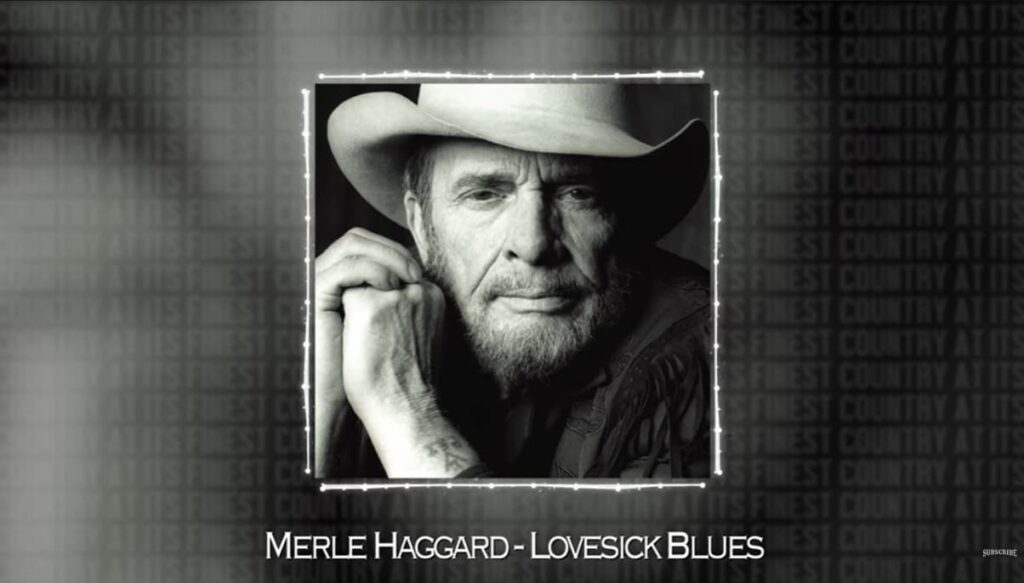
Merle Haggard – “The Storyteller of the Open Road”: A Soul Forged in the Furnace of Reality and the Freedom of the Highway
There are voices that sound like a polished studio, and then there are voices that sound like the wind whipping across a California valley or the rhythmic clatter of a freight train crossing the desert. Merle Haggard’s voice was the latter—a weathered, honest baritone that didn’t just sing songs, but breathed life into the very dust of the American experience. Known as the “Poet of the Common Man,” Haggard was a storyteller whose credibility was earned not in a classroom, but in the boxcars and barrooms of his youth. Released in 1977 on the album A Working Man’s Can’t Get Nowhere Today, the title track serves as a definitive anthem for anyone who has ever felt the pull of the horizon and the weight of the road.
The “backstory” of Merle Haggard’s legendary status is rooted in a life that mirrored his lyrics. Born in 1937 in Oildale, California, his journey was marked by early loss and a rebellious spirit that eventually led him to the gates of San Quentin State Prison. It was there, famously watching Johnny Cash perform, that the “storyteller” was truly born. While his career produced a staggering 38 number-one hits on the Billboard Country charts, including the iconic “Mama Tried” and “Okie from Muskogee,” Haggard‘s true ranking was found in his authenticity. He was the architect of the Bakersfield Sound, a gritty, electric alternative to the slicker productions of Nashville, ensuring that the stories of the working class remained raw and real.
The Philosophy of the Rambler and the Weight of the Journey
For the listener who has spent decades navigating the long highways of life, Merle’s music resonates with a profound, nostalgic truth. He understood that the “road” isn’t just a physical place; it’s a state of mind. It represents both the ultimate freedom and the ultimate isolation. In his storytelling, Haggard captured the duality of the American dream—the desire to settle down and the unquenchable thirst to see what’s around the next bend.
“I’m a lonesome fugitive, bobbin’ and a-weavin’… I’ve got a lot of miles behind me, and a lot of world to see.”
For our generation, who remembers the landscape of a simpler, perhaps more rugged America, Haggard’s songs are “souvenirs” of a time when your word was your bond and your work was your identity. He spoke for the “Working Man” who felt the system was closing in, the “Fugitive” looking for redemption, and the “Old Man” reflecting on the choices of his youth. His lyrics were often sparse, but they carried the weight of a thousand miles, delivered with a timing and sincerity that made every listener feel like the song was written specifically for them.
A Legacy of Grit, Grace, and the Golden West
As we look back at the grand legacy of Merle Haggard, we see a man who turned his “failed” youth into a masterpiece of cultural journalism. He was the guardian of the Dust Bowl spirit, a son of the San Joaquin Valley who never forgot where he came from, even as he performed for presidents. He taught us that a life lived with mistakes is still a life worth singing about, provided you tell the story with honesty.
He remains a titan because he understood that the most powerful stories are the ones we live. Whether he was singing about the “Silver Wings” of a departing plane or the “Mama Tried” regret of a prison cell, Haggard breathed the life of the road into every note. He was a beacon for the weary and a companion for the traveler, proving that as long as there is a road ahead, there is a story worth telling.
 Music Legend