
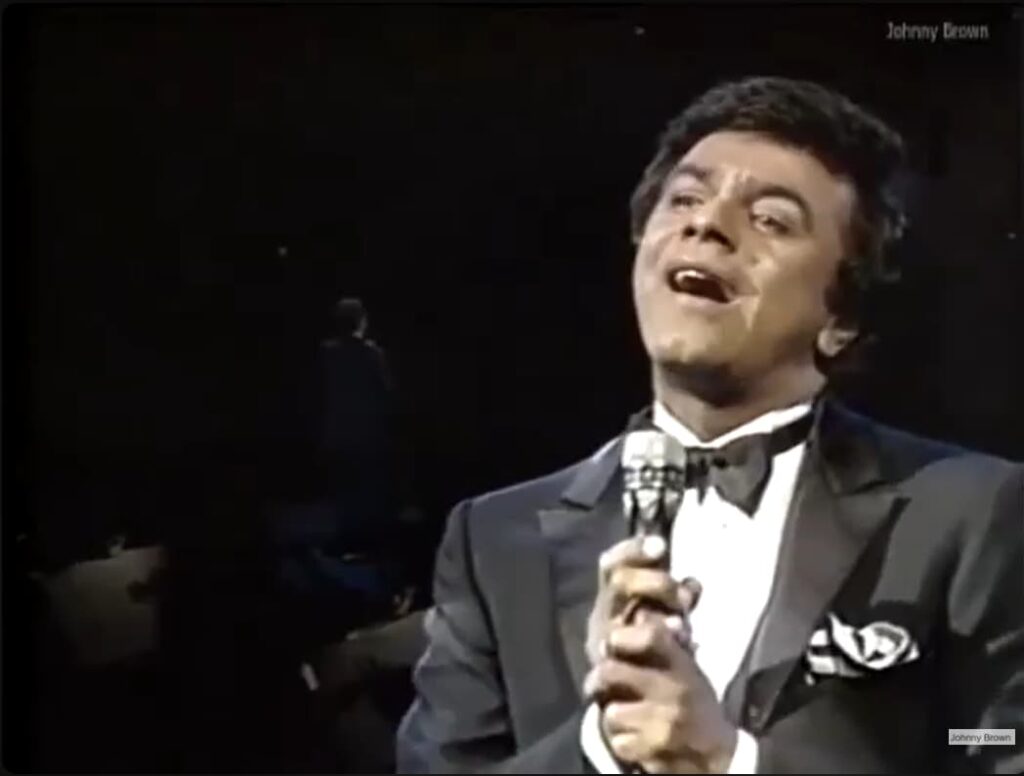
A lifetime distilled into song—“Live In Concert 1982” captures Johnny Mathis not at a single moment, but at the meeting point of memory, mastery, and quiet endurance
By the time Johnny Mathis stepped onto the stage for “Live In Concert 1982,” he was no longer simply a performer delivering familiar standards—he had become a custodian of an era. Nearly three decades had passed since his breakthrough in the late 1950s, when songs like “Chances Are” reached No. 1 on the Billboard Most Played by Jockeys chart in 1957, and “Misty” climbed to No. 12 on the Billboard Hot 100 in 1959 while becoming one of the most enduring interpretations of a jazz standard. These were not just chart achievements; they were foundations upon which a career of remarkable consistency was built.
The 1982 concert stands at a particularly meaningful point in that journey. Popular music had shifted dramatically by then—new sounds, new voices, new expectations. Yet Johnny Mathis remained unchanged in the ways that mattered most. His approach to music, rooted in clarity, phrasing, and emotional restraint, did not seek to compete with contemporary trends. Instead, it offered something increasingly rare: continuity.
In this live performance, the setlist moves fluidly between past and present, drawing from albums such as Heavenly (1959), which reached No. 1 on the Billboard 200, and later recordings that reflected his evolving repertoire. But what defines the concert is not the selection of songs alone—it is the way they are delivered. Each piece feels less like a standalone performance and more like a continuation of a longer conversation, one that has been unfolding for years.
Mathis’s voice in 1982 carries a subtle transformation. The youthful brightness that once defined his early recordings has softened, replaced by a deeper warmth. It is not diminished—it is refined. There is a calm assurance in his delivery, a sense that he no longer needs to reach for emotional effect. Instead, he allows the songs to settle naturally, trusting their structure and meaning.
The orchestration in “Live In Concert 1982” reflects this same philosophy. Rich, elegant arrangements support the vocal without overwhelming it. Strings rise and fall with measured precision, brass accents appear sparingly, and the rhythm section remains steady and unobtrusive. The result is a sound that feels timeless rather than dated, anchored in tradition yet untouched by excess.
What makes this concert particularly compelling is its sense of perspective. Unlike studio recordings, where perfection can be constructed piece by piece, a live performance reveals something more immediate. There are small variations in phrasing, slight shifts in tempo, moments where the voice leans into a note just a fraction longer. These details do not disrupt the performance—they define it. They remind us that music, at its core, is a living act.
There is also an unspoken narrative running through the concert. It is not announced or explained, but it is present in the way the songs are arranged, in the transitions between them, in the quiet pauses that separate one piece from the next. It is the story of time—not as something that passes quickly, but as something that accumulates. Each song carries with it the weight of its own history, and in this setting, those histories begin to overlap.
For listeners who have followed Johnny Mathis across the years, “Live In Concert 1982” offers something more than familiarity. It offers recognition. The voice may have changed slightly, the world around it certainly has, but the essence remains intact. That consistency becomes its own form of comfort, a reminder that not everything is subject to constant reinvention.
And for those encountering this performance without that history, the effect is no less significant. The concert does not rely on nostalgia alone. It stands on its own, supported by the strength of the material and the clarity of its delivery. It does not ask to be remembered—it simply exists, fully formed, in the moment it is heard.
In the end, Johnny Mathis does not treat this concert as a retrospective or a celebration. There is no sense of looking back with finality. Instead, there is a quiet continuation, as though the music has always been present and will remain so.
As the final notes fade, what lingers is not a single performance, but a feeling—one that suggests that music, when carried with care and honesty, does not belong to any one year or moment. It moves forward, gently, sustained by the voices that understand how to let it speak.