
A Flicker of Desire in the Glow of Glam Rock, Where Passion Burns Quietly Beneath the Surface
When Sweet released “Fever of Love” in 1978 as part of their album “Level Headed,” the band was already navigating a delicate transformation. Known throughout the early 1970s for their flamboyant glam rock anthems like “Ballroom Blitz” and “Fox on the Run,” Sweet had begun shifting toward a smoother, more melodic sound—one that leaned into soft rock textures and emotional subtlety. Though “Fever of Love” was not among their major charting singles and did not achieve significant positions on the UK Singles Chart or Billboard Hot 100, its presence within “Level Headed” reveals a quieter, more introspective chapter in the band’s evolution.
By 1978, the musical landscape had changed. Glam rock’s glittering dominance was fading, replaced by a growing appetite for more polished and reflective sounds. For Sweet, this meant stepping away from the theatrical excess that had defined their earlier image and embracing a more restrained identity. “Level Headed” itself marked this transition clearly, featuring the international hit “Love Is Like Oxygen,” which reached No. 8 on the Billboard Hot 100 and No. 9 in the UK. Within this context, “Fever of Love” feels like a companion piece—less immediate, perhaps, but equally revealing.
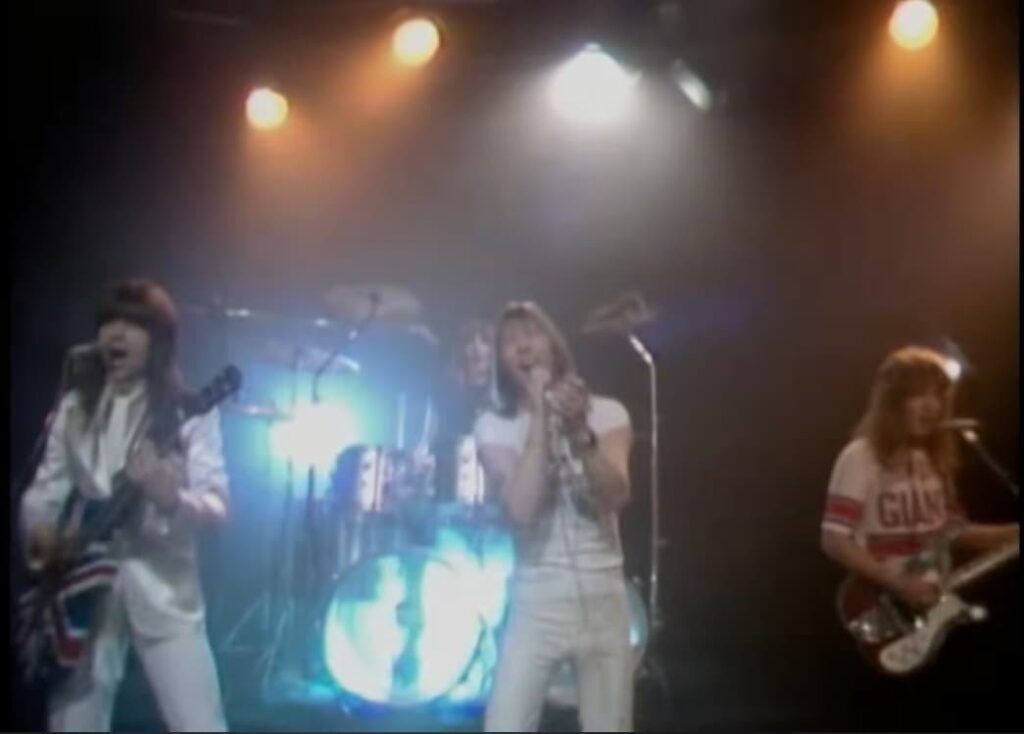
The promotional clip for “Fever of Love” captures this shift in a way that studio recordings alone cannot. There is a noticeable change in atmosphere. The bold colors and exaggerated gestures of earlier glam performances give way to something more controlled, more contemplative. The band’s presence feels grounded, almost reflective, as if aware that they are no longer chasing the same kind of spotlight.
At its core, “Fever of Love” explores the quiet intensity of emotion rather than its explosive expression. The title suggests heat, urgency, something overwhelming—but the song itself unfolds with a surprising sense of restraint. It does not rush toward its conclusion. Instead, it lingers, allowing the feeling to settle and deepen. This contrast between expectation and execution gives the song its subtle power.
Vocally, the performance carries a certain weariness, a recognition that passion is not always bright and consuming—it can also be slow-burning, complicated, and at times uncertain. The harmonies, once used to amplify energy in their earlier hits, are here softened, blending into the instrumentation rather than standing above it. The result is a sound that feels more mature, less concerned with immediate impact and more focused on lasting impression.
The story behind this period in Sweet’s career adds another layer of meaning. Internal tensions and changes within the band had begun to surface, and the shift in musical direction was both a creative choice and a response to those evolving dynamics. “Fever of Love” can be heard, in part, as a reflection of that moment—a band redefining itself, searching for balance between past identity and future direction.
Watching the promo clip now, there is a sense of distance—not just from the audience, but from their earlier selves. The energy is still there, but it has been tempered, shaped by experience. It is no longer about capturing attention at all costs. Instead, it feels like an attempt to hold onto something more elusive: authenticity.
And perhaps that is the lasting significance of “Fever of Love.” It does not stand as a defining hit in terms of chart success, but it offers a glimpse into a band willing to evolve, to take risks, to step away from what once guaranteed applause. In doing so, Sweet revealed a different kind of strength—not the loud, immediate kind, but the quieter resilience of artists willing to change.
As the song fades, there is no dramatic resolution, no triumphant return to familiar ground. Only a lingering warmth, like the afterglow of something once intense but now understood more clearly. And in that moment, “Fever of Love” becomes more than just a track on an album—it becomes a reflection of time itself, of how passion shifts, softens, and endures in ways that are not always visible, but always felt.