
A Ballad of Fate and Return, Where Love Rides Back Even Knowing the End
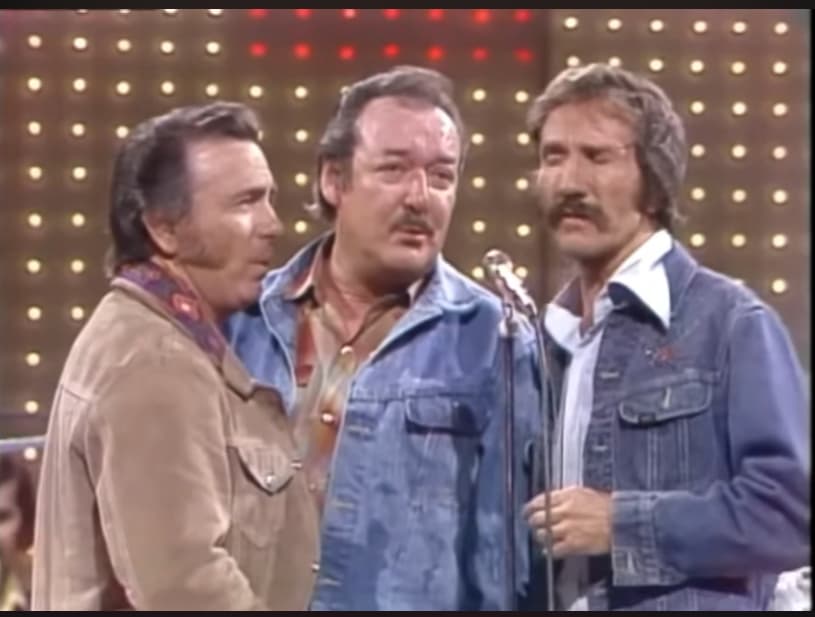
When Marty Robbins performed “El Paso” on The Midnight Special in 1973, he was not simply revisiting a signature song—he was stepping once again into a story that had already secured its place in American music history. Originally released in 1959 as part of the album “Gunfighter Ballads and Trail Songs,” “El Paso” became a landmark achievement, reaching No. 1 on the Billboard Hot 100 in 1960 and earning the Grammy Award for Best Country & Western Recording. At a time when country songs rarely crossed fully into the pop mainstream, this sweeping western narrative did more than succeed—it endured.
By 1973, Marty Robbins had long since moved beyond being defined by a single hit. Yet “El Paso” remained inseparable from his identity as an artist. It was more than a song; it was a story that listeners carried with them, one that unfolded like a film each time it was heard. And on that televised stage, years after its original release, Robbins approached it not as a relic, but as something still very much alive.
The performance on The Midnight Special captures a unique balance between precision and familiarity. Unlike the original studio recording—carefully structured, almost cinematic in its pacing—this live rendition breathes differently. There is a subtle flexibility in the phrasing, a sense that the story is being told rather than recited. Marty Robbins does not rush the narrative, nor does he dramatize it beyond its natural rhythm. Instead, he allows the song to unfold with the quiet confidence of someone who knows every turn of its path.
The story of “El Paso” remains one of the most compelling in country music. A cowboy falls in love with a dancer named Feleena, kills a rival in a moment of jealousy, flees into the badlands, and ultimately returns—fully aware that doing so will cost him his life. It is a tale built on inevitability, where love and fate move together toward a conclusion that cannot be avoided.
What gives the 1973 performance its particular resonance is the way Robbins inhabits that inevitability. There is no sense of surprise in the ending; it is known from the very first line. And yet, he sings as though the journey still matters, as though each moment leading to that final return carries its own weight. This is where his artistry becomes most evident—not in altering the story, but in deepening its emotional presence.
Musically, the arrangement remains faithful to the original’s western texture, with its distinctive Spanish guitar influences and steady rhythm that mirrors the movement of a horse across open land. But live, there is an added sense of immediacy. The notes feel closer, less distant, as though the landscape itself has been brought into the room.
There is also a subtle shift in Robbins’ voice. By 1973, it carries a maturity that adds depth to the narrative. The youthful urgency of the original recording is tempered by something more reflective. This does not diminish the story’s intensity; rather, it enhances its sense of inevitability. The listener is not only hearing what happens, but understanding why it must happen.
In the broader context of televised performances of the era, this appearance stands out for its restraint. There is no elaborate staging, no attempt to transform the song into spectacle. The focus remains entirely on the performance itself—on the voice, the guitar, and the story being told. This simplicity allows the song’s narrative power to come forward without distraction.
Over time, “El Paso” has become more than one of Marty Robbins’ greatest achievements. It has become a benchmark for storytelling in music—a reminder that a song can carry the weight of a novel within a few minutes. And in this 1973 performance, that legacy is not merely preserved; it is quietly reaffirmed.
As the final lines are delivered, there is no dramatic pause, no attempt to heighten the conclusion. The story ends as it always has—calmly, inevitably. And in that ending, there is a sense that nothing more needs to be said.
Because “El Paso”, whether in 1959 or 1973, is not about changing its outcome. It is about returning to it, understanding it more deeply each time, and recognizing that some stories remain powerful not because they surprise us, but because they remind us—again and again—of the choices that define us, and the paths we follow, even when we know where they lead.