
A Final Serenade of Timeless Romance: When a Voice That Defined Love Gently Takes Its Bow
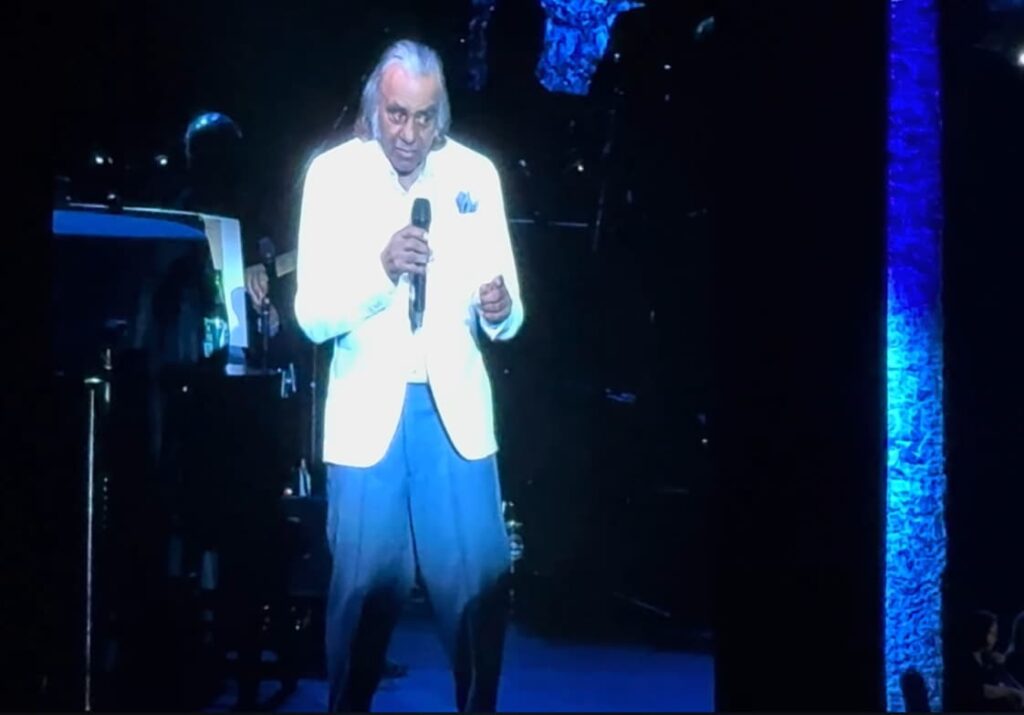
On the evening of May 18, 2025, at the Bergen Performing Arts Center, something quietly historic unfolded. The audience gathered, as they had so many times before, to hear Johnny Mathis—a voice that had, for nearly seven decades, defined the very language of romance in popular music. What no one fully realized in that moment was that this would be the final live performance of a man whose career had become inseparable from the emotional fabric of countless lives.
To understand the weight of that evening, one must return to where it all began. Johnny Mathis first rose to prominence in the late 1950s, a time when popular music was undergoing a transformation. His 1957 single “Chances Are”, from the album Johnny’s Greatest Hits, reached No. 1 on the Billboard Most Played by Jockeys chart (a precursor to today’s Billboard Hot 100) and climbed to No. 2 on the overall Top 100 chart. It became one of his signature songs—an intimate, tender expression of love that felt less like a performance and more like a whispered confession.
That same year, “Misty”, originally composed by Erroll Garner, was transformed by Mathis into something deeply personal. His version, released in 1959, reached No. 12 on the Billboard Hot 100, but its true success cannot be measured by chart position alone. It became a standard—timeless, elegant, and forever associated with his voice. There was a softness in his delivery, a kind of restraint that allowed emotion to bloom naturally rather than overwhelm.
By the time of his final performance in 2025, Mathis had long since secured his place among the great interpreters of song. His compilation album Johnny’s Greatest Hits itself had spent an astonishing 490 consecutive weeks on the Billboard album chart, a record that stood for years and spoke to the enduring appeal of his music.
And yet, on that final night, there was no sense of grandeur or spectacle overshadowing the moment. Instead, there was something far more powerful—a quiet awareness, perhaps unspoken, that time had gently brought things full circle.
As he moved through songs like “Chances Are” and “Misty”, the voice—though touched by age—retained its unmistakable warmth. It was no longer the voice of a young man discovering love, but of someone who had lived with it, lost it, cherished it, and carried its memory across decades. Each note seemed to linger just a little longer, as if reluctant to let go.
There is a particular kind of poignancy in hearing such songs at the close of a long life in music. They do not simply recall the past—they transform it. The lyrics, once filled with youthful longing, now carry layers of reflection. The melodies, familiar and comforting, feel almost sacred.
Mathis’s decision to step away from the stage, citing age and memory challenges, is not one of defeat, but of grace. There is dignity in knowing when to pause, when to allow the music to remain as it is—untouched, preserved in its finest form.
For those present that evening, the experience was undoubtedly unforgettable. Not because it was the last, but because it felt complete. There was no need for dramatic farewells or grand gestures. The songs themselves said everything that needed to be said.
Looking back, Johnny Mathis’s career is not defined solely by chart positions or accolades, though they are remarkable. It is defined by something far more enduring—the ability to give voice to emotion in its purest form. To sing about love not as an abstract idea, but as something deeply felt, deeply remembered.
And perhaps that is why his music continues to resonate.
Because in a world that often moves too quickly, his songs remind us to slow down—to listen, to feel, to remember. They belong to a time when music was not just heard, but held close.
As the final notes faded on that May evening, what remained was not silence, but a kind of quiet gratitude. For the songs. For the memories. For a voice that, even now, continues to echo long after the stage has gone dark.
In the end, Johnny Mathis did not simply leave the stage.
He left behind a lifetime of music that still knows how to speak, softly and sincerely, to the heart.