
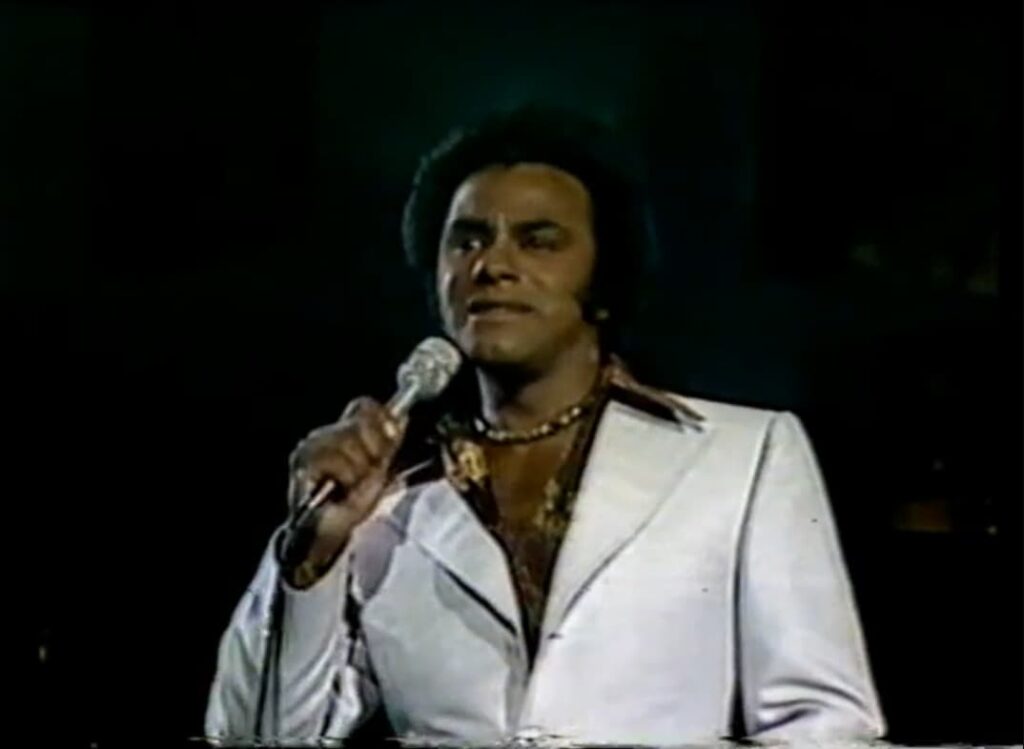
A tender reflection on love, memory, and the timeless elegance of an evening wrapped in melody
There are voices that simply sing, and then there are voices that seem to remember for us. Johnny Mathis has always belonged to the latter. In his 1978 Canadian television performance of “It’s A Beautiful Evening” and “Misty,” he was no longer just the young crooner who had dominated the charts two decades earlier—he had become something deeper: a custodian of feeling, a quiet storyteller of romance in its most refined form.
By 1978, Johnny Mathis was already a towering figure in popular music. His early recordings had shaped the sound of adult contemporary and easy listening, with songs like “Chances Are” (Billboard No.1, 1957) and “Misty” (Billboard Top 20, 1959) firmly securing his place in music history. While “It’s A Beautiful Evening” was not a major charting single in the same way, it functioned beautifully within his live repertoire—a reflective piece that allowed his voice to glide effortlessly across gentle orchestration, evoking intimacy rather than spectacle.
The inclusion of “Misty”, however, carries far greater historical weight. Originally composed as an instrumental by Erroll Garner in 1954, the song gained lyrical life through Johnny Burke, and it was Johnny Mathis’ 1959 rendition that transformed it into a definitive vocal standard. His version reached No.12 on the Billboard Hot 100 and became one of the most enduring interpretations of the song—so much so that it remains inseparable from his identity as an artist.
Watching or listening to the 1978 Canadian performance, one cannot help but notice the subtle transformation in Mathis’ delivery. Gone is the youthful brightness of the late 1950s; in its place is a voice softened by time, enriched with nuance. When he sings “Misty,” the phrasing feels less like performance and more like recollection—as if each line carries the weight of lived experience. The famous opening line, “Look at me, I’m as helpless as a kitten up a tree,” is no longer just poetic—it becomes almost confessional.
There is also a quiet dignity in the way Mathis approaches “It’s A Beautiful Evening.” The song itself is understated, built on gentle melodies and a sense of calm reflection. It does not strive for dramatic peaks; instead, it lingers in the soft spaces between notes. In the context of 1978—a time when popular music was shifting toward disco, rock, and more aggressive sounds—this kind of performance felt almost like a deliberate pause. A reminder that beauty could still be found in restraint, in simplicity, in the unhurried unfolding of a melody.
Behind these performances lies a deeper narrative—not of chart positions or commercial success, but of endurance. Johnny Mathis had navigated the ever-changing tides of the music industry with remarkable grace. While many of his contemporaries faded as trends evolved, he remained steadfast, adapting without losing the essence of what made him unique. His music continued to speak to those who valued sincerity over spectacle.
And perhaps that is where the true meaning of this 1978 moment resides. It is not merely about two songs, but about continuity—about how music can accompany us through different seasons of life, taking on new meanings as we change. “Misty” may have once sounded like the innocent confession of young love, but in Mathis’ later interpretation, it becomes something richer: a reflection on love remembered, love endured, love that lingers quietly in the heart.
In a world that often rushes forward, performances like this invite us to slow down, to listen more closely—not just to the music, but to ourselves. And in that gentle, unhurried space, Johnny Mathis reminds us that some emotions never fade; they simply deepen with time, like a melody carried softly into the night.