
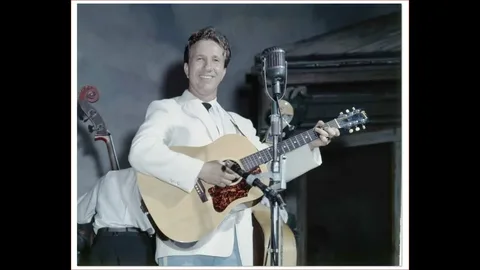
Marty Robbins and “Funny Face”: A Masterclass in the Tender, “Velvet” Sincerity of 1970s Country-Pop
In the early 1970s, as the musical landscape shifted toward a more polished, orchestrated sound often referred to as “Countrypolitan,” Marty Robbins demonstrated once again why he was the undisputed master of the crossover ballad. In 1972, he released “Funny Face,” a song that would become one of the most endearing and commercially successful tracks of his later career. Serving as a centerpiece for his self-titled album on Columbia Records, the song climbed to Number 6 on the Billboard Hot Country Songs chart and even made significant inroads on the Adult Contemporary charts. For those of us who spent our evenings in the early seventies with the radio tuned to the “Nashville Sound,” “Funny Face” wasn’t just a hit; it was a warm, melodic embrace—a song that traded the rugged gunbelts of the Old West for the intimate, domestic beauty of a long-term love.
The “story” behind “Funny Face” is a testament to Marty Robbins’ own evolution as a songwriter and performer. While he was famous for the epic scale of his Gunfighter Ballads, he penned this particular track as a tribute to the quiet, everyday devotion found in a marriage. The lyrics are a tender, rhythmic list of the small “imperfections” and endearing quirks that make a partner irreplaceable. Marty’s delivery is a masterclass in his signature “Gentle Giant” style; he uses his crystalline tenor to deliver lines like “Funny face, I love you,” with a vulnerability that feels entirely authentic. It was a bold, sentimental pivot in an era of “Outlaw” grit, proving that there was still a massive, sophisticated audience for a well-crafted, honest love song.
For the sophisticated listener who has weathered the decades and seen the world change from the analog warmth of the fifties to the digital pace of the new millennium, hearing “Funny Face” today is a deeply nostalgic experience. It evokes memories of wood-paneled dens, the soft glow of a bedside lamp, and the realization that the most profound loves are often found in the simplest moments. The lyrics speak to the “qualified” reader who understands that “perfection” is a myth, and that true beauty lies in the “funny faces” and shared histories of a lifetime together. For those of us in our silver years, the song is a mirror of our own resilience and the quiet strength of the bonds we have built. It reminds us of a time when the “Master Storyteller” was just a man with a guitar, singing to the heart of the person sitting right across from him.
The meaning of “Funny Face” lies in its unapologetic sweetness. Marty Robbins possessed the unique, almost magical gift of making a sentimental lyric feel profound rather than “saccharine.” As we reflect on this masterpiece today, through the lens of our own decades of experience, we see it as more than just a 1972 chart-topper; it is a testament to the enduring power of kindness and affection. The Gentle Giant of the narrative song may have moved on to his own “little spot in heaven,” but in the playful, loving groove of this song, he remains the eternal romantic. To listen to it now is to sit once more with Marty, acknowledging that in the end, it’s the people who make us laugh and the ones who love our “funny faces” that matter most of all.
 Music Legend