
A glittering escape anthem where desire, illusion, and independence collide under the neon glow of fame
When Sweet released Fox On The Run in 1975, it marked a decisive shift in their artistic identity, becoming their first self-produced single and a defining moment of autonomy. The track surged to No. 2 on the UK Singles Chart and reached No. 5 on the Billboard Hot 100 in the United States, later appearing on the American version of Desolation Boulevard. In that instant, Sweet moved beyond the confines of their earlier songwriting partnerships and stepped fully into their own creative control, crafting a sound that was as polished as it was defiant.
At its surface, Fox On The Run gleams with the infectious energy of glam rock at its commercial peak. The synthesizer intro, crisp and immediate, feels like a curtain rising on a world of flashing lights and restless ambition. Yet beneath that sheen lies a far more nuanced portrait of fame and femininity, one that reflects the shifting cultural currents of the mid-1970s. The “fox” of the title is not merely an object of admiration. She is elusive, self-directed, and ultimately untouchable, slipping through the grasp of those who try to define or possess her.
This duality is where the song finds its enduring strength. Sweet, often associated with flamboyance and theatricality, reveal a sharper observational edge here. The lyrics suggest a knowing awareness of the music industry’s machinery, where image and identity are constantly constructed and consumed. The central figure moves through this world with calculated distance, aware of the gaze upon her yet never fully yielding to it. In that sense, Fox On The Run becomes less a love song and more a commentary on the transient nature of attraction in a media-saturated landscape.
Musically, the track embodies precision. The layered harmonies, a hallmark of Sweet, are deployed with remarkable discipline, balancing sweetness with a subtle tension. The rhythm section drives forward with a steady, almost mechanical pulse, mirroring the relentless pace of the world it depicts. Unlike the heavier stomp of their earlier hits, this arrangement feels streamlined, modern, and intentionally controlled. It is glam rock refined into something sleeker, hinting at the evolving sonic palette of the late 1970s.
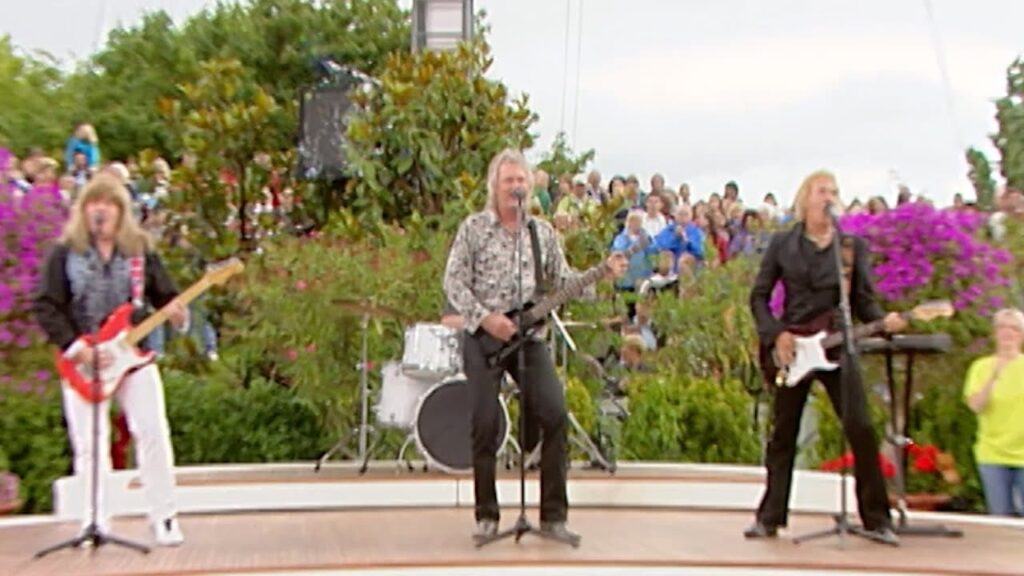
In live performances, such as the later televised renditions, the song takes on an additional dimension. Time transforms its meaning. What once sounded like a contemporary observation begins to feel almost prophetic. The figure of the “fox” anticipates a future where celebrity becomes even more fragmented, more curated, more distant. Watching Sweet revisit Fox On The Run decades later, one senses not nostalgia alone, but a quiet recognition of how accurately the song captured a cultural trajectory still unfolding.
Ultimately, Fox On The Run endures because it balances immediacy with insight. It invites listeners in with its irresistible hook, then leaves them reflecting on something more complex. Beneath the glitter lies a question that remains unresolved. In a world built on attention and illusion, who truly holds the power—the one who is seen, or the one who chooses to disappear.