
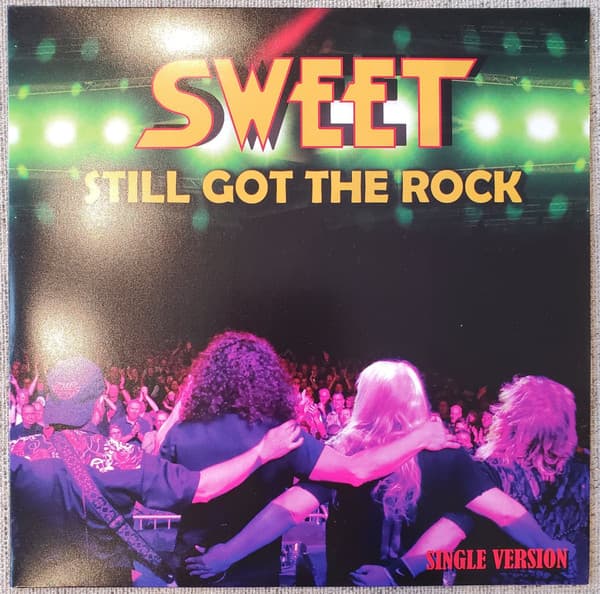
Defiant echo of survival, where the fire of rock endures long after the spotlight fades
By the time Sweet delivered Still Got the Rock, the band had long transcended the glitter and immediacy of their early 1970s chart dominance, when singles like those from Desolation Boulevard propelled them into the upper reaches of the UK charts and international acclaim. Though Still Got the Rock does not belong to that peak commercial era, it stands as a later-period statement, less concerned with chart positions and more invested in identity, endurance, and artistic survival. It reflects a band no longer chasing the charts, but instead reaffirming its place within the lineage of rock itself.
What makes Still Got the Rock compelling is not a singular origin story, but the accumulated weight of history embedded in its sound. Sweet, once synonymous with glam rock flamboyance, had by this stage evolved into something more grounded, more resilient. The track functions almost as a manifesto. It is not merely a declaration of relevance, but a refusal to be dismissed as a relic of a bygone era.
The song’s central theme is unmistakable. Time passes, trends shift, audiences move on, yet something essential remains. That “something” is not just musical style, but spirit. In Still Got the Rock, the phrase itself becomes a thesis. Rock is not presented as a genre confined to a decade, but as a living force carried within the artist. It survives lineup changes, industry upheavals, and the quiet erosion of mainstream attention.
Musically, the track leans into a harder, more straightforward rock framework than the polished, hook-driven glam hits that first defined Sweet. There is less theatrical gloss here, replaced by a muscular directness. Guitars carry more weight, rhythms feel more deliberate, and the vocals project conviction rather than flamboyance. It is the sound of a band stripping away ornamentation to reveal its core.
Yet beneath that sonic assertiveness lies a subtle undercurrent of reflection. Still Got the Rock is not simply loud; it is self-aware. It acknowledges, implicitly, the distance between past glory and present reality. But instead of nostalgia, it offers continuity. The past is not something to be recreated, but something that informs the present.
For listeners familiar with Sweet’s early catalog, the song resonates as a bridge between eras. It connects the glitter-soaked immediacy of their youth with a more seasoned, almost philosophical perspective. For newer audiences, it stands independently as a testament to persistence, a reminder that authenticity in rock music is not dictated by commercial cycles.
In the broader context of rock history, Still Got the Rock occupies a meaningful space. It speaks to a generation of artists who refused to disappear quietly, who continued to create not out of necessity, but out of conviction. The song does not ask for validation. It simply states its truth.
And in that statement lies its enduring power.