
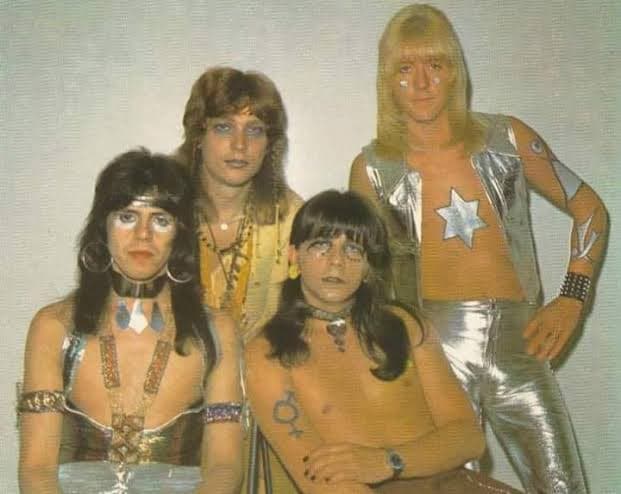
Portrait of quiet disillusionment, where youth drifts into inertia beneath the fading glow of glam rock
Within the hard-edged, guitar-driven landscape of Sweet Fanny Adams, Sweet delivered one of their most understated yet revealing moments with Sunny Sleeps Late. Released in 1974 as part of that album—widely regarded as the band’s artistic breakthrough—the track did not emerge as a standalone charting single, yet its presence within the record speaks volumes about the group’s evolving identity beyond the glitter and stomp of their earlier hits. Known for dominating charts with explosive anthems, Sweet here turned inward, offering something far more introspective.
At first glance, Sunny Sleeps Late feels deceptively simple. The arrangement lacks the bombast typically associated with Sweet’s glam era output. Instead, it leans into a more restrained, almost languid mood. This sonic shift is crucial. It mirrors the emotional core of the song itself: a subtle meditation on detachment, routine, and the quiet unraveling of youthful energy. The character of “Sunny” becomes less a specific individual and more an archetype—a figure suspended between possibility and stagnation.
Lyrically, the song drifts through imagery that suggests withdrawal rather than rebellion. In contrast to the defiant spirit that defined much of early 1970s rock, Sunny Sleeps Late presents a kind of passive surrender. Sunny does not rage against the world; he simply opts out of it, retreating into sleep, into stillness, into a life that unfolds without urgency. There is a haunting quality in that choice. It reflects a deeper cultural undercurrent of the time, when the initial fire of the late 1960s had begun to cool, leaving behind questions about direction, purpose, and identity.
Musically, the band demonstrates a sophistication that often goes overlooked in discussions of Sweet. The guitar work is measured, allowing space rather than filling it, while the vocal delivery carries a softness that contrasts sharply with their more aggressive material. This dynamic restraint gives the song its emotional weight. It is not the volume that commands attention, but the absence of it. Silence, pauses, and gentle phrasing become as expressive as any amplified riff.
Within the broader arc of Sweet Fanny Adams, Sunny Sleeps Late functions almost like a reflective pause—a moment where the band steps away from spectacle and confronts something more human and fragile. It underscores the duality at the heart of Sweet’s artistry: the ability to ignite arenas with electrifying energy while also capturing the quieter, more ambiguous corners of the human experience.
Over time, the song has gained a kind of understated reverence among listeners who look beyond the surface of glam rock. Sunny Sleeps Late endures not because it demands attention, but because it rewards it. It invites the listener into a slower rhythm, one where meaning is found not in grand declarations, but in the subtle realization that sometimes, the loudest stories are the ones told in a whisper.