
A life carved from hardship and dignity, where memory becomes music and truth stands unpolished, yet unbreakable
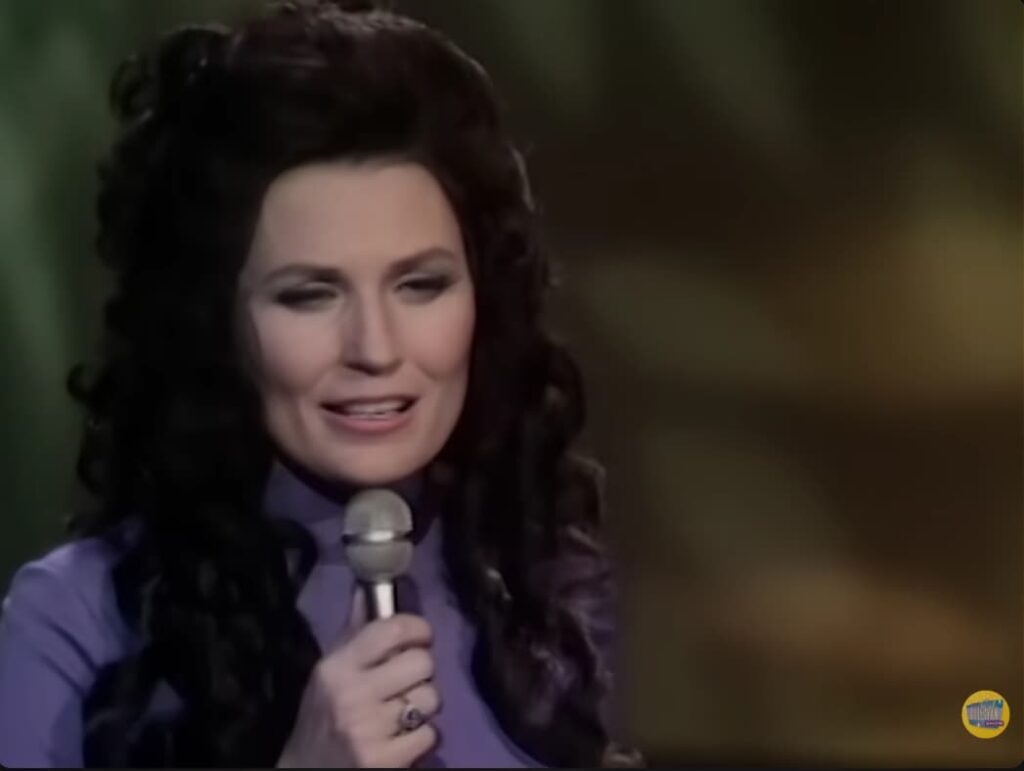
When Loretta Lynn stepped onto the stage of The Ed Sullivan Show to perform “Coal Miner’s Daughter”, it was not merely another televised appearance. It was, in many ways, the quiet arrival of a life story told without adornment, carried by a voice that never tried to be anything other than honest. Released in 1970 as the title track of her album “Coal Miner’s Daughter”, the song would go on to reach No. 1 on the Billboard Hot Country Singles chart, further solidifying Lynn’s place among the most important storytellers in country music.
But chart positions alone cannot explain why this song endures.
Written by Loretta Lynn herself, “Coal Miner’s Daughter” is autobiographical in the most direct sense. It traces her upbringing in the small coal mining community of Butcher Hollow, Kentucky—a place where life was defined not by comfort, but by resilience. The lyrics speak of a childhood shaped by poverty, yet never reduced by it. There is no self-pity here, no attempt to dramatize hardship. Instead, there is a quiet pride, a recognition that what was lacking in material wealth was often replaced by something more enduring.
Watching her performance on The Ed Sullivan Show, one becomes aware of how little separation exists between the singer and the song. There is no theatrical distance, no sense of performance as something separate from experience. Each line feels lived, not rehearsed. And perhaps that is what gives the moment its weight—the understanding that this is not a story being told for effect, but a memory being shared as it was.
The arrangement is simple, almost restrained, allowing the narrative to take center stage. The melody does not compete with the words; it supports them, moving gently, as though aware that the story itself carries enough power. And within that simplicity, something remarkable happens—the listener is drawn not into spectacle, but into reflection.
At its core, “Coal Miner’s Daughter” is about identity. It is about knowing where one comes from, and carrying that knowledge forward without shame or hesitation. In a time when much of popular music leaned toward escapism, Loretta Lynn offered something different—a grounding presence, rooted in reality. She did not ask the audience to imagine another life. She invited them to understand hers.
There is also a broader significance to consider. As a woman writing and performing her own material in an industry that often limited such voices, Loretta Lynn stood apart. Her songs did not conform to expectations; they expanded them. And “Coal Miner’s Daughter” remains one of the clearest examples of that independence—a declaration not just of personal history, but of artistic autonomy.
Over the years, the song has taken on a life beyond its original release. It inspired her 1976 autobiography and later the 1980 film adaptation of the same name, further embedding the story into cultural memory. Yet even as it grew in recognition, the essence of the song remained unchanged. It never lost its sense of intimacy, its connection to the life it describes.
What makes the Ed Sullivan Show performance particularly compelling is the contrast it presents. Here is a story born from rural hardship, delivered on one of the most prominent stages in American television. And yet, nothing about it feels out of place. If anything, the simplicity of the song stands in quiet contrast to the grandeur of the setting, reminding us that authenticity does not require embellishment.
As the performance unfolds, there is a sense that time itself has slowed. The audience is not being entertained in the usual sense. They are being invited to listen—to truly listen—to a life that might otherwise remain unheard.
And when the final note fades, what lingers is not just admiration, but understanding.
Because “Coal Miner’s Daughter” is not only about one person’s past. It speaks to something broader—the idea that dignity is not defined by circumstance, that strength can exist in the most modest of beginnings, and that the stories worth telling are often the ones that come without decoration.
In the end, Loretta Lynn did not simply perform a song that night.
She offered something far more lasting—a piece of truth, carried in melody, and left behind for anyone willing to hear it.