
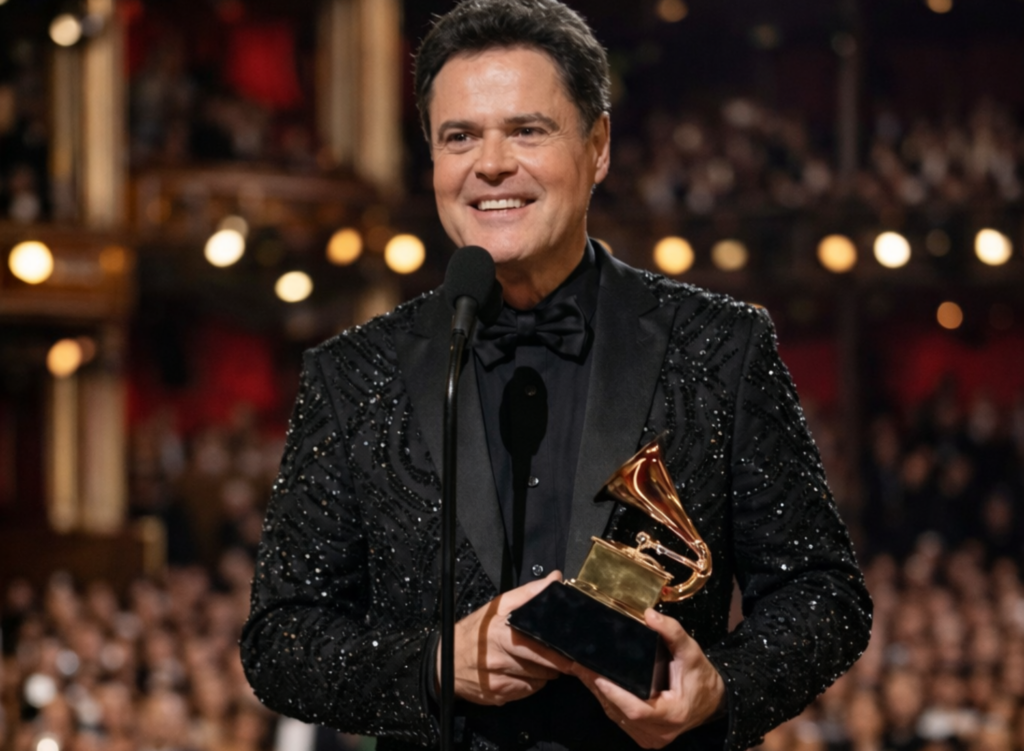
A voice shaped by time, finally honored—not for a moment, but for a lifetime that never stopped believing in the song.
In February 2026, at the Grammy Awards, one of the most quietly powerful moments of the evening did not come with spectacle, but with reverence. When the name Donny Osmond was announced as the winner of Best Traditional Pop Vocal Album, the room did not erupt—it rose. Every artist, every musician, every listener in attendance stood to their feet in a rare and deeply sincere standing ovation, acknowledging a career that had stretched across more than six decades. It was not simply applause. It was recognition, long delayed yet perfectly timed.
The award honored an album centered around the emotionally resonant ballad “Love Will Survive”, a work that did not rely on modern trends or production tricks, but instead leaned into something far more enduring—clarity of voice, honesty of feeling, and a lifetime of experience distilled into song. While official chart positions for the album reflected modest commercial performance compared to contemporary releases, its true impact lay elsewhere. It resonated deeply within the traditional pop community, earning critical respect and, ultimately, the industry’s highest acknowledgment.
Yet perhaps the most poignant detail of that evening was this: Donny Osmond was not physically present to receive the award. Due to health reasons, his son, Chris Osmond, walked onto the stage in his place. There was something profoundly symbolic in that image—a continuation, a passing of time, a reminder that legacies are not confined to a single moment or a single voice. As Chris accepted the Grammy on his father’s behalf, the applause did not fade. If anything, it deepened, carrying with it decades of memory.
To understand why this moment mattered so deeply, one must return to the beginning. Donny Osmond first stepped into the public eye not as a man, but as a boy—wide-eyed, disciplined, and already carrying a voice that would soon become unmistakable. As part of the Osmonds, he grew up in front of an audience that watched him transform from child performer to teen idol, navigating the overwhelming success of the early 1970s. Hits came quickly, and so did expectations. For many, that would have been the peak.
But for Osmond, it was only the opening chapter.
The decades that followed were not always easy, nor were they always visible. The music industry shifted, tastes evolved, and the spotlight moved elsewhere. Yet he remained—sometimes at the forefront, sometimes just beyond it—continuing to perform, to record, to refine. He transitioned into television, into theater, into residencies that demanded consistency rather than fleeting popularity. What defined him was not reinvention for its own sake, but a quiet commitment to staying relevant without losing authenticity.
That is what makes “Love Will Survive” so fitting as the centerpiece of this recognition. The song itself carries the weight of lived experience. It is not the voice of youthful certainty, but of someone who has seen time pass, who understands loss, endurance, and the quiet resilience that follows. There is no need for excess in its arrangement. The strength lies in restraint—in the way each note feels considered, earned.
And so, when that Grammy was finally placed into his legacy, it felt less like a victory and more like a conclusion gently arriving at the right moment. Not an ending, but a full circle.
Because this award was never just about one album.
It was about the boy who began singing before he fully understood the world, and the man who continued long after he had seen it change. It was about persistence in an industry that rarely rewards longevity without reinvention. It was about choosing to continue, even when the applause grows quieter, even when recognition seems to belong to another time.
In the end, the message is as clear as it is timeless.
Passion does not measure itself in years. It does not fade simply because time moves forward. If anything, it deepens, becoming something steadier, something more meaningful. And success—true success—often arrives not to those who shine the brightest for a moment, but to those who refuse to stop shining at all.
The standing ovation in that hall was not just for Donny Osmond. It was for every note he ever sang, every stage he ever stepped onto, every moment he chose to continue when stopping would have been easier.
Because in the quiet truth of it all, the music never left him—and he never left the music.