
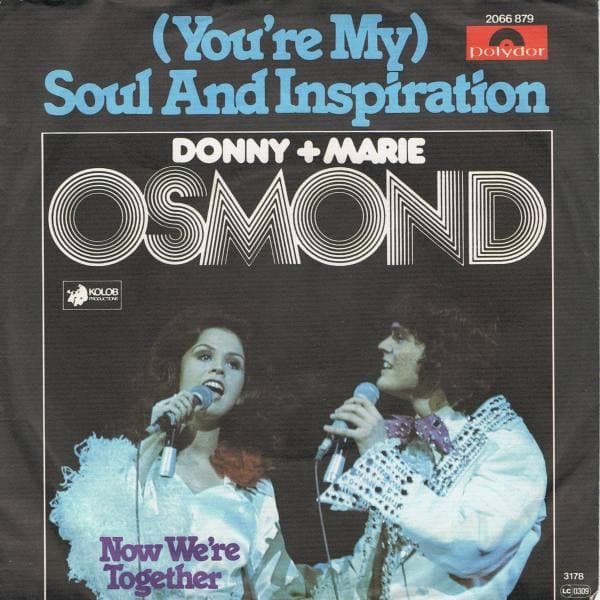
A tender declaration of devotion where harmony becomes memory and love is spoken in unguarded voices
(You’re My) Soul and Inspiration as recorded by Donny & Marie Osmond stands as one of the most emotionally restrained yet quietly powerful reinterpretations of a modern pop standard. Released in 1978, their version reached No. 13 on the Billboard Hot 100 and climbed to No. 5 on the Adult Contemporary chart, affirming that this sibling duo could move beyond youthful novelty into material shaped by reflection, maturity, and emotional poise. While the song was already deeply familiar to listeners from its celebrated earlier life, Donny and Marie approached it not as a challenge to the past, but as a conversation with it.
Originally written by Barry Mann and Cynthia Weil, (You’re My) Soul and Inspiration was first made immortal by The Righteous Brothers in 1965, when it reached No. 1 on the Billboard Hot 100 and became one of the defining romantic ballads of its era. By the time Donny & Marie Osmond chose to record it more than a decade later, the song already carried the weight of shared cultural memory. Rather than attempt to replicate the sweeping drama of the original, their version softened the edges, leaning into intimacy rather than grandeur.
At this stage in their career, Donny Osmond and Marie Osmond were transitioning. The exuberance of their early pop success had given way to a desire for greater emotional credibility. This recording arrived during a period when their music increasingly reflected careful phrasing, balanced harmony, and lyrical sincerity. Their sibling bond brought a unique emotional clarity to the song. There is trust in the way their voices meet, an ease that allows the lyric to breathe without theatrical excess.
The arrangement is deliberately understated. Gentle strings, measured piano lines, and restrained production frame the vocals rather than compete with them. This musical restraint is central to the song’s meaning. (You’re My) Soul and Inspiration is not about dramatic longing or emotional collapse. It is about recognition. The lyric speaks to the moment when love becomes essential, when another presence is no longer optional but foundational. In Donny and Marie’s hands, that realization unfolds slowly, with calm certainty rather than urgency.
What gives their version particular resonance is its emotional posture. There is no desperation here, no fear of loss. Instead, the song feels reflective, as if spoken from a place of lived understanding. Donny’s vocal carries warmth and steadiness, while Marie’s harmonies offer reassurance rather than contrast. They do not perform at each other. They listen. This shared attentiveness transforms the song into a dialogue rather than a declaration.
The success of the single on both pop and adult contemporary charts reflected an audience ready for this quieter expression of romance. In a decade marked by excess and experimentation, Donny & Marie Osmond offered something timeless. Their version respected the craftsmanship of Barry Mann and Cynthia Weil, honoring the song’s melodic strength while allowing its emotional center to shift toward introspection.
The meaning of (You’re My) Soul and Inspiration has always rested on its simplicity. It speaks of love not as excitement, but as grounding. In this recording, that meaning deepens. The song becomes less about romantic idealism and more about emotional anchoring. It suggests a relationship shaped by patience, mutual regard, and the quiet confidence that comes from being understood.
Looking back, this performance stands as one of the duo’s most graceful moments. It shows Donny & Marie Osmond not chasing trends, but embracing musical continuity. By revisiting a song already etched into memory, they added a new layer rather than erasing the old one. Their version remains compelling precisely because it does not demand attention. It invites it.
In the long arc of classic pop recordings, (You’re My) Soul and Inspiration by Donny & Marie Osmond endures as a reminder that some songs grow richer when revisited with care, humility, and emotional honesty. It is a testament to the power of restraint, and to the enduring language of love spoken softly, but with conviction.