
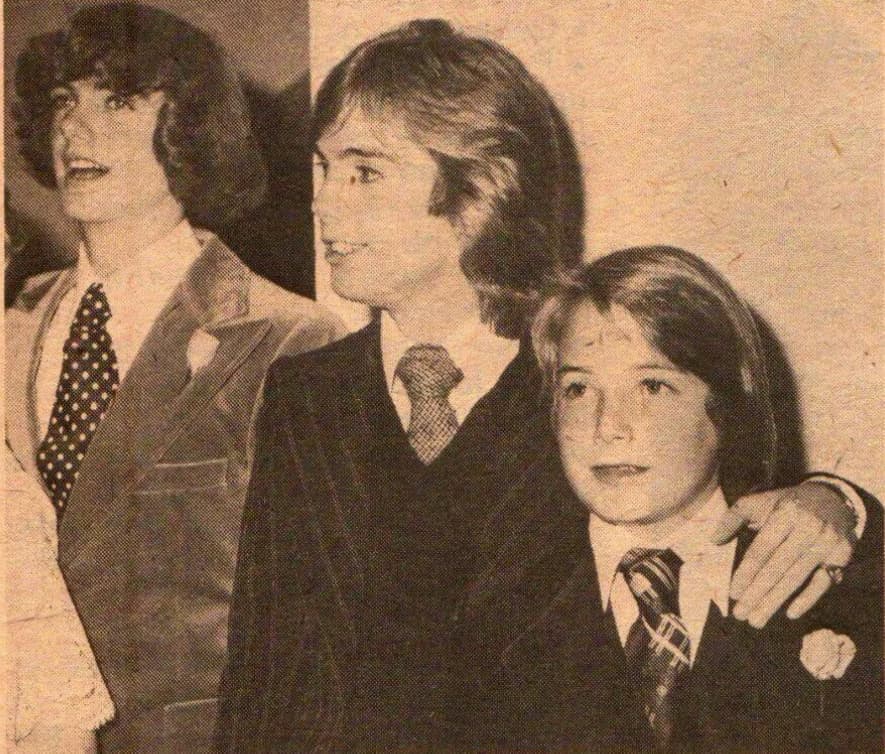
A fragile plea wrapped in harmony, where two voices meet to deny the inevitable truth of heartbreak.
When David Cassidy and Shaun Cassidy came together for “Tell Me It’s Not True”, the moment carried a quiet weight that went beyond the song itself. Released in 1978 as part of Shaun Cassidy’s album Under Wraps, the track did not emerge as a major chart-dominating single in the United States, where the album reached No. 33 on the Billboard 200, but its significance has never been measured solely in numbers. Instead, it lives in the delicate interplay between two voices shaped by the same roots, yet marked by different journeys through fame and expectation.
By the late 1970s, both brothers stood at distinct points in their careers. David Cassidy, once the defining teen idol of the early decade through his work with The Partridge Family, had already experienced the intense rise and gradual cooling of global superstardom. His voice, no longer carrying the untouched brightness of youth, had deepened, gathering nuance and a certain weariness that only time could bring. Shaun Cassidy, on the other hand, was in the midst of his own ascent, propelled by hits like “Da Doo Ron Ron,” capturing a new generation while inevitably being compared to his older brother.
“Tell Me It’s Not True” exists precisely at that intersection—where past and present, experience and innocence, quietly meet. The song itself is built around a familiar theme in pop music: the refusal to accept the end of love. But in this particular performance, the sentiment feels less like dramatized heartbreak and more like something inward, almost restrained. There is no theatrical excess, no attempt to overpower the listener. Instead, the emotion unfolds gently, carried by harmonies that feel more like conversation than performance.
What gives the song its lasting resonance is the unmistakable chemistry between David and Shaun Cassidy. Their voices do not compete; they complement. One brings a sense of reflection, the other a touch of urgency. Together, they create a layered emotional space where denial and acceptance coexist. It is as if the song itself becomes a dialogue—not only between two individuals, but between two stages of life.
The production of Under Wraps reflects the musical climate of the late 1970s, with a smoother, more polished pop sound that leans away from the raw immediacy of earlier rock influences. Yet even within this refined framework, “Tell Me It’s Not True” stands out for its emotional clarity. It does not rely on elaborate arrangements or studio effects to make its point. Instead, it trusts the voices at its center, allowing them to carry the weight of the story.
Looking back, the collaboration feels almost symbolic. It captures a fleeting moment when both brothers, shaped by the same legacy, stood side by side in a shared musical space. Such moments are rare, not only in the industry but in life itself. Careers move in different directions, paths diverge, and opportunities to reconnect in such a direct, creative way do not always come again.
There is also an undercurrent of quiet reflection that runs through the song, particularly when heard with the knowledge of what lay ahead. The Cassidy name, once synonymous with youthful exuberance and mass adoration, would continue to evolve, carrying with it both triumphs and challenges. In this sense, “Tell Me It’s Not True” becomes more than a song about romantic uncertainty—it becomes a subtle meditation on time, change, and the difficulty of holding onto what once felt certain.
For those who listen closely, the beauty of the track lies not in its surface simplicity, but in its emotional honesty. It does not promise resolution. It does not offer clear answers. Instead, it lingers in that delicate space between hope and realization, where the heart resists what the mind already understands.
And perhaps that is why it endures.
Because in the end, songs like “Tell Me It’s Not True” remind us that some feelings never fully fade. They remain, quietly echoing through the years, carried by voices that once stood together—if only for a moment—capturing something both deeply personal and universally understood.