
A voice caught between youth and longing, where rain becomes a quiet companion to love and memory.
When David Cassidy recorded “Walking in the Rain”, he was no longer just the bright-faced symbol of television pop innocence—he was beginning to reveal something deeper, more introspective beneath the surface. Released during the height of his fame in the early 1970s, the song did not achieve the towering chart success of his earlier hits, yet it remains one of the most emotionally telling performances of his career. While it did not break into the upper reaches of the Billboard Hot 100 like “I Think I Love You”—which famously reached No. 1 in 1970 with The Partridge Family—“Walking in the Rain” has endured in a quieter, more reflective way, embraced by those who listen not for spectacle, but for sincerity.
The song itself is a reinterpretation of the 1964 classic originally performed by The Ronettes, but in David Cassidy’s hands, it takes on a different emotional texture. Where the original carried the polished drama of Phil Spector’s “Wall of Sound,” Cassidy’s version feels more intimate, almost hesitant—like a confession spoken under one’s breath rather than a declaration shouted into the world. This shift in tone is significant, especially when placed against the backdrop of his career at the time.
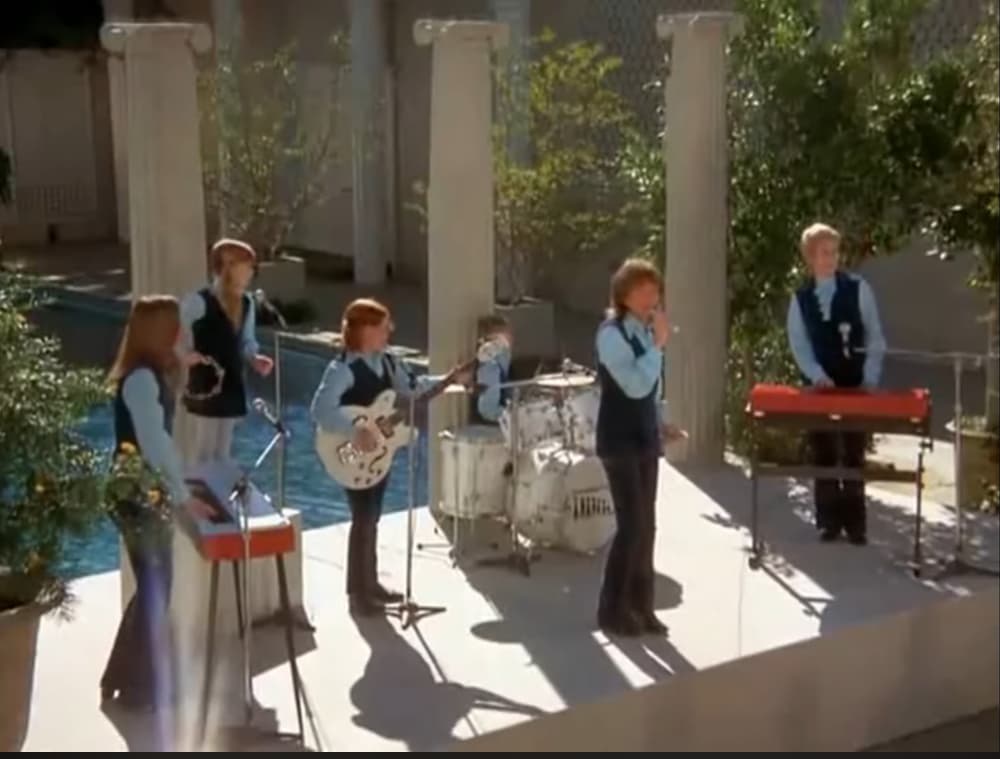
By the early 1970s, Cassidy had become a global phenomenon. As the leading figure of The Partridge Family, his image was carefully crafted—youthful, charming, effortlessly appealing. Yet behind the scenes, there was a growing desire to be taken seriously as a musician, not merely a television personality. Songs like “Walking in the Rain” hinted at that transition. They revealed an artist searching for depth, for authenticity, for a way to bridge the gap between public expectation and private expression.
There is something unmistakably poignant in the way he delivers the song. His voice, still youthful, carries a trace of weariness—as if already aware of the fleeting nature of fame. The imagery of walking alone in the rain becomes more than a romantic gesture; it transforms into a metaphor for solitude, for reflection, for the quiet spaces that exist beyond the glare of stage lights and screaming audiences.
Listening now, decades removed from its release, the song feels almost prophetic. It captures a moment suspended in time—when everything seemed bright on the surface, yet something more complicated was beginning to stir underneath. That tension gives the performance its lasting power. It is not just about love or longing; it is about the awareness of change, the subtle realization that nothing, not even the height of success, remains untouched by time.
What makes “Walking in the Rain” particularly enduring is its restraint. There is no need for vocal excess or dramatic flourish. Instead, Cassidy allows the melody to breathe, letting silence and softness carry as much weight as the lyrics themselves. It is a performance built not on perfection, but on feeling—and that is precisely why it continues to resonate.
For those who followed David Cassidy through his rise and beyond, this song often feels like a turning point, even if it was not recognized as such at the time. It stands as a quiet reminder that behind every carefully constructed image lies a human voice, searching for truth in its own way.
In the end, “Walking in the Rain” is not defined by chart positions or commercial milestones. Its significance lies in what it reveals—an artist stepping gently beyond the boundaries of expectation, offering a glimpse of vulnerability in a world that often demanded certainty.
And perhaps that is why it lingers.
Because long after the noise fades and the headlines disappear, it is these quieter moments—the ones filled with reflection, uncertainty, and honesty—that remain. Like footsteps in the rain, they may seem fleeting at first, but they leave an imprint that time cannot easily wash away.