
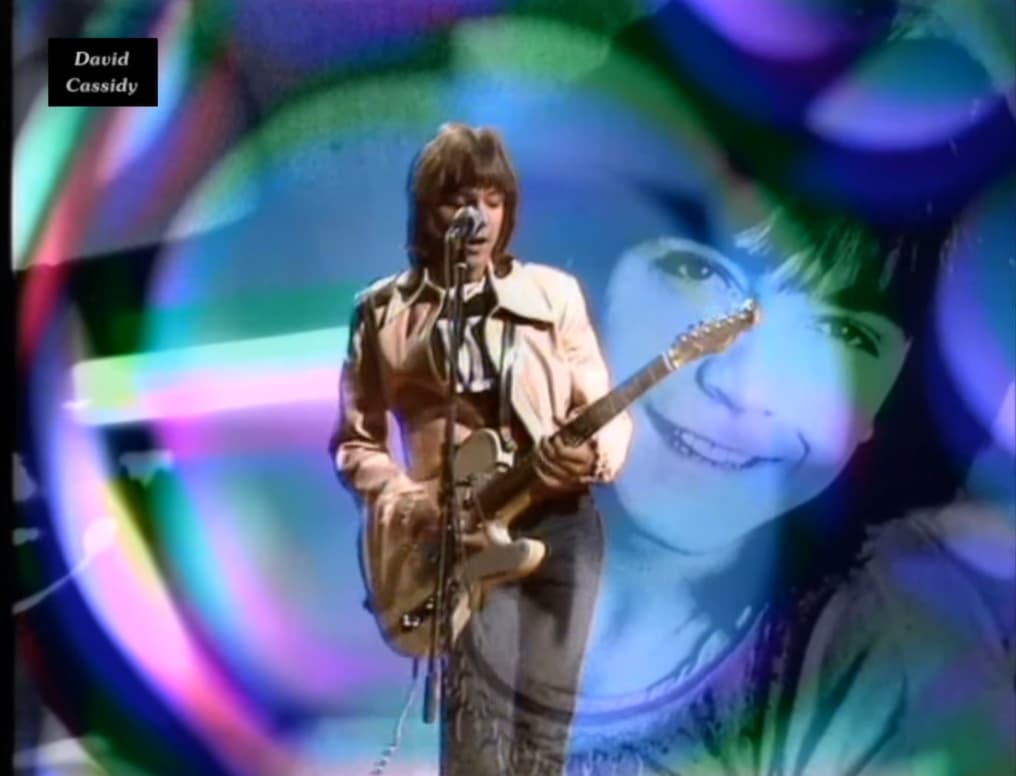
A Restless Heart Behind the Spotlight, Where Youthful Energy Meets the Quiet Search for Something Real
By 1974, David Cassidy stood at a crossroads that few artists navigate comfortably. The immense success that had carried him through the early years of the decade — powered by television fame and a string of pop hits — was beginning to feel like both a gift and a limitation. It was in this moment of transition that he recorded “Rock Me Baby”, a track from the album “Gettin’ It in the Street”. Released at a time when Cassidy was consciously stepping away from the polished image of his earlier career, the album itself reached No. 25 on the Billboard 200, while finding even stronger appreciation in the UK, where it climbed into the Top 20. Though “Rock Me Baby” was not issued as a major charting single, it remains an essential piece in understanding the artist he was trying to become.
The mid-1970s marked a significant shift in David Cassidy’s musical direction. Having already distanced himself from The Partridge Family, he sought to establish credibility beyond the confines of teen idol status. This was not simply a change in sound, but a deeper, more personal effort to reclaim artistic identity. “Gettin’ It in the Street”, produced with the involvement of Bruce Johnston of The Beach Boys, reflected this ambition — blending elements of pop, rock, and a more grounded, almost introspective approach to songwriting.
Within that framework, “Rock Me Baby” carries a different kind of energy than one might expect from its title. It is not a straightforward rock-and-roll anthem, nor is it driven purely by youthful exuberance. Instead, there is a subtle tension beneath the surface — a sense of movement without complete direction, as if the song itself is searching for footing. The rhythm pushes forward, the arrangement leans into a more contemporary sound for its time, yet Cassidy’s vocal retains that familiar clarity, now shaded with a hint of weariness.
There is an interesting duality at play. On one hand, the song reflects a desire to break free — to embrace a more mature, less constrained musical identity. On the other, it reveals the difficulty of that transformation. David Cassidy was still, in the public eye, the figure they had come to know a few years earlier. Every new note, every new stylistic choice, was measured against that expectation. In “Rock Me Baby”, one can hear both the effort to move forward and the lingering echo of what came before.
The story behind this period of his career adds weight to the song’s interpretation. By 1974, Cassidy had already begun to express frustration with the demands of fame, the relentless touring, and the lack of creative control that had defined his earlier success. This album, and songs like “Rock Me Baby”, were part of a broader attempt to redefine that narrative. It was not about abandoning the past, but about reshaping it — finding a way to carry forward what was authentic while letting go of what no longer fit.
Musically, the track reflects the transitional nature of the era. The production is fuller, more layered than his early recordings, yet it avoids the excess that would come to define later decades. There is a balance — guitars that carry weight without overpowering, rhythms that maintain momentum without urgency. It is the sound of an artist testing new ground, carefully but deliberately.
Listening now, “Rock Me Baby” feels less like a definitive statement and more like a moment captured in motion. It does not present a finished identity, but rather the process of becoming. There is something deeply human in that — the recognition that growth rarely arrives fully formed, that it often reveals itself in fragments, in attempts, in songs that do not seek perfection but honesty.
For those who followed David Cassidy’s journey, this period holds a particular significance. It represents the point where the image began to separate from the individual, where the music started to reflect not just what was expected, but what was felt. And while “Rock Me Baby” may not carry the chart success of his earlier hits, it carries something perhaps more enduring — a sense of authenticity emerging through uncertainty.
In the end, the song stands as a quiet testament to an artist in transition. Not yet fully removed from the past, not entirely settled in the future, but moving forward nonetheless. And in that movement, David Cassidy reveals something that goes beyond performance — the ongoing effort to find one’s own voice, even when the world is still listening for the echo of who you used to be.