
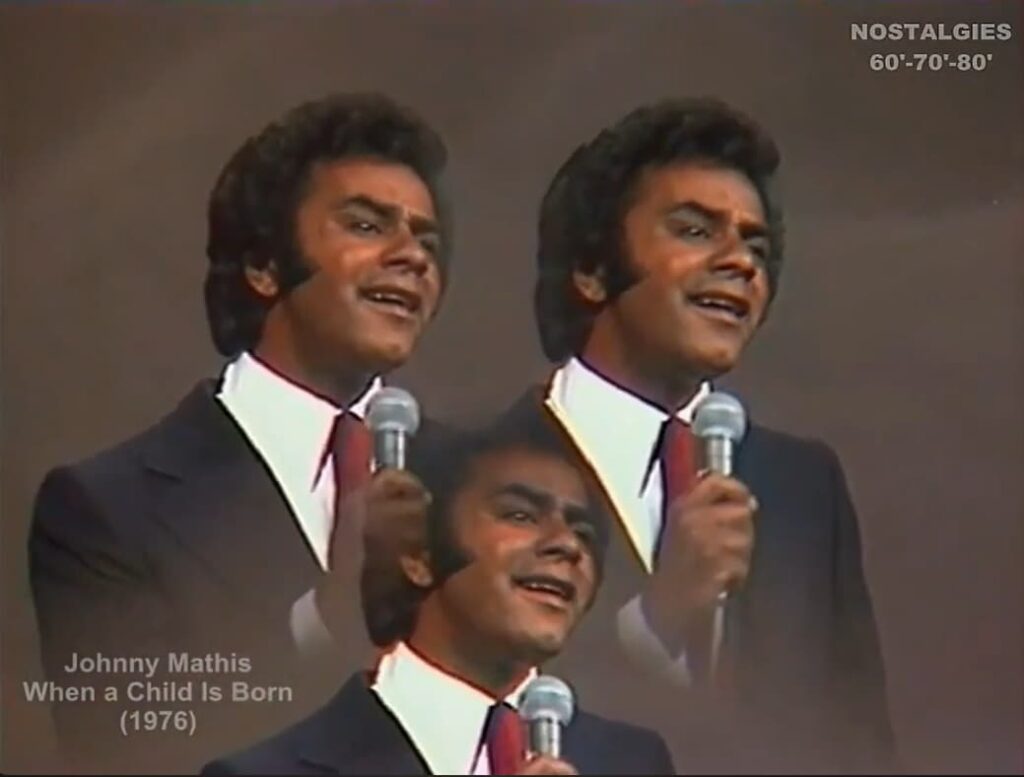
A quiet hymn of hope, where innocence becomes the promise that the world can begin again.
When Johnny Mathis released “When a Child Is Born” in 1976, it did not arrive with the urgency of a typical pop single. Instead, it unfolded gently, almost reverently, as though it already understood that its place would not be measured by speed, but by endurance. By the time it reached the No. 1 position on the UK Singles Chart in 1976, the song had already begun to establish itself as something more than a seasonal release—it had become a quiet tradition, a reflection that returned year after year with undiminished meaning.
The origins of “When a Child Is Born” trace back to an earlier melody titled “Soleado,” composed by Ciro Dammicco. English lyrics were later added, transforming the piece into a contemplative narrative centered on the birth of a child as a symbol of hope, renewal, and peace. In the hands of Johnny Mathis, however, the song found its most enduring voice. His interpretation does not seek to dramatize the message; instead, it allows the sentiment to unfold with a kind of calm assurance, as if speaking directly to something deeply personal within the listener.
By the mid-1970s, Mathis was already a seasoned artist, known for his smooth, controlled delivery and his ability to convey emotion without excess. Yet “When a Child Is Born” stands apart even within his extensive catalog. There is a stillness to his performance, a deliberate pacing that invites reflection rather than applause. Each phrase is shaped with care, each note placed as though it carries weight beyond the melody itself.
The arrangement supports this sense of quiet reverence. Soft orchestration builds gradually, never overwhelming the vocal, but instead creating a gentle foundation upon which the message can rest. The structure of the song mirrors its meaning: it begins with simplicity, grows in emotional depth, and resolves not with grandeur, but with a sense of calm acceptance. It is less a performance than a meditation set to music.
What gives “When a Child Is Born” its lasting significance is the universality of its message. It speaks of a moment that transcends time and circumstance—the arrival of new life as a reminder that change is always possible. Yet the song does not ignore the complexities of the world. It acknowledges uncertainty, even darkness, but counters it with a quiet belief that renewal can emerge from even the most uncertain conditions.
For listeners, the song often becomes intertwined with memory. It is heard in moments of stillness, in gatherings where words are few, in times when reflection feels more natural than celebration. Over the years, it has taken on a role that extends beyond its original release, becoming part of a shared emotional landscape. It is not tied to a single era, despite its origins in 1976; instead, it moves freely through time, carrying its message wherever it is heard.
There is also something deeply personal in Mathis’s delivery. His voice, neither hurried nor overly adorned, carries a sense of understanding that cannot be manufactured. It suggests an awareness of both the fragility and the resilience of hope. This balance is what allows the song to resonate so deeply. It does not promise that everything will change immediately, but it offers the possibility that something new—something better—can begin.
Looking back, the success of “When a Child Is Born” on the charts feels almost secondary to its cultural impact. Reaching No. 1 in the UK was a significant achievement, but the song’s true accomplishment lies in its ability to remain relevant, to continue speaking to listeners long after its initial release. It has become part of a tradition not because it demands attention, but because it invites reflection.
In the end, Johnny Mathis’s recording of “When a Child Is Born” is defined by its restraint, its sincerity, and its quiet strength. It reminds us that some songs do not need to evolve to remain meaningful. They endure because they speak to something fundamental—something that does not change with time.
And in that gentle, unwavering voice, the message remains clear: even in a world that often feels uncertain, there is always the possibility of beginning again.